You do not always need to retrain a model to shrink it. Post-training quantization takes an already trained checkpoint and converts it to a lower-precision format using a short calibration pass.
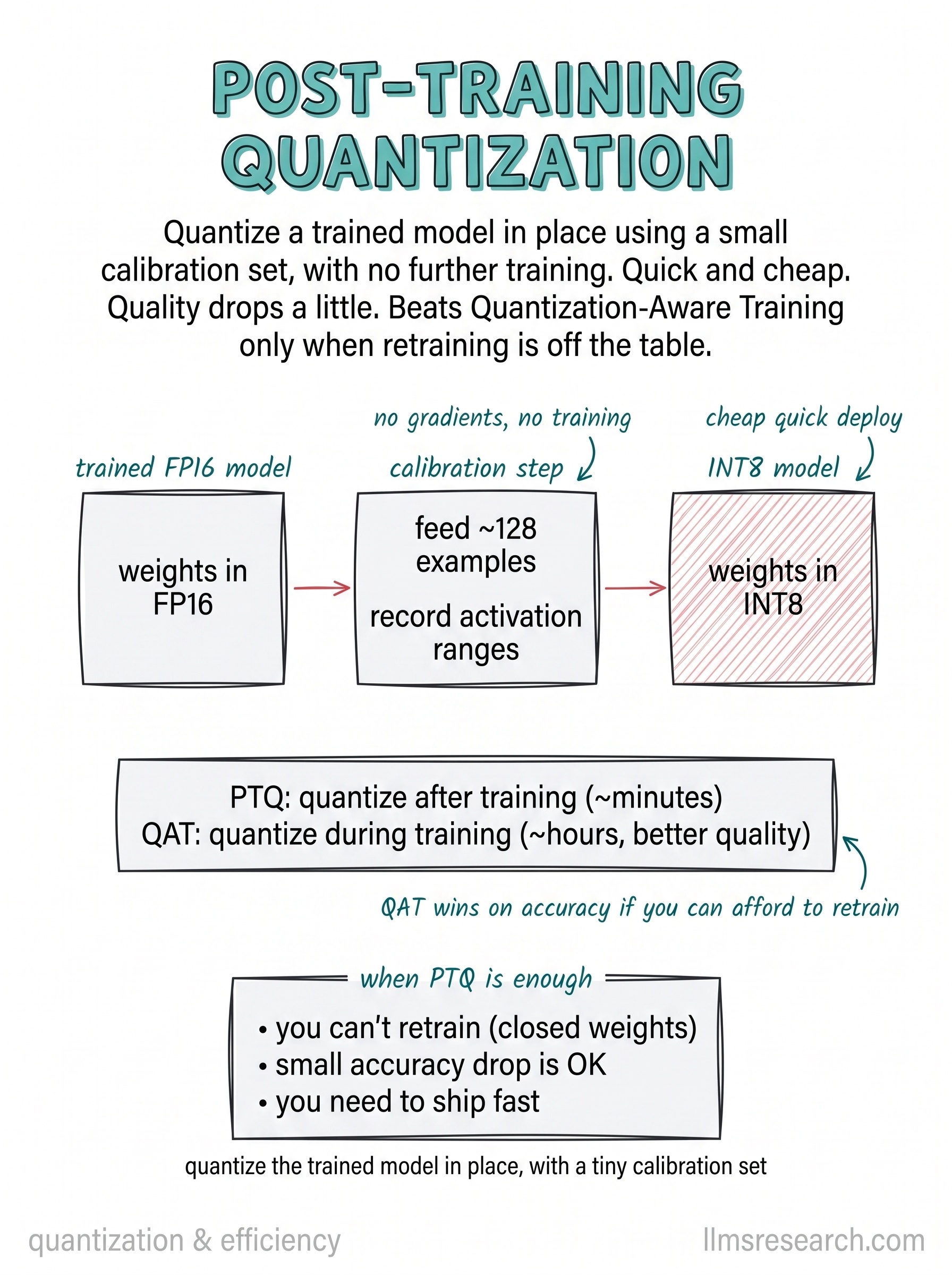
The card shows a three-box pipeline. On the left is a trained FP16 model with weights stored in 16-bit floats. In the middle is a calibration step: feed a small set of example inputs (the card suggests on the order of 128) and record the range of activations each layer sees. On the right emerges an INT8 model with quantized weights. The middle box is annotated as requiring no gradients and no training loop, and the output box as suited to quick deployment.
Below the pipeline, a contrast panel separates PTQ from quantization-aware training (QAT). PTQ runs after training and takes minutes. QAT simulates quantization during training and takes hours, but the model learns to tolerate rounding error and often retains accuracy better. QAT wins when retraining is possible; PTQ wins when it is not.
The lower panel lists when PTQ is enough: closed weights you cannot retrain, a small accuracy drop you can accept, or a need to ship quickly. The recipe is to quantize the trained model in place with a tiny calibration set, not to rebuild the training run.