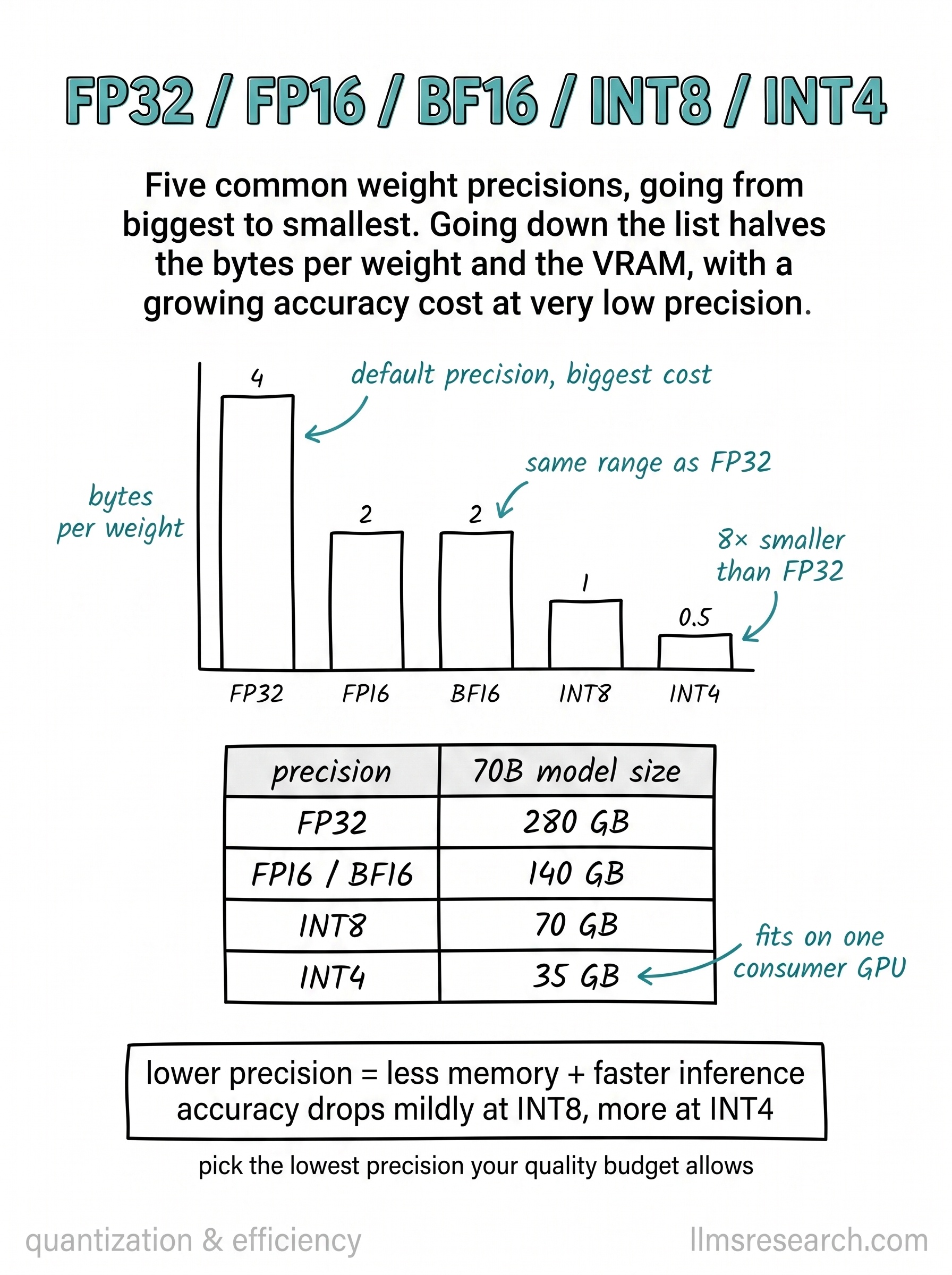
Choosing a precision is choosing how many bits each weight costs. The card makes that choice concrete with a bar chart and a model-size table.
The upper chart plots bytes per weight across five formats. FP32 uses four bytes per weight and sits at the top of the ladder. FP16 and BF16 both use two bytes, so their bars share the same height. INT8 drops to one byte. INT4 uses half a byte per weight, which is eight times smaller than FP32. Annotations mark FP32 as the default precision with the biggest memory cost, BF16 as sharing FP32’s exponent range, and INT4 as the most aggressive savings on the chart.
The table translates those per-weight numbers into total model size for a 70B parameter model. At FP32 the weights alone would need about 280 GB. Halving the precision to FP16 or BF16 brings that to 140 GB. INT8 reaches 70 GB. INT4 lands near 35 GB, a size that can fit on a single high-end GPU where the FP32 original could not.
The lower note states the tradeoff in one line: lower precision means less memory and faster inference, but accuracy drops mildly at INT8 and more noticeably at INT4. In practice you pick the lowest precision your quality budget allows, not the lowest number on the chart.