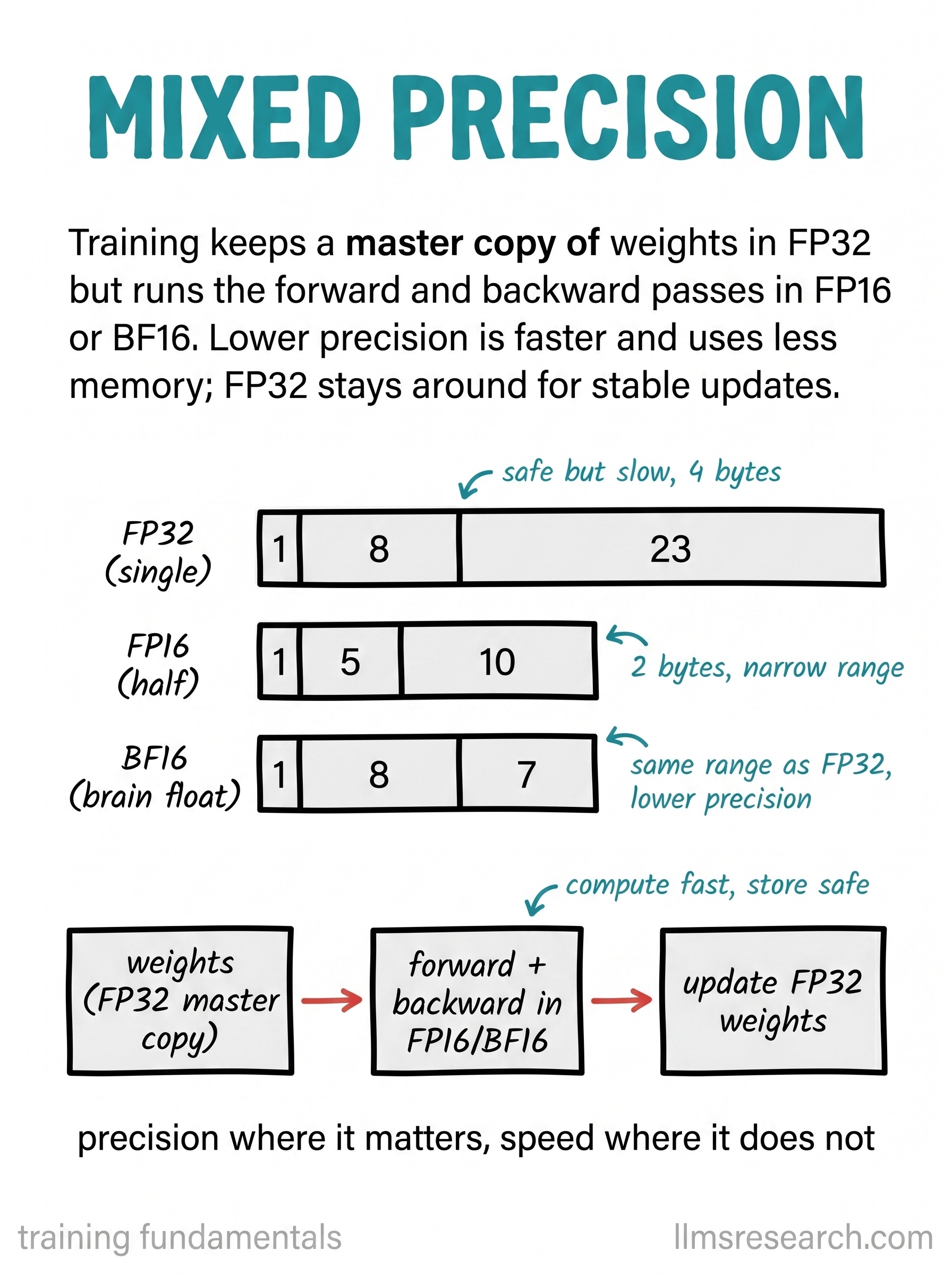
Memory pressure keeps coming up because the numbers themselves take space. A weight stored in full 32-bit precision is four bytes, and a large model has billions of them, with the optimizer state and activations stored the same way. Mixed precision cuts that by doing most of the arithmetic in a 16-bit format while keeping full precision only where it is actually needed.
The card lays out the three formats by how they split their bits. FP32 spends 1 bit on sign, 8 on exponent, and 23 on the fraction, giving both wide range and fine precision at four bytes each. FP16 halves the storage to two bytes but shrinks the exponent to 5 bits, which narrows the range of representable magnitudes and makes very small or very large values overflow or underflow to zero. BF16 keeps the full 8-bit exponent of FP32 and gives up fraction bits instead, so it covers the same range as FP32 at lower precision. That range is why BF16 has become the more common choice for large training runs: it rarely overflows, so it needs less of the careful scaling that FP16 requires.
The flow at the bottom is the actual scheme. A master copy of the weights is held in FP32. Each step, those weights are cast down to 16-bit for the forward and backward passes, which is where nearly all the compute lives, so it runs faster and with less memory. The resulting gradients are then applied back to the FP32 master copy, so the running accumulation of tiny updates happens in full precision. The caption states the tradeoff plainly: precision where it matters, speed where it does not.
The reason the master copy cannot be dropped is subtle but important. Individual weight updates are often much smaller than the weight itself, and in 16 bits such a small change can round away to nothing, so training would stall as if the learning rate were zero. Keeping the accumulator in FP32 preserves those small updates. FP16 setups add one more piece not drawn here, loss scaling, which multiplies the loss up before the backward pass so that small gradients stay inside FP16’s range and then divides them back down before the update. BF16 mostly avoids needing it.