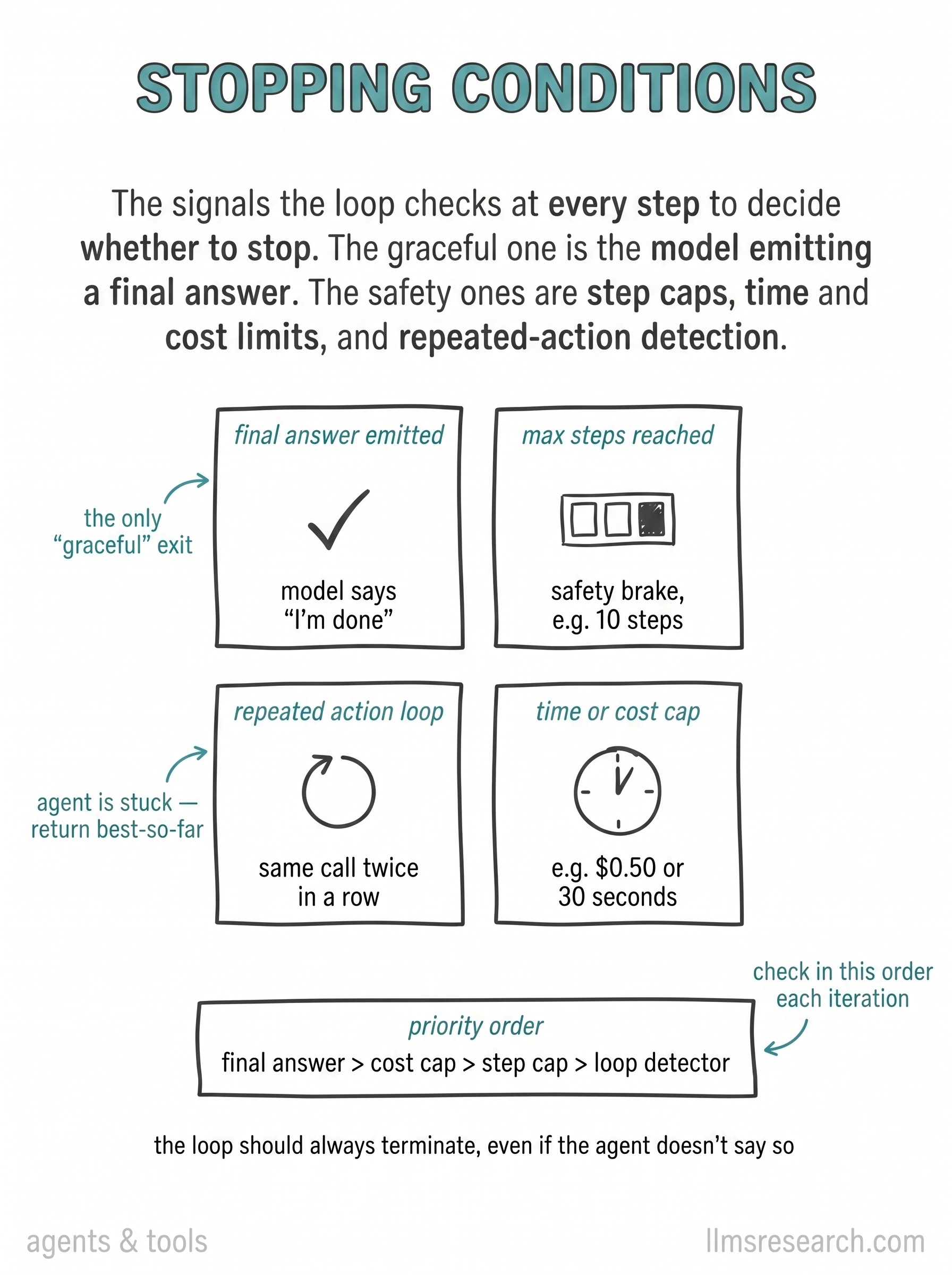
The card lays out four quadrants, one per stopping signal. Top left: the model emits an explicit final answer, the graceful exit. Top right: the step counter hits its maximum, a safety brake regardless of whether the task is finished. Bottom left: the same tool call repeats without progress, a loop detector fires. Bottom right: a wall-clock timer or dollar budget trips, cutting off runaway cost. Each quadrant has a small icon and a short label so the four cases read at a glance.
Only one exit is initiated by the model itself. The other three are enforced by the runtime because models do not reliably know when to stop. An agent asked to “keep improving” may call tools indefinitely. A confused model may alternate between two equivalent actions. A long research task may burn tokens without reaching a conclusion. External caps guarantee termination and bound worst-case spend.
Implementations often prioritize these signals in a fixed order, though the card notes that order varies. A common policy treats a valid final answer as highest priority, then cost cap, then step cap, then loop detection. The details matter less than the principle: check every signal after each iteration, and define what to return when stopped early. “Best answer so far,” a partial result, or an explicit “step limit reached” message is better than hanging or silently truncating.
Stopping conditions are part of the agent contract with users and operators. Step and cost limits should be configurable per task class. Loop detection needs a definition of “sameness,” identical arguments, identical observations, or no change in state. When a safety stop fires, pair it with logging so you can tell whether the limit was too tight or the agent was genuinely stuck. A loop that always terminates is a prerequisite for shipping anything autonomous, even when the graceful answer case works most of the time.