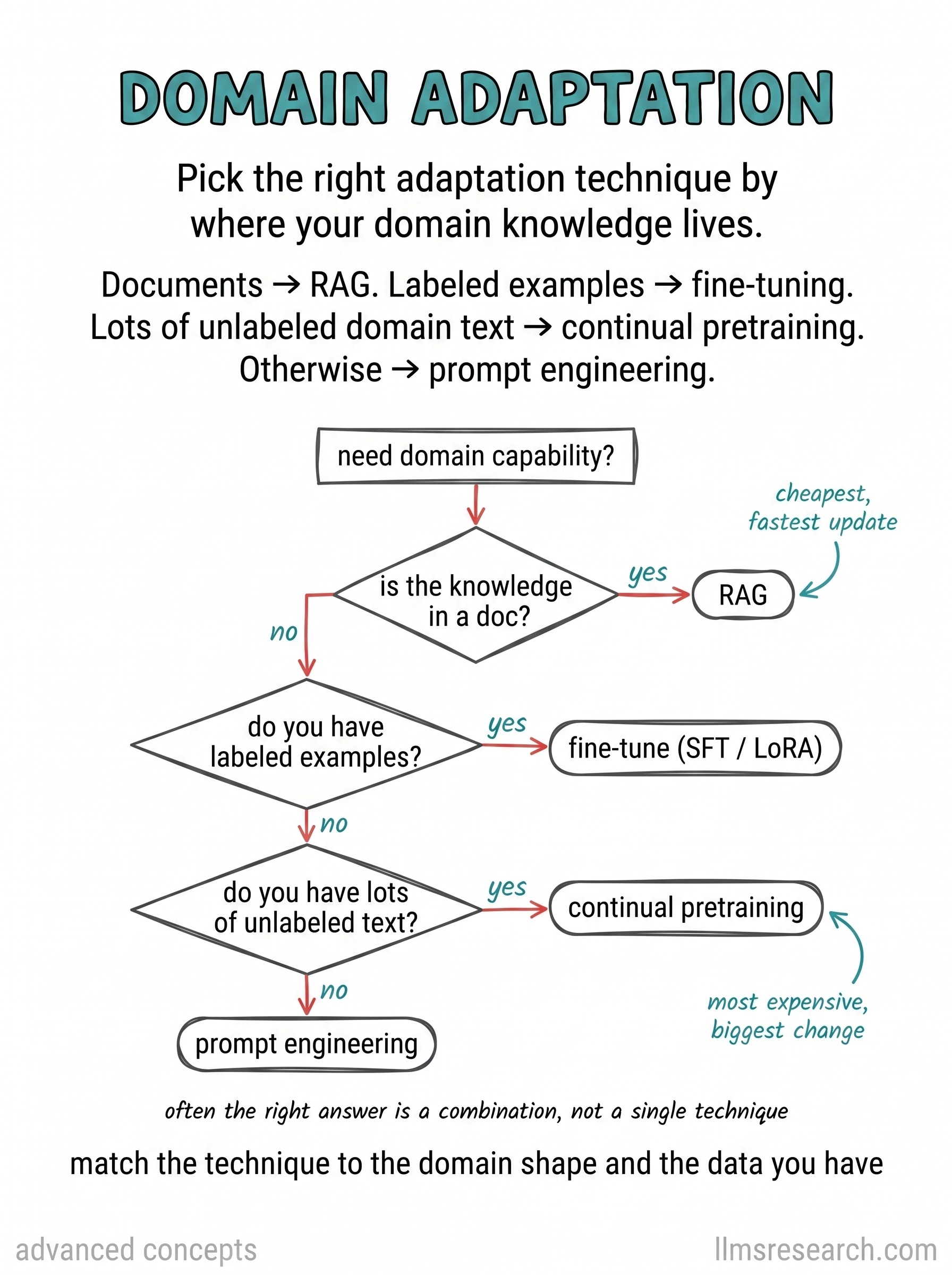
A base language model is general by design. Making it useful in a specific domain requires choosing how to inject that domain’s knowledge, format, and vocabulary. Domain adaptation is the umbrella term for that choice, and the card maps four techniques to the shape of the data and effort you have available.
The decision tree starts at the root: do you need domain capability? The first branch asks whether the knowledge lives in documents. If yes, RAG is the lightest path. You index the corpus, retrieve at query time, and update the index when facts change without touching model weights. The annotation marks this as the cheapest and fastest update cycle.
If the knowledge is not sitting in retrievable documents, the tree asks whether you have labeled examples. Labeled input-output pairs point to fine-tuning, whether full supervised fine-tuning or parameter-efficient methods like LoRA. This path changes how the model behaves on a fixed task format when you have examples to train on.
If you lack labels but have a large volume of unlabeled domain text, continual pretraining adapts the base model to the domain’s language and concepts through further self-supervised training. This is the most expensive option and the biggest change to model behavior, with forgetting risk if the data mix is wrong. If none of these conditions apply, prompt engineering remains: instructions, few-shot examples, and tool use without weight updates.
The footer notes that the right answer is often a combination. A legal assistant might use RAG over case files, a fine-tuned model trained on citation format, and prompt templates that enforce abstention. The tree is a starting point for scoping effort, not a mandate to pick exactly one technique.
The practical takeaway is to match the method to where your domain knowledge lives and how often it changes. Documents that update frequently favor retrieval. Fixed behavioral patterns favor tuning. Domain language without labels may justify continued pretraining. Start with the lightest option that meets the requirement and add heavier methods only when eval shows a clear gap.