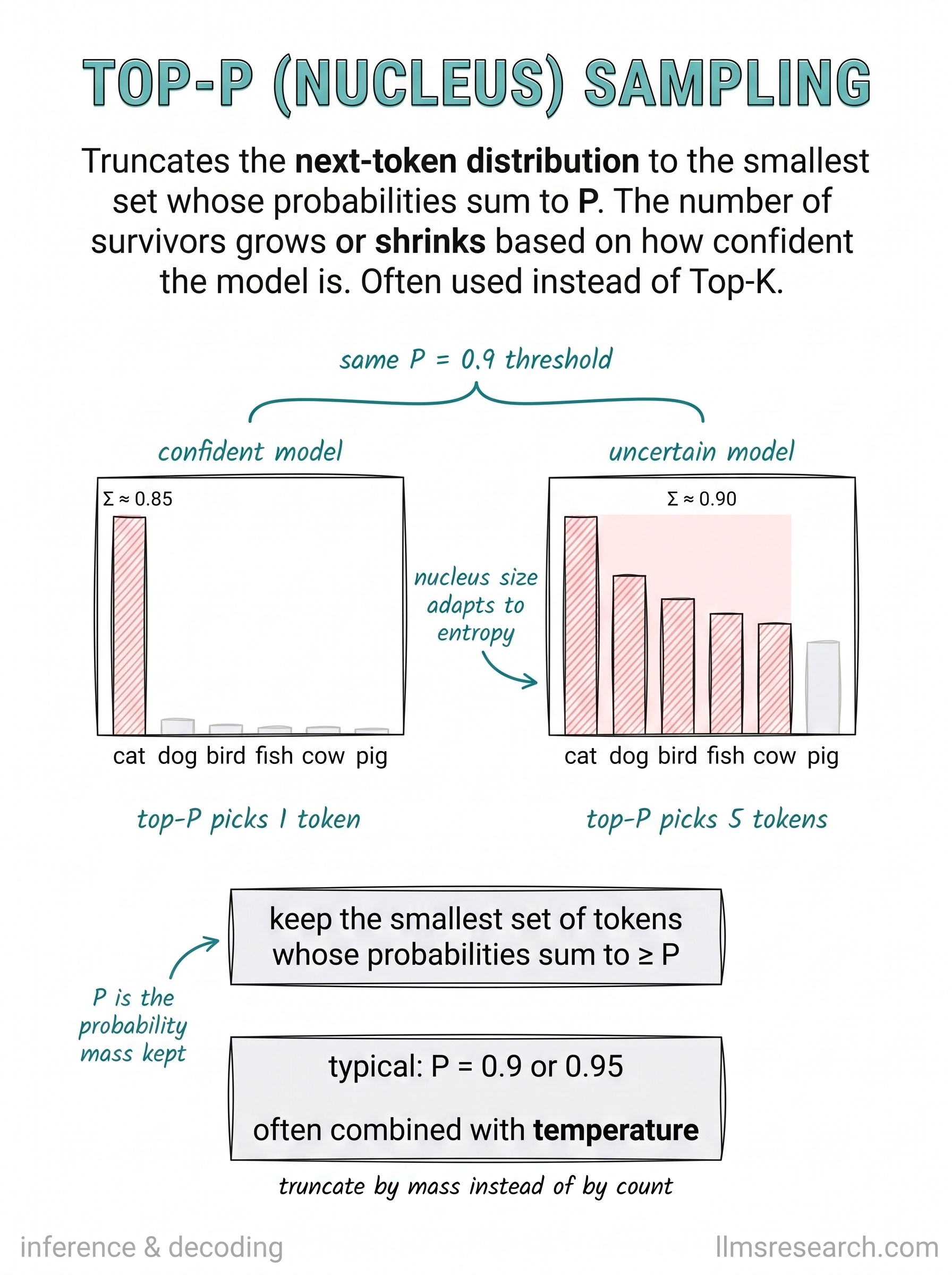
Top-P sampling, also called nucleus sampling, fixes the weakness of a fixed K. It does not ask for a set number of candidate tokens. It asks for enough tokens to cover a chosen amount of probability mass.
The two histograms use the same P threshold, 0.9, under two different model states. On the left the model is confident. One token already carries most of the probability, so the nucleus is small and top-P may keep only that token. On the right the model is uncertain. Probability is spread across several plausible tokens, so the nucleus grows until the kept set reaches the same cumulative mass.
The rule in the center is the whole method: sort tokens by probability and keep the smallest prefix whose probabilities sum to at least P. Then renormalize that kept set and sample from it. With P at 0.9 or 0.95, the sampler preserves most of the model’s probability mass while discarding the tail that usually contains low-quality surprises.
This makes top-P adaptive in a way top-K is not. It is strict when the model is confident and permissive when the model is unsure. Temperature and top-P are often used together: temperature reshapes the distribution first, and top-P decides how much of the reshaped distribution remains eligible for sampling.