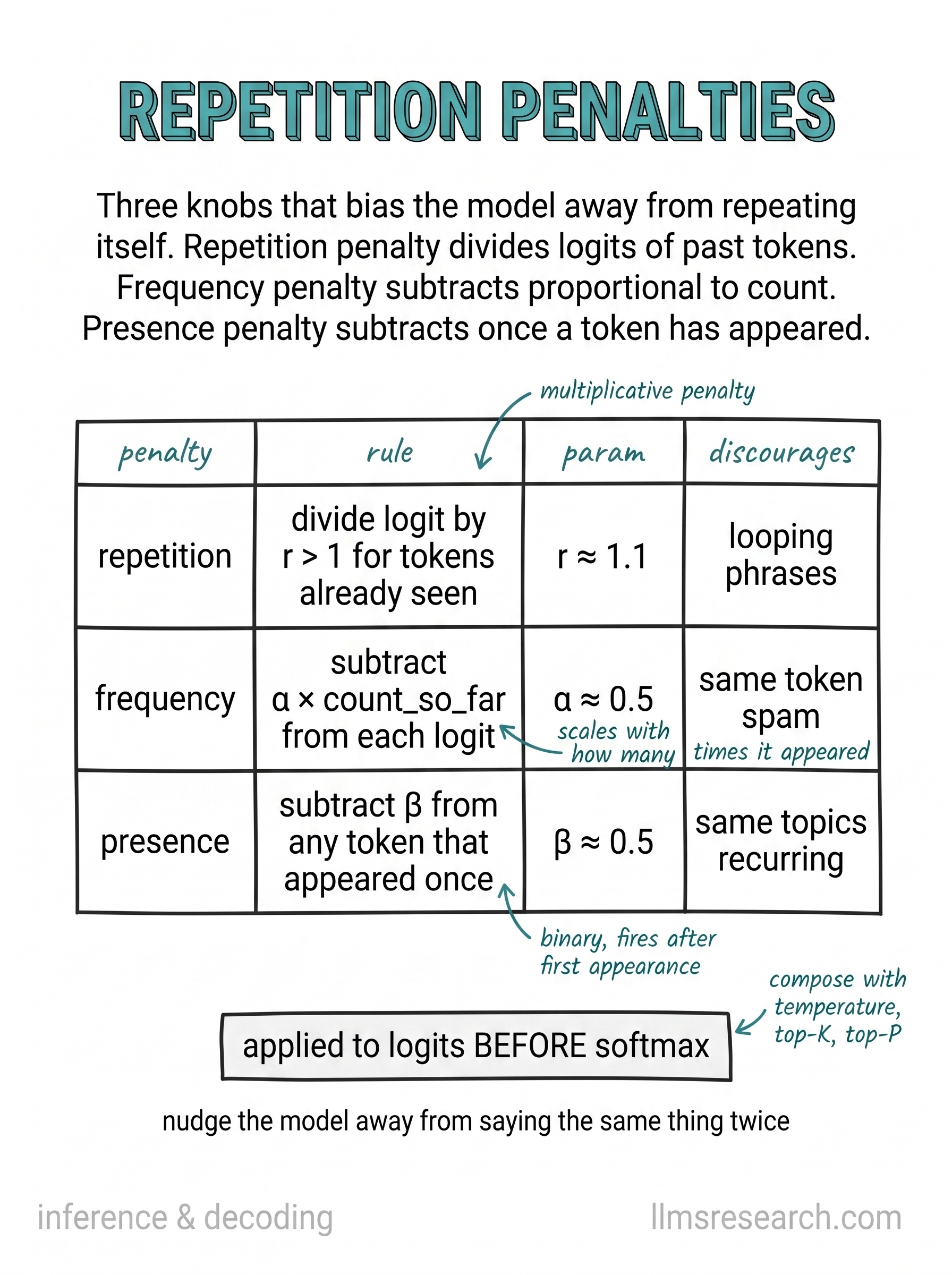
The previous decoding knobs reshape or truncate the whole next-token distribution. Repetition, frequency, and presence penalties are more targeted. They look at what has already been generated and lower the logits of tokens that would repeat it.
The first row is repetition penalty. If a token has appeared before, its logit is divided by a value greater than one, such as 1.1. This is a multiplicative penalty on tokens already seen, and it is mainly aimed at obvious loops where the model keeps saying the same phrase.
Frequency penalty is count-based. Each time a token appears, the penalty grows, so the logit is reduced by alpha times the number of prior occurrences. A token used five times is pushed down more than a token used once. This is useful when the failure mode is not a single repeated phrase but gradual token spam, where the same word keeps reappearing because it remains locally likely.
Presence penalty is binary. Once a token has appeared at least once, subtract beta from its logit. It does not care whether the token appeared once or ten times. That makes it a rougher tool for encouraging topic movement: mention something, then make it slightly less attractive to mention again.
All three penalties are applied before softmax, so they compose with temperature, top-K, and top-P. They do not make the model understand boredom or redundancy. They just change the scores so the sampler is less likely to walk back into the same tokens.