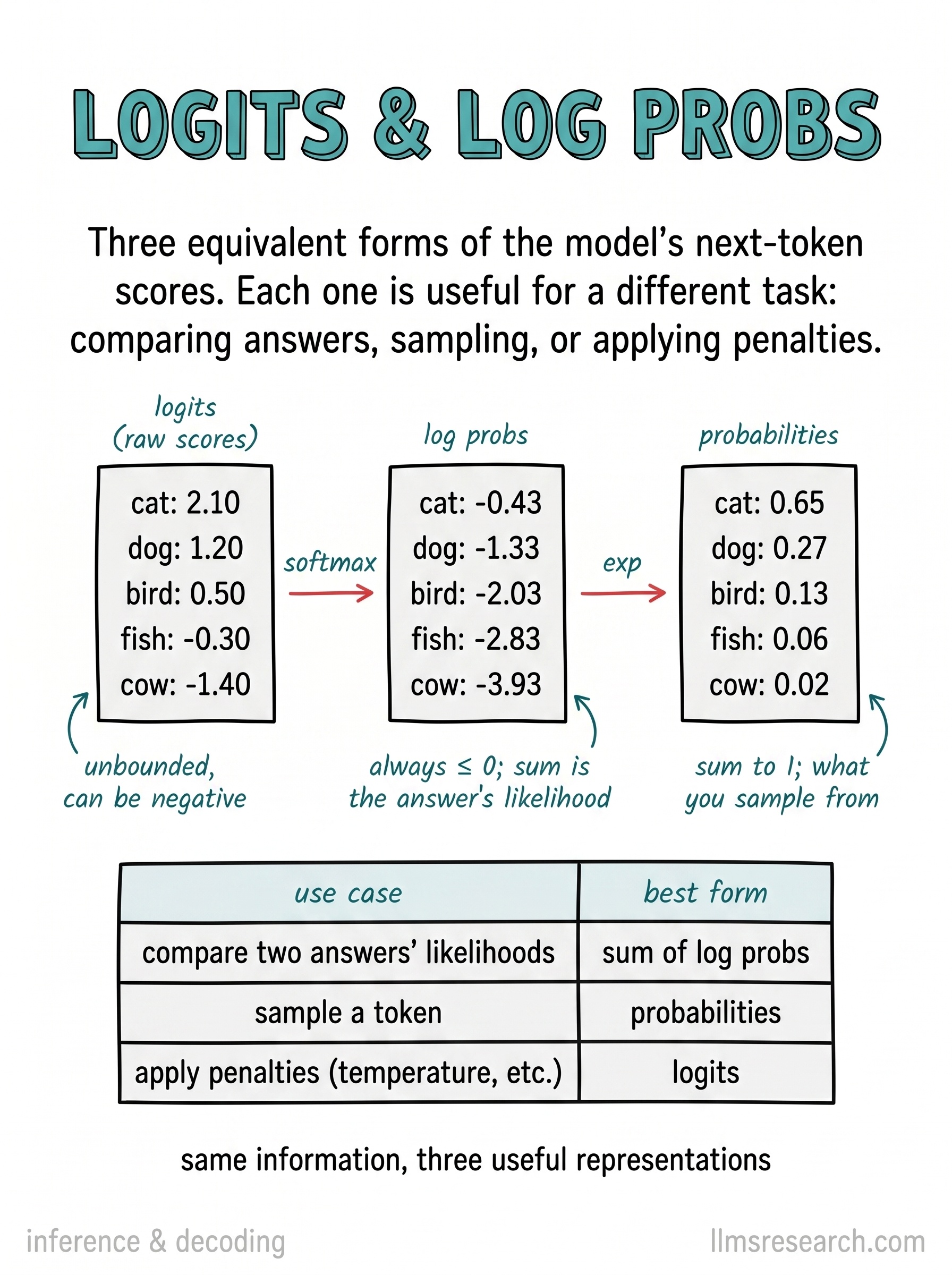
The output head does not hand back a word. It hands back a score for every token in the vocabulary. This card is about the three forms those scores usually take once they leave the model: logits, log probabilities, and probabilities.
Logits are the raw scores. They are unbounded, can be negative, and do not have to sum to anything. A higher logit means the model prefers that token more, but the number is not yet a probability. Softmax turns the whole vector of logits into a distribution by exponentiating the scores and normalizing them. The result is a probability for each token, all adding to one, which is the form the sampler draws from.
Log probabilities sit between those two views. Taking the log of each probability makes every value less than or equal to zero, with values closer to zero meaning more likely. That looks less intuitive than percentages, but it is the natural form for comparing whole answers. A generated sentence is a product of token probabilities, and products of many small numbers underflow quickly. Summing log probabilities gives the same ranking without the numerical trouble.
The table at the bottom is the practical rule. Use logits when you still need to modify the distribution, because temperature, penalties, and other decoding knobs act before softmax. Use probabilities when you are sampling the next token. Use the sum of log probabilities when you want to compare how likely two candidate answers were under the model. Same scores, three representations, each useful at a different point in the decoding pipeline.