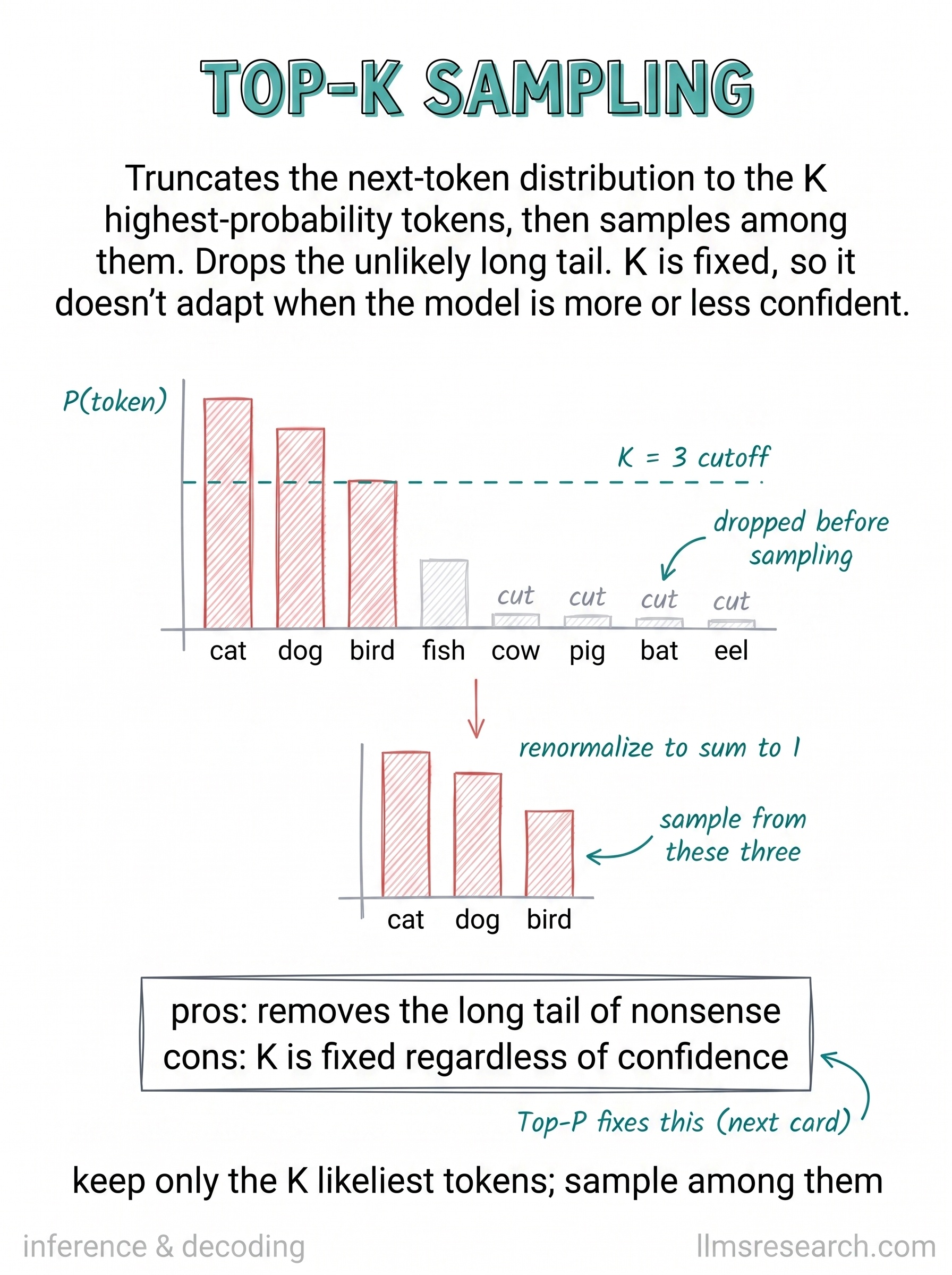
Top-K sampling starts from the probability distribution over the next token and cuts it down to a fixed count. Keep the K most likely tokens, drop everything else, renormalize the survivors so they sum to one, then sample.
The histogram makes the operation visible. The model gives some probability to a long list of tokens, including many that are technically possible but poor in context. With K set to three, only “cat”, “dog”, and “bird” survive. The rest of the bars are cut before sampling, so an unlikely token from the tail cannot appear just because random sampling happened to hit it.
Renormalization is the step people often skip when describing the method. Once the tail is removed, the surviving probabilities no longer sum to one. The lower chart shows the remaining three tokens inflated into a valid distribution, and the actual sample is drawn from that smaller set. Temperature can still be applied before this cutoff, but the cutoff itself is a separate operation.
The limitation is that K is fixed even when the model’s confidence changes. If the model is already sure, keeping fifty options may keep too much noise. If the model is uncertain, keeping only three may remove reasonable alternatives. Top-P sampling changes that by truncating to probability mass rather than to a fixed number of tokens.