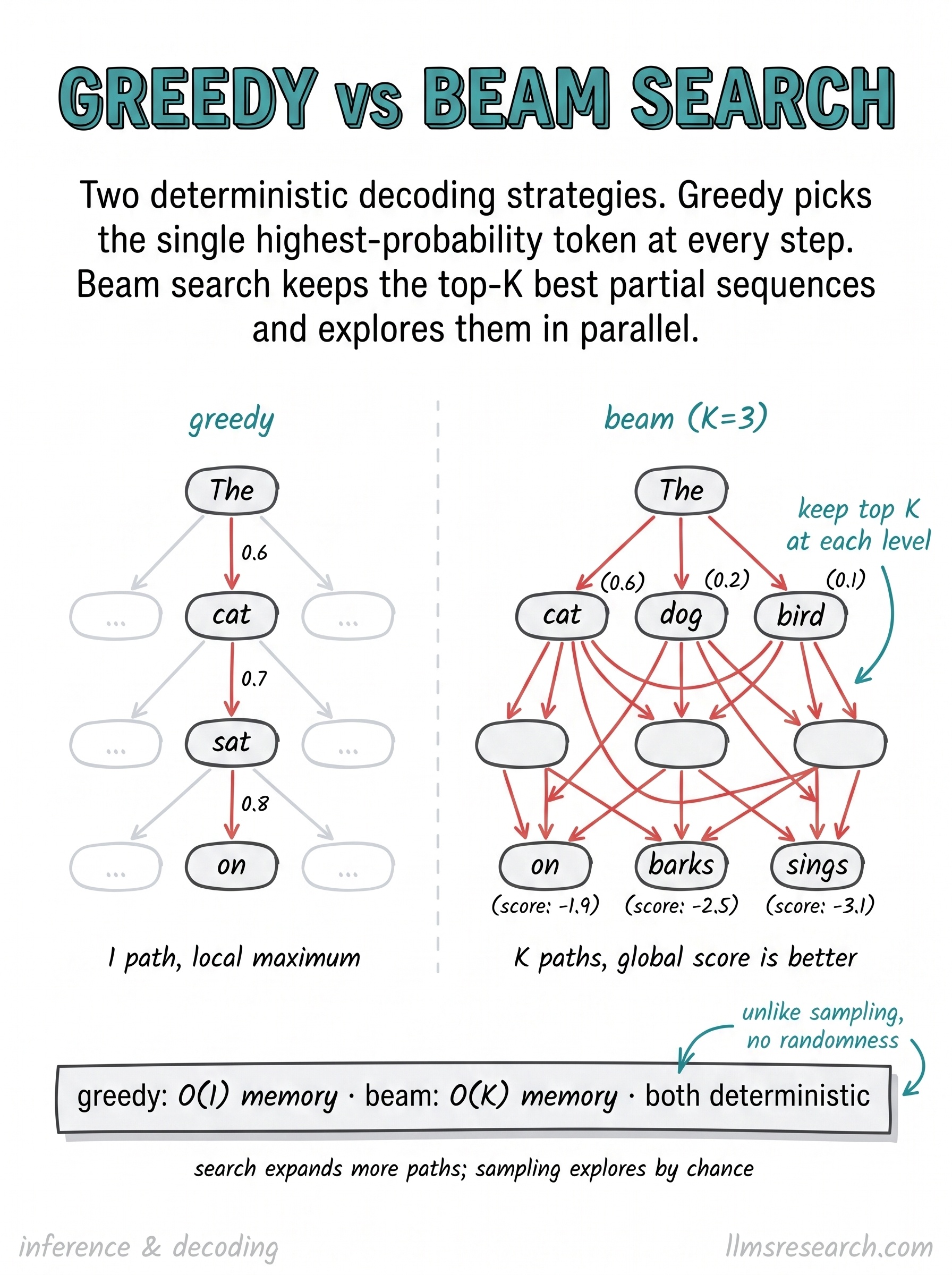
Greedy decoding and beam search are search strategies, not sampling strategies. They do not introduce randomness. Given the same model state and the same scores, they choose the same continuation every time.
The left tree is greedy decoding. At each step it keeps the single token with the highest local probability and throws away the siblings. In the card’s example the path goes from “The” to “cat”, then to “sat”, then to “on”. The cost is small because there is only one active path. The risk is that the locally best token can lead into a weaker full sequence, and once greedy decoding has dropped an alternative it never comes back.
Beam search widens that choice. Instead of keeping one partial sequence, it keeps the best K candidates at each level and expands them in parallel. The card shows K equal to three, so “cat”, “dog”, and “bird” all survive the first step. Each candidate accumulates a sequence score, usually a sum of log probabilities, and the beam keeps the best partial paths as the tree grows.
The tradeoff is exactly the bottom row: greedy uses constant memory, while beam uses memory proportional to K. Both are deterministic, which separates them from temperature, top-K, and top-P sampling. Beam search is useful when you want a high-scoring string rather than varied outputs, but it can still produce dull or overly safe text because it optimizes likelihood rather than diversity.