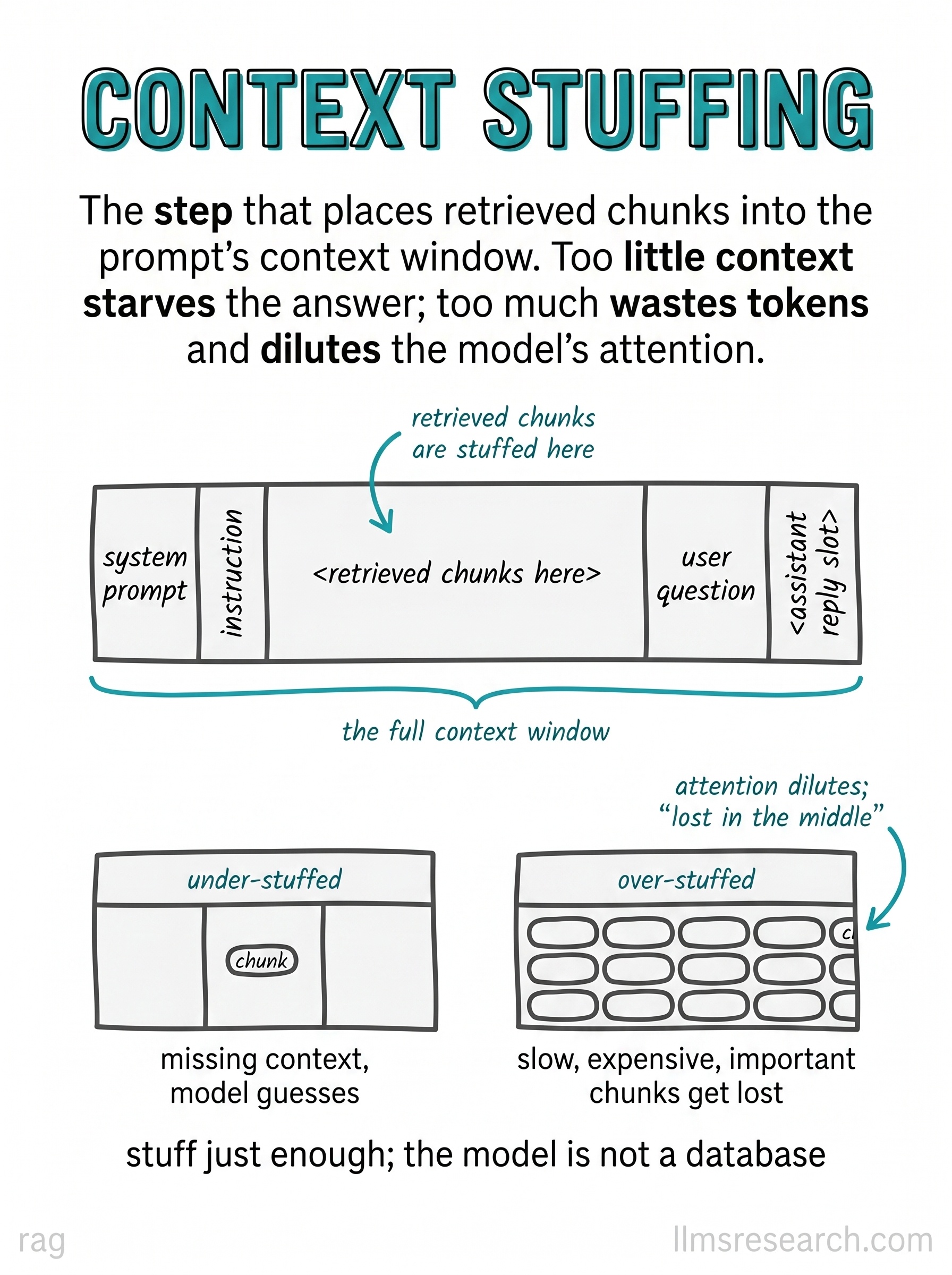
Retrieval finds relevant passages. Context stuffing is where those passages actually enter the model’s input. The card shows the layout of a filled context window and why both too little and too much retrieved text cause problems.
The main diagram is a horizontal bar divided into five sections. The system prompt sits at the left, followed by instructions, then a large middle section labeled for retrieved chunks, then the user question, then a slot reserved for the assistant reply. Retrieved text is stuffed into the middle, between the model’s instructions and the user’s question. That placement tells the model to treat the chunks as reference material when answering.
The two variants below show the extremes. An under-stuffed window contains only one chunk when the answer required three. The model lacks evidence and falls back to parametric memory, which is where hallucination risk rises. An over-stuffed window packs in so many chunks that the bar overflows, latency climbs, cost rises, and attention spreads thin across marginally relevant passages. Important chunks can get lost in the middle of a long context, a pattern sometimes called lost in the middle.
Stuffing is not just concatenation. Production templates usually wrap chunks in delimiters, label them with ids for citation, and order them by relevance score. The instruction layer often tells the model to answer only from the provided context and to abstain when the context is insufficient. How you format the stuffed text affects whether the model uses it faithfully.
The practical takeaway is to stuff just enough context to answer the question and no more. Tie stuffing to your Top-K setting and context budget, format chunks clearly, and test both failure modes: missing context and context overflow. The model is a reasoner over supplied text, not a database that absorbs unlimited documents per query.