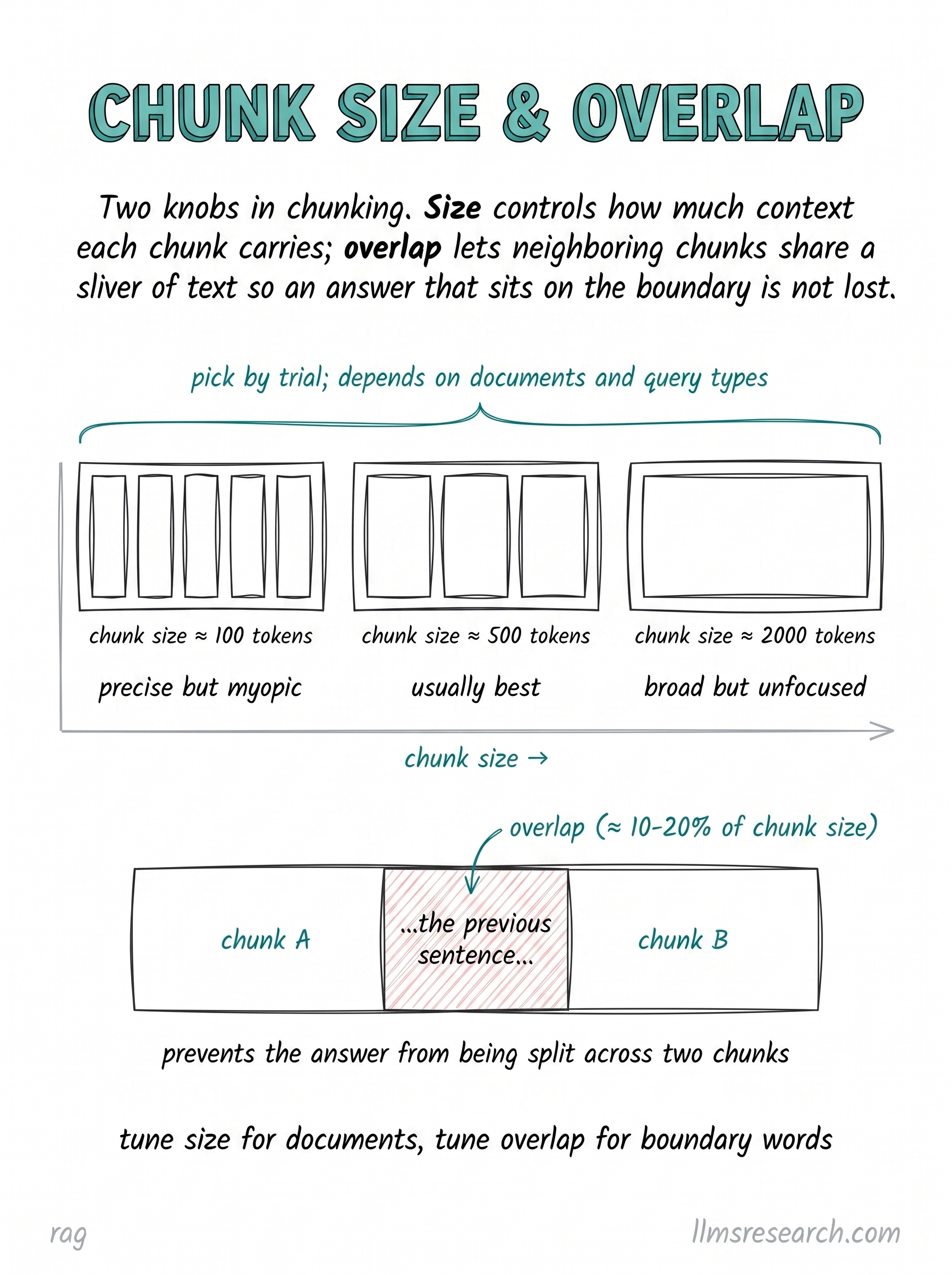
Chunking splits documents into passages, but the split parameters are not obvious defaults. Chunk size and overlap are the two knobs that most affect retrieval quality, and the card shows the tradeoffs for each.
The upper section compares three chunk sizes along a horizontal scale. Small chunks around one hundred tokens are precise: each vector represents a narrow topic, so similarity scores are focused. They can also be myopic, missing context that sits just outside the window. Medium chunks around five hundred tokens are the usual starting point for general documentation. Large chunks around two thousand tokens carry more surrounding context but produce vaguer vectors that match many queries weakly. The bracket above notes that the right size depends on document type and query style, and is typically found by trial on held-out questions.
The lower section shows overlap between neighboring chunks. Chunk A and Chunk B share a hatched region containing the same sentences at their boundary. When an answer spans the line between two sections, overlap ensures that at least one chunk contains the full relevant passage. A common setting is ten to twenty percent of chunk size, enough to catch boundary straddling without nearly doubling index size.
Size and overlap interact. Larger chunks need less overlap to preserve context because each chunk already carries more surrounding text. Smaller chunks benefit more from overlap because the risk of cutting an answer in half rises. Neither parameter has a universal optimum; both should be tuned against retrieval eval on representative queries.
The practical takeaway is to treat chunk size as a precision-versus-context tradeoff and overlap as insurance against boundary splits. Start near five hundred tokens with modest overlap, measure recall on real questions, then adjust before investing in reranking or query rewriting to fix retrieval gaps that chunking caused.