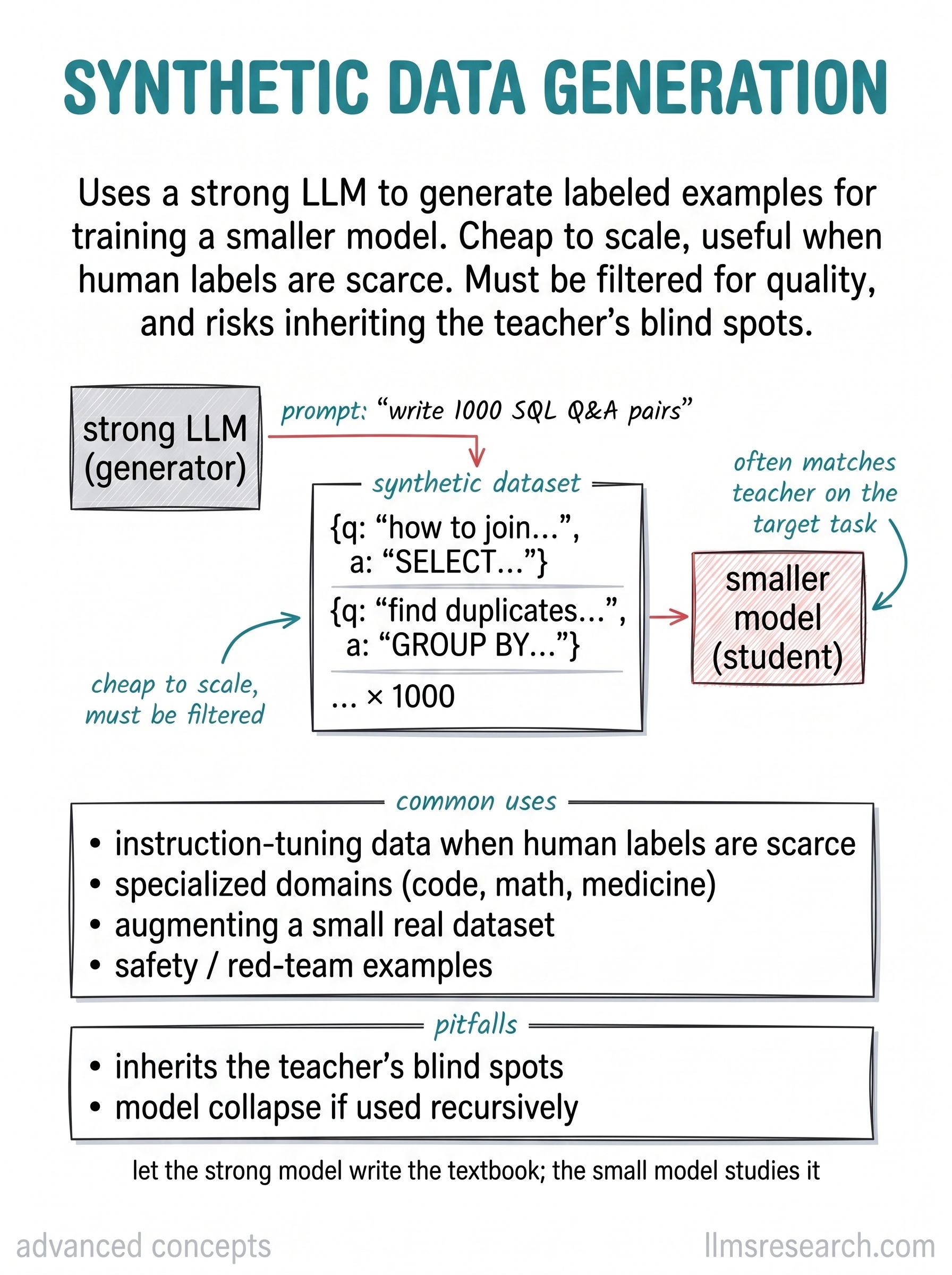
Pretraining runs on text that already exists. Synthetic data generation makes new training text on demand. The card frames it as a teacher and student: a strong model is prompted to produce labeled examples, and a smaller model trains on them. The example prompt, write a thousand SQL question-and-answer pairs, turns into a dataset of paired questions and answers that the student learns from, repeated at whatever volume you are willing to pay for.
The appeal is on the left of the card: cheap to scale. A capable model can emit examples far faster and cheaper than people can write and check them, which matters most exactly where human labels are hardest to get. The common uses listed on the card follow from that. Instruction-tuning data when labels are scarce, coverage of specialized domains like code, math, and medicine, augmentation of a small real dataset, and safety or red-team examples that are awkward to collect from real users. In each case the generator is standing in for labor that would otherwise be the bottleneck.
The card is careful to mark the cost right next to the benefit: must be filtered. A strong model still produces wrong answers, and a synthetic SQL answer that does not run or a math solution that reaches the wrong number is worse than no example, because the student will faithfully learn the error. The generated set has to be checked before it is trained on, and for tasks with a verifier, running the code or checking the result, that filtering can be automated, which is part of why code and math are such common targets.
The two pitfalls at the bottom are the ones to internalize. The student inherits the teacher’s blind spots: it cannot learn a fact or a skill the generator does not have, so synthetic data tends to transfer the teacher’s ceiling along with its knowledge, which is why a student rarely surpasses its teacher on the target task through imitation alone. The second, model collapse, is the failure mode when this is pushed to an extreme: train a model largely on the output of models, across generations, and the distribution narrows and drifts, losing the rare cases and diversity that were present in real data. Synthetic data is a way to multiply a good source, not to manufacture capability from nothing.