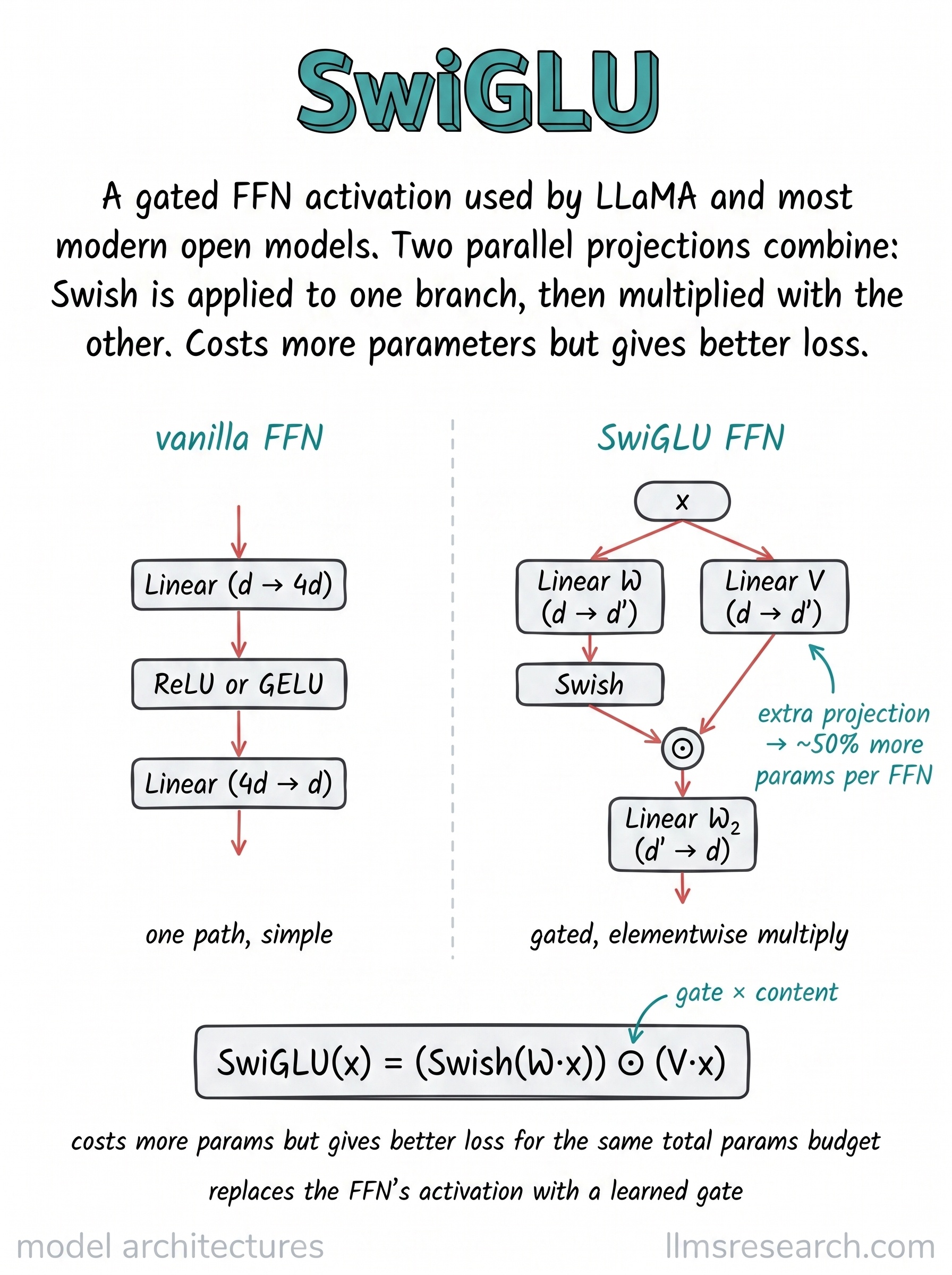
The previous card described the standard feed-forward network. SwiGLU is a redesign of that block’s middle, and it is now the default in the LLaMA family and most modern open models, so it is worth seeing side by side with the vanilla version.
The card puts them next to each other. Vanilla FFN is a single path: expand with one linear layer, apply ReLU or GELU, project back. SwiGLU splits the expansion into two parallel projections of the input, W and V. The W branch is passed through Swish, a smooth activation, and the result is multiplied elementwise by the V branch. A final linear layer projects that product back down. The formula reads SwiGLU of x equals Swish of W times x, elementwise multiplied by V times x.
The idea is gating. The Swish branch acts as a learned gate, a set of values between roughly zero and one, and it modulates the content branch position by position and dimension by dimension. Rather than a fixed activation deciding what passes, the model learns a gate that controls the flow. The card frames it as gate times content, and as replacing the FFN’s activation with a learned gate.
There is a real cost, called out on the card. Two input projections instead of one means about fifty percent more parameters in the FFN. The trade the design accepts is that, for the same total parameter budget, a SwiGLU model reaches lower loss than a vanilla FFN model. In practice implementations shrink the hidden width so the three matrices land near the same total size as the original two, which keeps the comparison fair.
SwiGLU is one of a small set of changes, alongside RMSNorm and RoPE, that separate a modern open model from the original transformer. RMSNorm is the next card.