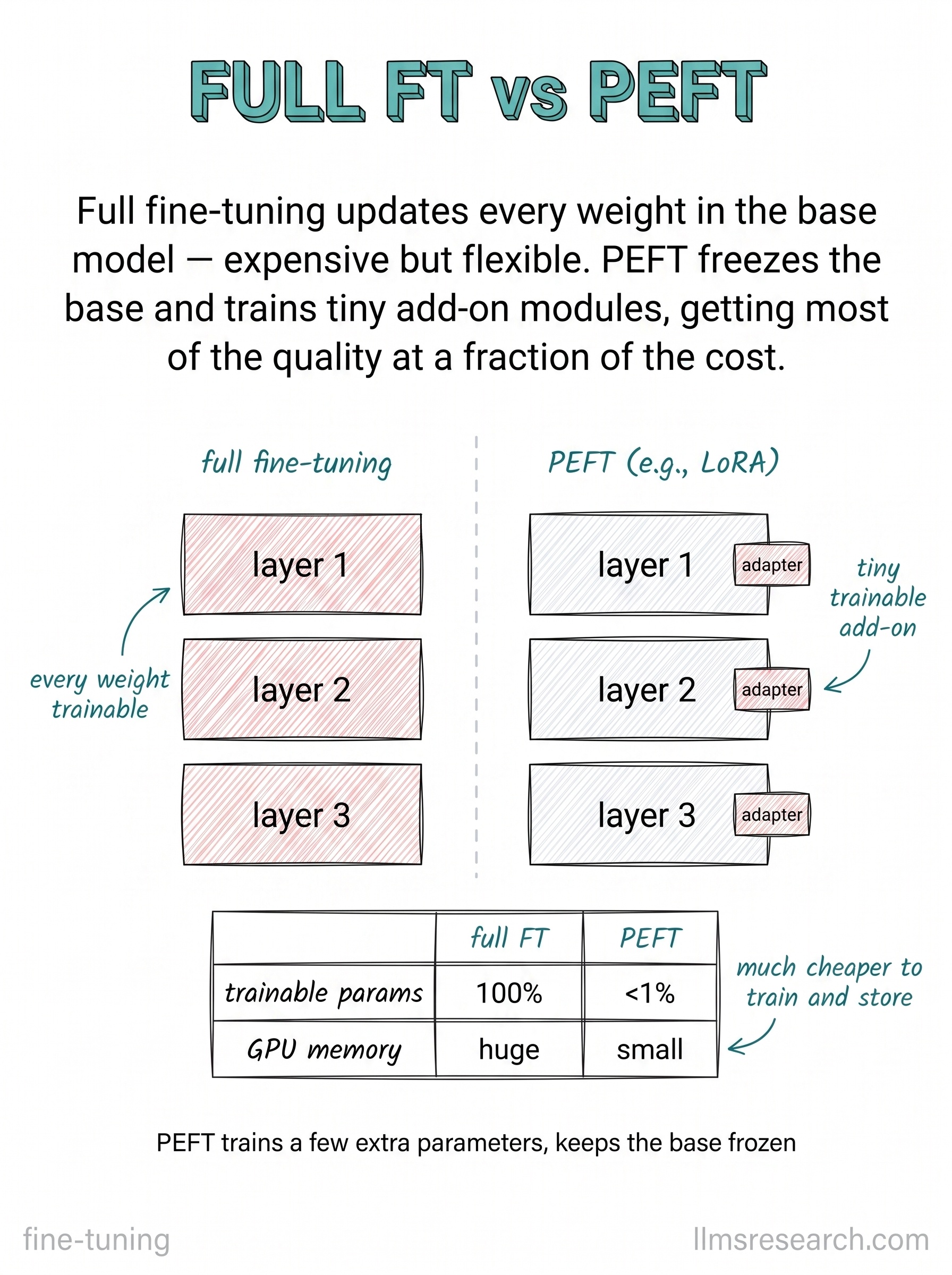
Once you have a fine-tuning objective, the next decision is how much of the model to actually train. The card draws the two ends of that choice. On the left, full fine-tuning: every layer is shaded as trainable, and the whole weight set moves. On the right, parameter-efficient fine-tuning, or PEFT: the layers stay frozen and a small adapter is bolted onto each one, and only those adapters train.
Full fine-tuning is the flexible option. Since every parameter can move, the model can in principle adapt as far as the data pushes it. The cost is that you are training and storing a complete copy of the model for each task. The optimizer needs gradients and optimizer state for every weight, which is where the memory goes, and the result is a full-sized checkpoint per fine-tune. For a large model that is a serious bill in both compute and storage.
PEFT takes a different bet. It keeps the base weights fixed and inserts a small number of new trainable parameters, then trains only those. The table on the card sums up the tradeoff: full fine-tuning trains 100 percent of the parameters and needs huge GPU memory, while PEFT trains under 1 percent and needs little. Because the base is shared and frozen, each task adds only a tiny adapter rather than a whole model, so you can keep many task-specific fine-tunes around cheaply and swap them in as needed.
The claim that PEFT reaches most of the quality is empirical and holds well across common tasks, though it is not a guarantee for every case; when a task demands large changes to the model’s behavior, full fine-tuning can still pull ahead. The card names LoRA as the example adapter, which is not incidental, since LoRA is the method that made PEFT the default choice for most fine-tuning work. The next cards open that method up.