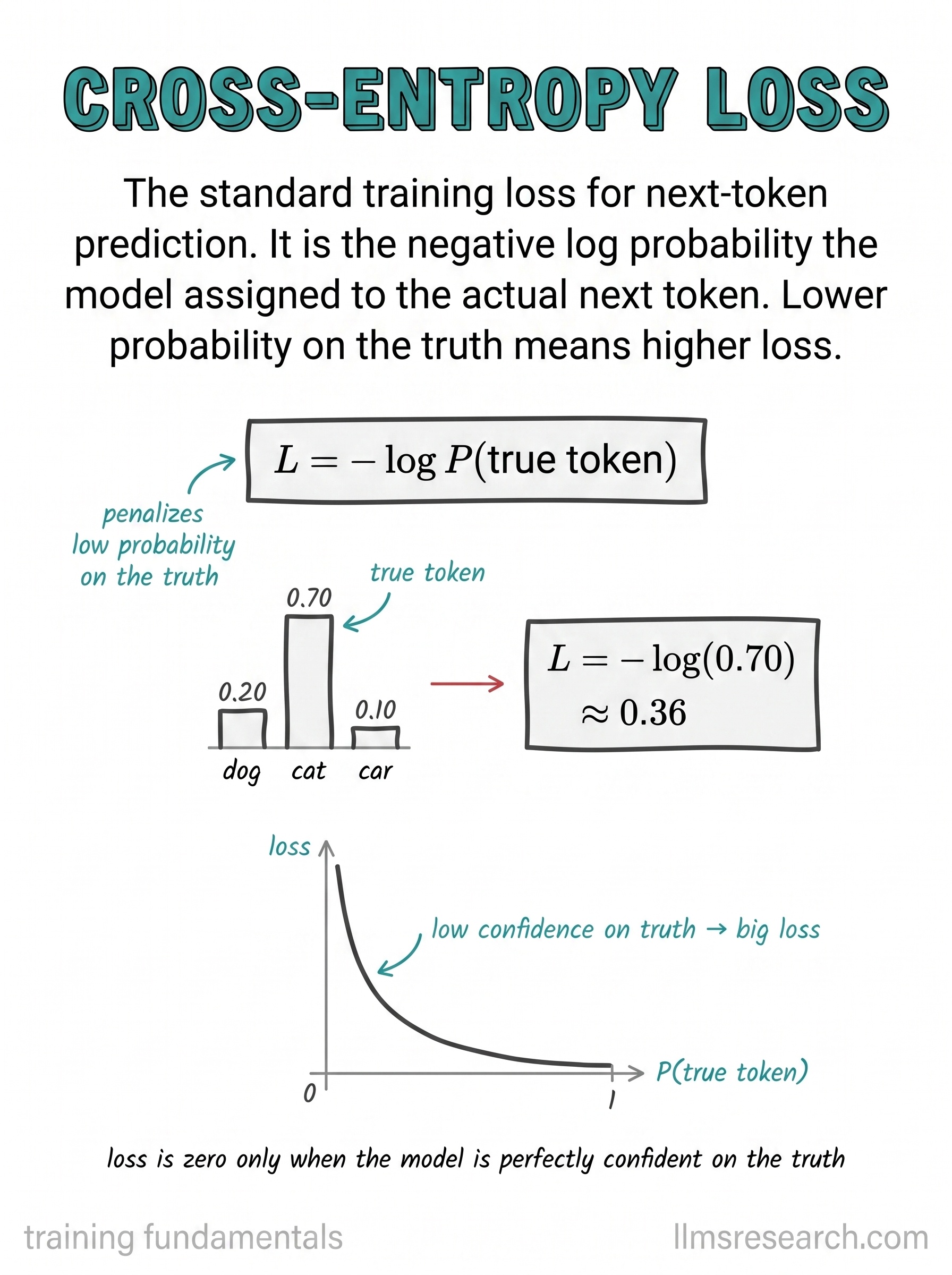
The previous card described what the model is trying to do, predict the next token. This one gives the number that measures how well it did. The card states it in one line: the loss is the negative log of the probability the model placed on the true token. Nothing else about the distribution enters the calculation. Only the weight assigned to the one token that actually came next matters.
The worked example makes the shape concrete. The model spreads its probability over three candidates, “dog” at 0.20, “cat” at 0.70, “car” at 0.10, and the true continuation turns out to be “cat”. The loss is the negative log of 0.70, about 0.36. Had the model been more confident and put 0.95 on “cat”, the loss would have dropped toward zero. Had it hedged and left only 0.30 there, the loss would have climbed. The other two bars do not appear in the arithmetic at all, though they are not free: probabilities sum to one, so raising the weight on “cat” necessarily pulls it from “dog” and “car”.
The curve at the bottom explains why this particular function is used rather than something simpler like counting mistakes. As the probability on the truth falls toward zero, the negative log rises without bound. A model that was not just wrong but confidently wrong, assigning almost no weight to what actually happened, pays an enormous penalty. That steepness is what makes the gradient informative. Being nearly right produces a gentle nudge; being badly wrong produces a strong correction.
One detail worth keeping straight is the base of the logarithm. The card writes plain log, and in most training code that is the natural log, which puts the loss in units of nats. Reported losses of around 2 to 3 for a competent language model are natural-log values. The choice of base only rescales the number, so it does not change which model is better, but it matters the moment you try to turn loss into the next card’s quantity, perplexity, where you have to exponentiate with the matching base.