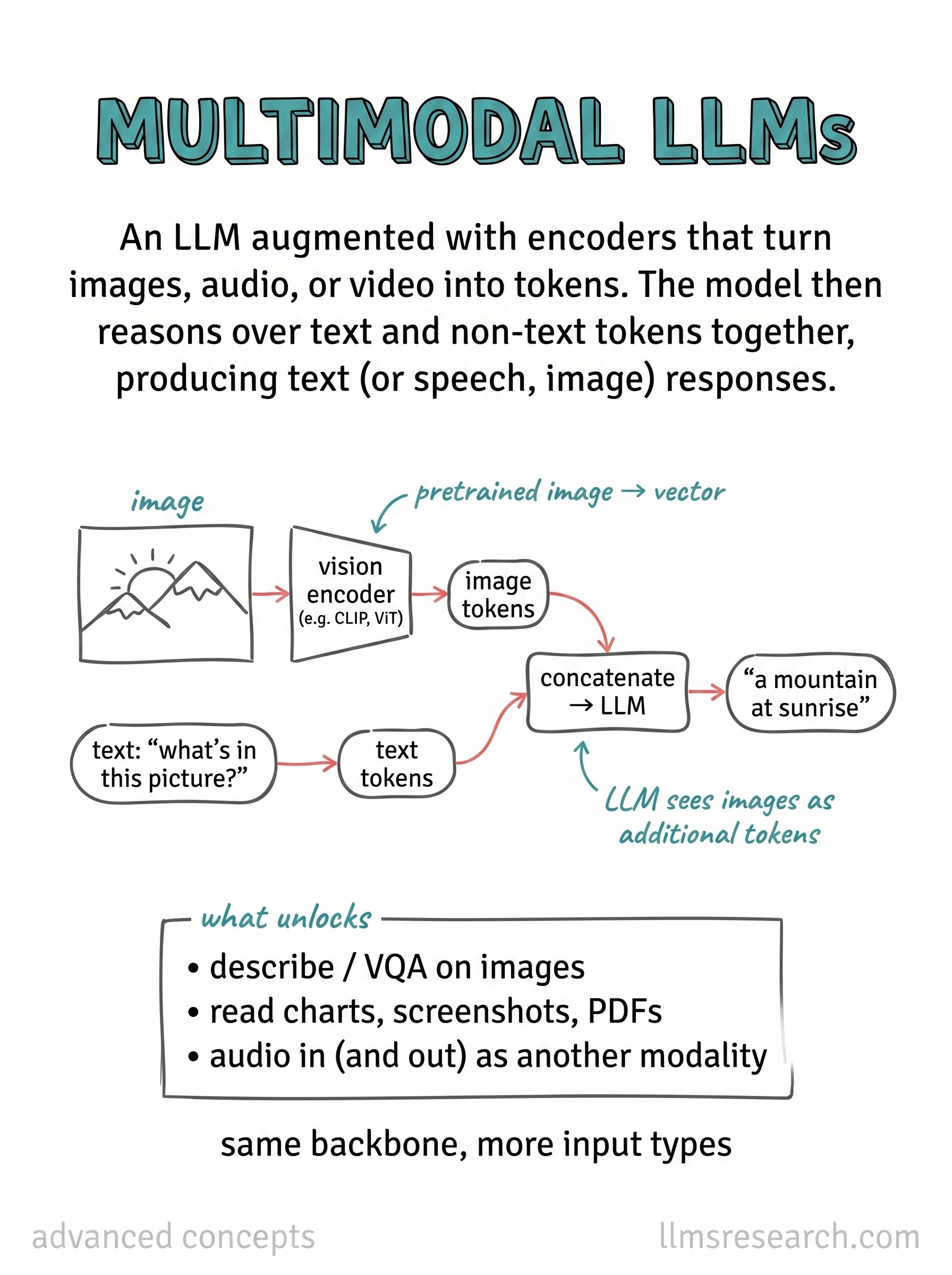
The card shows a horizontal pipeline. An image enters a vision encoder and emerges as a sequence of image tokens. A text prompt is tokenized separately. The two streams merge into one input the LLM processes, and the model emits a text response, for example describing what is in the picture. The caption reads “same backbone, more input types,” which is the architectural point: the core language model stays familiar; new encoders bring other modalities into its input format.
Token concatenation is one common fusion pattern. Image tokens sit beside text tokens in a single sequence, and the transformer attends across both. The model learns, through training on image-text pairs, how to ground words like “the red car on the left” in visual features. Other designs keep modalities separate longer: cross-attention layers let text queries attend to image features without flattening them into the same token grid, and lightweight adapter layers project encoder outputs into the LLM’s embedding space. The card notes these alternatives because concatenation is not the only production approach.
What this enables is practical rather than exotic. Visual question answering, reading charts and screenshots, describing UI state, and parsing scanned documents are tasks where text-only models guess from priors. A multimodal model can condition on pixels. Audio and video extend the same idea with encoders that produce token-like representations over time, though the card’s hero focuses on the image case as the canonical diagram.
The limits carry over from text models. Context window size still caps how much image and text you can send together. High-resolution inputs are often downsampled or tiled, which can lose fine detail. Hallucination persists: the model may describe objects that are not present or misread small text in a chart. Multimodal capability is not grounding by itself; it is access to raw sensory input, and verification still matters for high-stakes use. CLIP and vision-language architectures elsewhere in this chapter zoom into how the encoders that feed these models are built and trained.