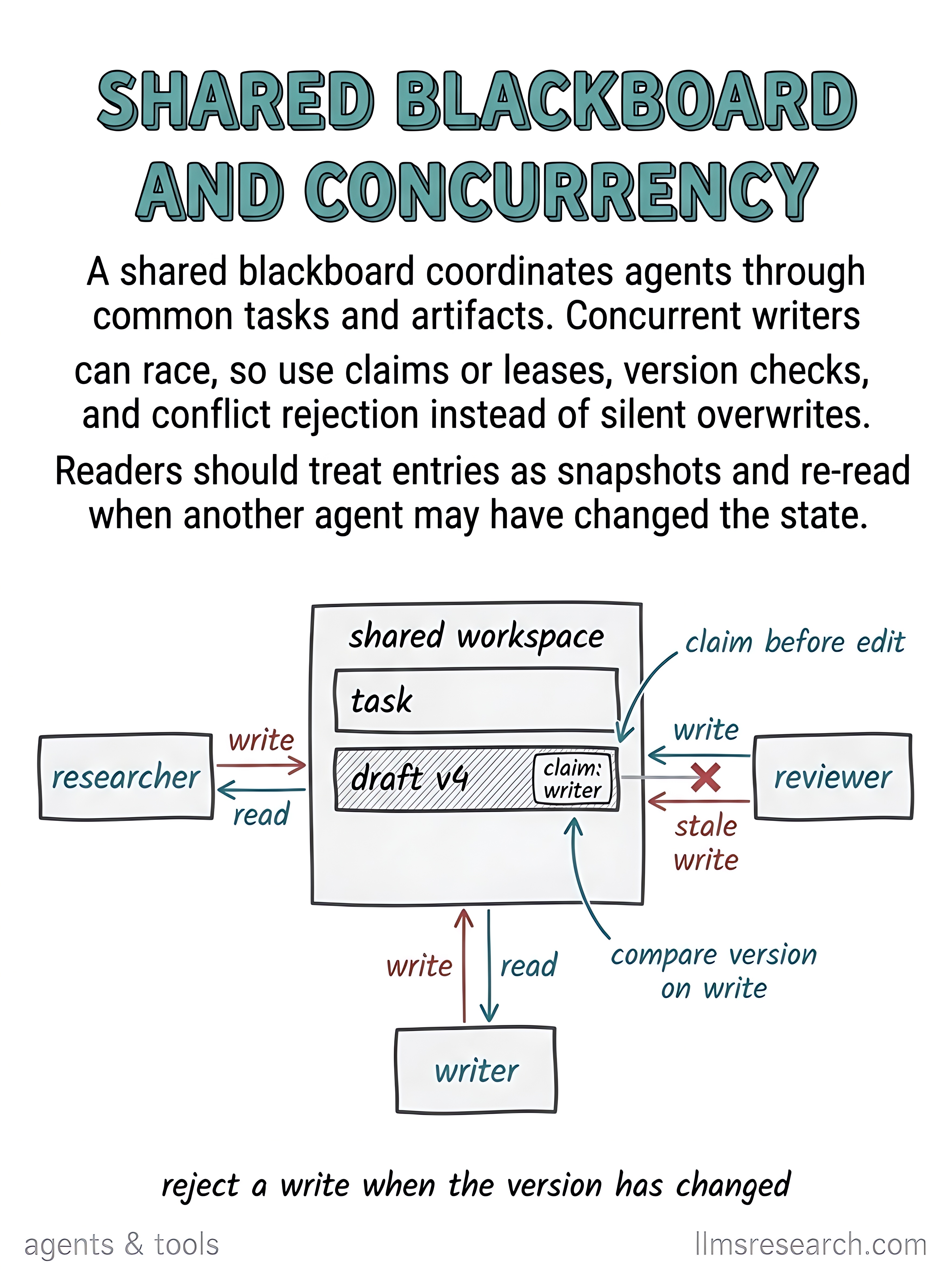
The card centers on a shared workspace board with rows for task and a hatched draft v4. Three agents surround it: researcher, writer, and reviewer. Thin red arrows labeled write enter the board; teal arrows labeled read exit. On the draft row sits a badge claim writer. One red arrow labeled stale write bounces away with an X. Callouts mark claim before edit and compare version on write. The bottom line reads reject a write when the version has changed.
A shared blackboard is a coordination pattern, not a single standard store in A2A or MCP. Agents publish tasks, notes, and draft artifacts to a common space others can read. That enables parallel work: a researcher can add sources while a writer drafts and a reviewer comments. The failure mode is concurrent writes. Two agents editing the same draft without coordination can silently lose content when the last write replaces earlier work. Production designs add claims or leases so only one writer holds an edit lock, version numbers so clients compare the expected version on write, and rejection when the version changed underneath them. Readers should treat entries as snapshots and re-read after notifications because state may have changed.
This card focuses on multi-agent write concurrency. Single-agent memory tiers and high-level team topologies are covered elsewhere. Nothing here implies a built-in consistency model from a protocol; you choose storage, locking, and merge policy in application code.
Use a shared workspace when several agents collaborate on the same evolving artifact and need visibility without routing every update through one orchestrator. Pair it with explicit claim rules for editable sections, optimistic concurrency on writes, and events or polling so readers detect changes. Keep authoritative state in a store you control rather than assuming LLM transcripts alone will stay consistent under parallel agents.