The previous card added something to each token vector without saying why. This card is the why, and it comes from a real limitation of attention.
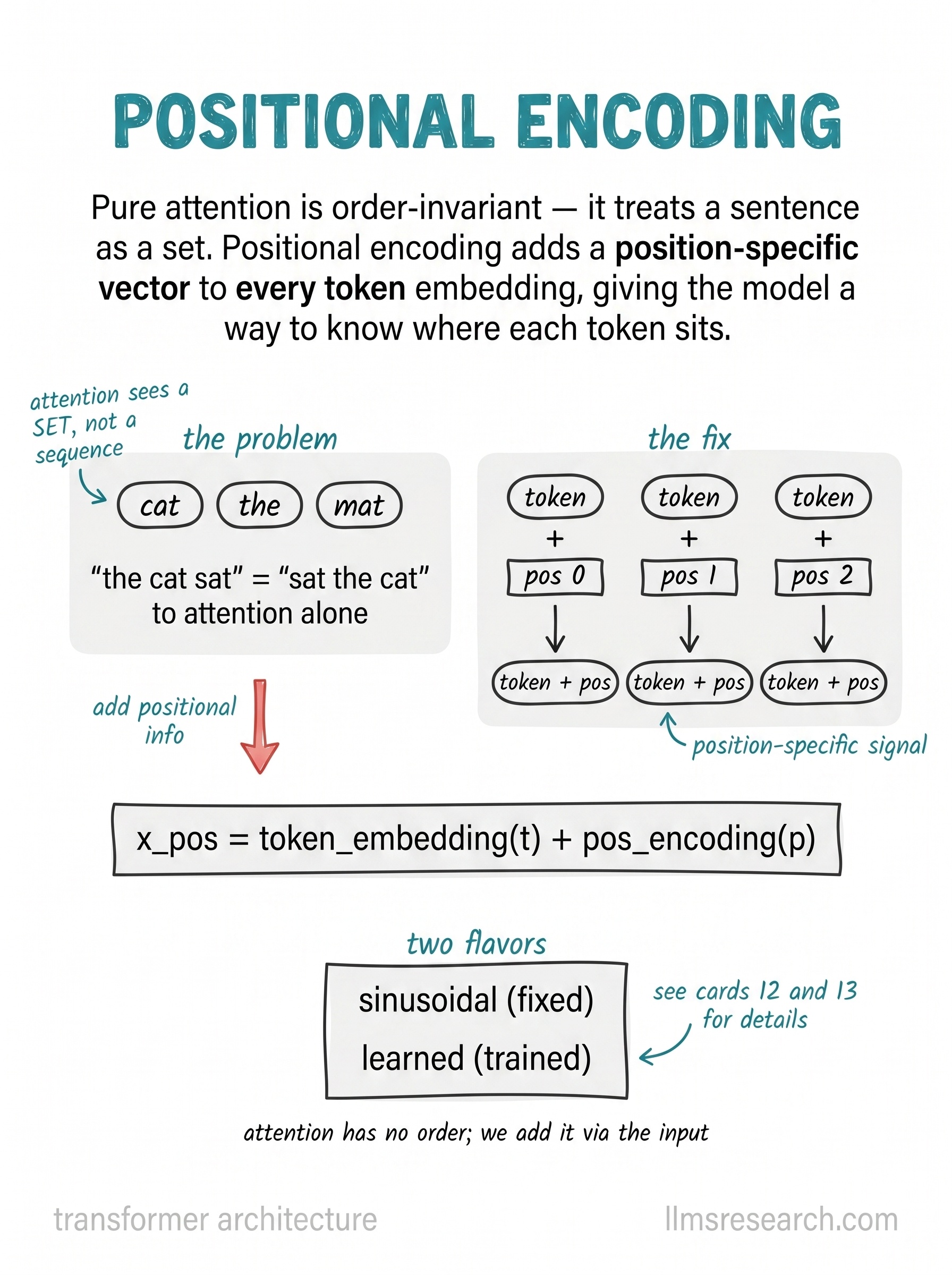
Attention, which the coming cards cover in detail, treats its input as a set. It looks at which tokens are present and how they relate, but it has no built-in notion of order. The card makes this concrete: to attention alone, “the cat sat” and “sat the cat” are the same collection of tokens. That is a problem, because order carries meaning in language, and a model that cannot tell those two apart is missing something basic.
The fix is to inject position at the input. Each token embedding gets a position-specific vector added to it: the token at slot 0 gets the vector for position 0, the token at slot 1 gets the vector for position 1, and so on. The formula on the card states it plainly, the input is the token embedding plus a position encoding. After this addition, two tokens that are identical as words but sit in different places arrive at attention as different vectors, so order survives.
It is worth noting where this happens. Position is not something attention computes; it is something added to the representation before attention runs. The model then learns to read that added signal however it finds useful.
The card lists two flavors, sinusoidal and learned, and points ahead to the next cards for each. They differ in whether the position vectors are computed by a fixed formula or trained like any other parameter, and that choice turns out to matter mostly for how well a model handles sequences longer than it saw in training. Those trade-offs are the subject of the next two cards.