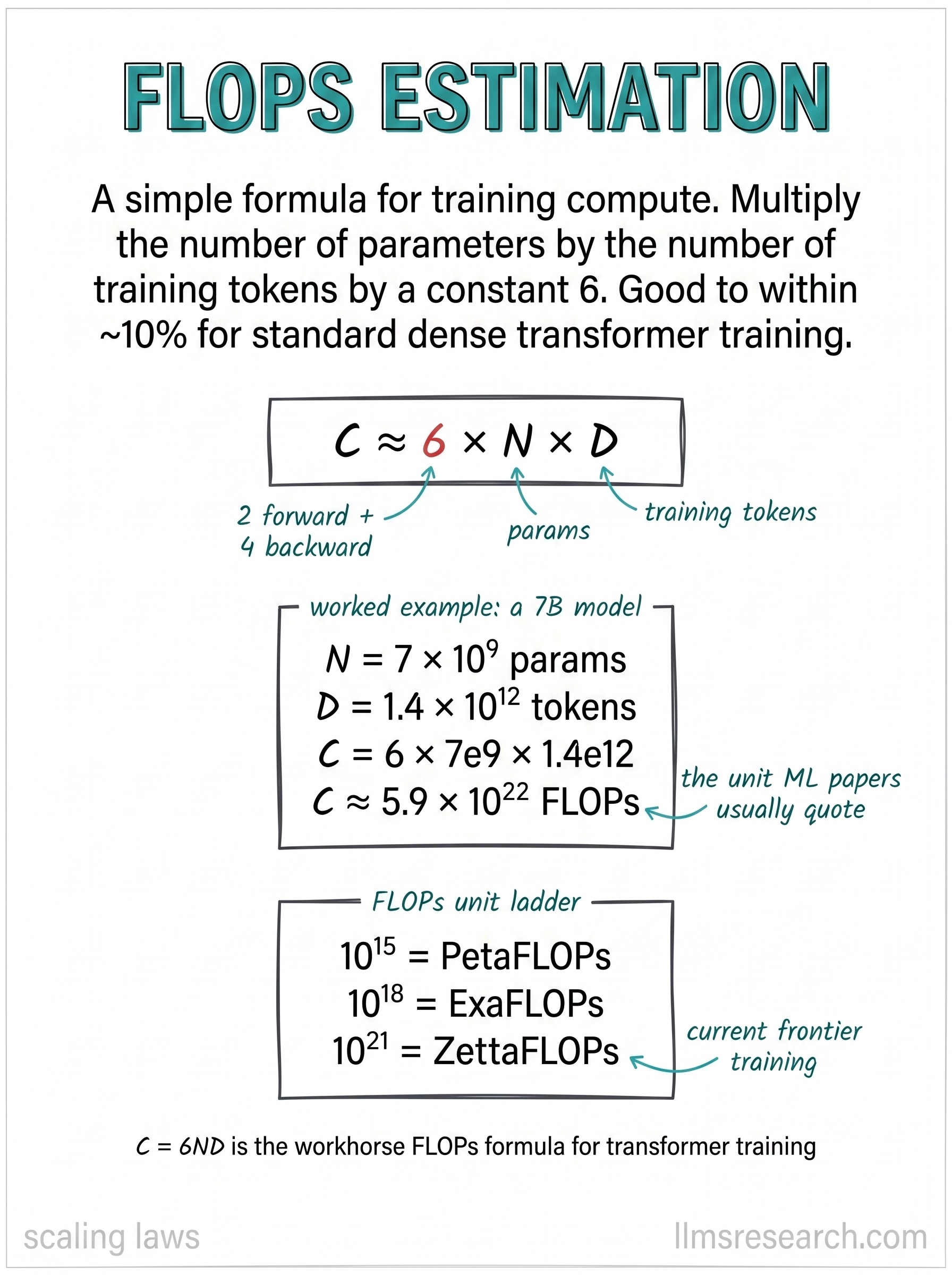
Scaling laws are written in terms of compute, so it helps to have a cheap way to turn a training plan into a compute number. The card gives the standard one: total training compute C is approximately 6 times the number of parameters N times the number of training tokens D. It is a rule of thumb, but a reliable one, accurate to within about ten percent for standard dense transformer training.
The factor of 6 is the part worth understanding rather than memorizing. Each token passes through the model twice per training step, once forward to compute the loss and once backward to compute the gradient. A matrix multiply and its gradient cost roughly two floating-point operations per parameter per token, and the accounting comes out to about two operations for the forward pass and four for the backward pass, which is where the annotations 2 forward plus 4 backward come from. Six operations per parameter per token, multiplied across all parameters and all tokens, gives the total.
The worked example fixes the scale. A 7-billion-parameter model trained on 1.4 trillion tokens needs about 6 times 7e9 times 1.4e12, which is roughly 5.9 times 10 to the 22 FLOPs. That is the kind of figure quoted in model reports, and the unit ladder on the card places it: 10 to the 15 is a petaFLOP, 10 to the 18 an exaFLOP, 10 to the 21 a zettaFLOP, with frontier runs sitting in the upper part of that range. The example run is a few hundred zettaFLOPs of total work.
Two limits keep the estimate honest. The formula counts the arithmetic of the matrix multiplies and ignores overheads like attention on very long sequences, data movement, and hardware inefficiency, so real wall-clock cost is higher than the raw FLOP count implies. And the factor of 6 assumes a dense model where every parameter is used on every token; a mixture-of-experts model activates only a fraction of its parameters per token, so its training cost tracks the active count rather than the total. Within those bounds, C equals 6 times N times D is the workhorse that connects a model plan to the scaling curves.