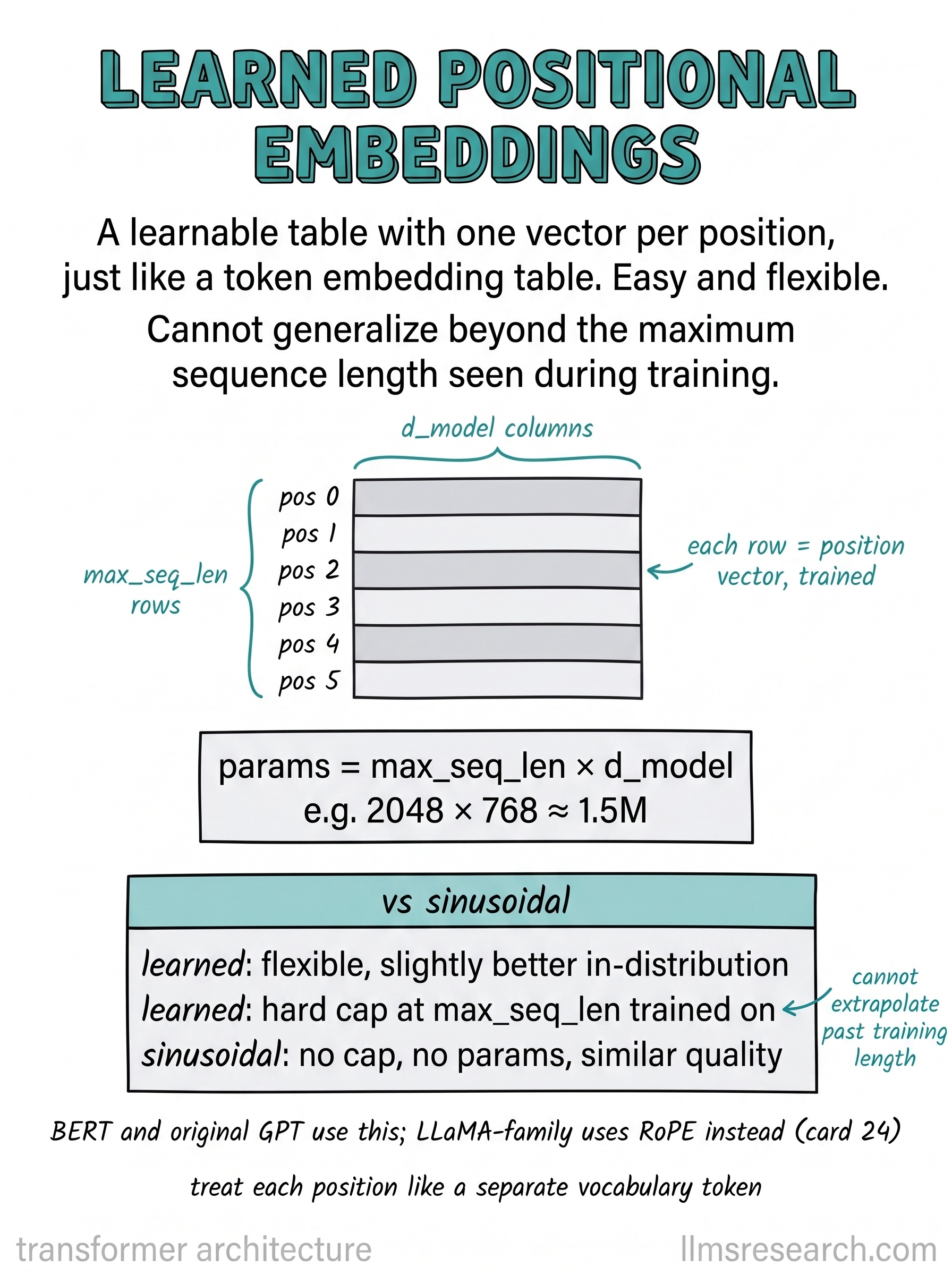
If a token embedding table works by learning one vector per token, the obvious alternative to the sinusoidal formula is to learn one vector per position the same way. That is all a learned positional embedding is.
The card draws it as a table with max_seq_len rows and d_model columns. Row 0 is the vector for position 0, row 1 for position 1, and so on, and every entry is trained by backpropagation alongside the rest of the model. There is no formula to design and no assumption about how position should look; the model simply learns whatever position vectors help it predict text. The parameter count is max_seq_len times d_model, which the card puts at roughly 1.5 million for a 2048 by 768 table, small next to the token embedding matrix.
The appeal is flexibility. Because nothing is fixed in advance, the learned table can adapt to the data and tends to be slightly better than sinusoidal within the range it was trained on. The comparison box captures both sides of that.
The cost is the hard ceiling. The table has exactly max_seq_len rows, so there is no vector for position 2049 if you only trained to 2048. Unlike a formula, a table cannot produce an entry it was never given, so a model with learned positions simply cannot process sequences longer than its training length without extra work. Sinusoidal encoding has no such cap and uses no parameters, at similar quality, which is the trade the box lays out.
This choice split the field. The card notes BERT and the original GPT used learned positions, while the LLaMA family moved to RoPE, the next card, precisely to get better behavior on long contexts.