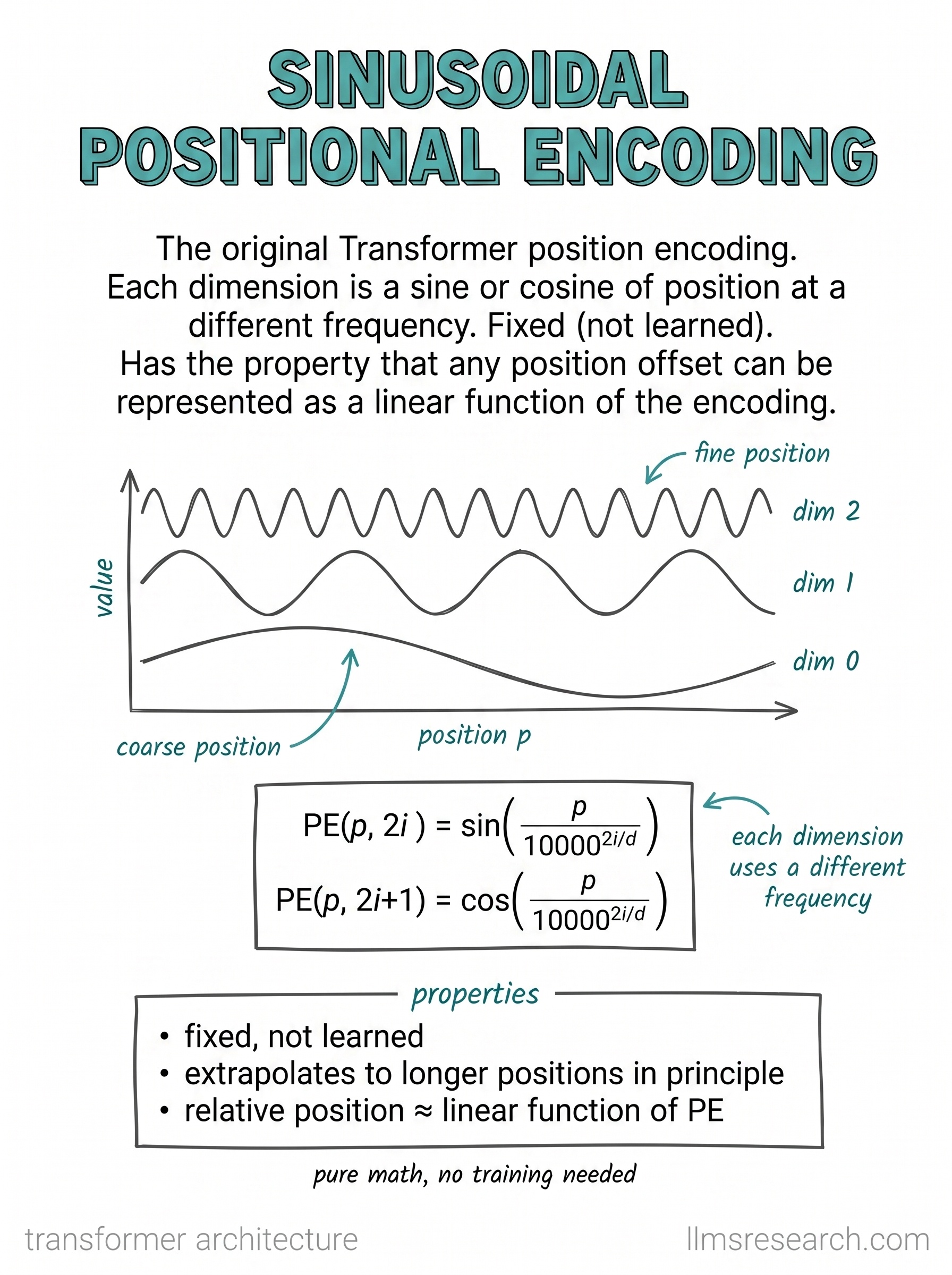
The first way anyone gave a transformer a sense of position was to compute it, not learn it. This card is that method, the one from the original transformer paper.
The idea is to build each position vector out of sines and cosines. The formula sets even dimensions to a sine of position and odd dimensions to a cosine, and crucially each dimension uses a different frequency. The plot shows the effect: the low dimensions wave slowly and act as a coarse position signal, while the high dimensions wave quickly and pin down fine position. Together, across many dimensions at many frequencies, the set of values is distinct for each position, so the model can read out where a token sits.
Two properties make this more than a party trick. First, it is fixed, computed straight from the formula with no training involved. That means it costs no parameters and requires no data to set up. Second, and this is the subtle one, the encoding is built so that shifting by a fixed offset is a linear function of the encoding. A position a few steps away is reachable by a fixed linear transform, which gives the model a clean handle on relative position, the distance between two tokens rather than their absolute slots.
Because it is a formula rather than a table, it can in principle produce a vector for any position, including ones longer than anything seen in training. The card notes this extrapolation holds in principle. In practice the benefit is partial, which is part of why later methods were developed.
This is the baseline the next cards measure against. Learned embeddings drop the formula for a trained table, and RoPE keeps the rotational idea but applies it inside attention rather than adding it at the input.