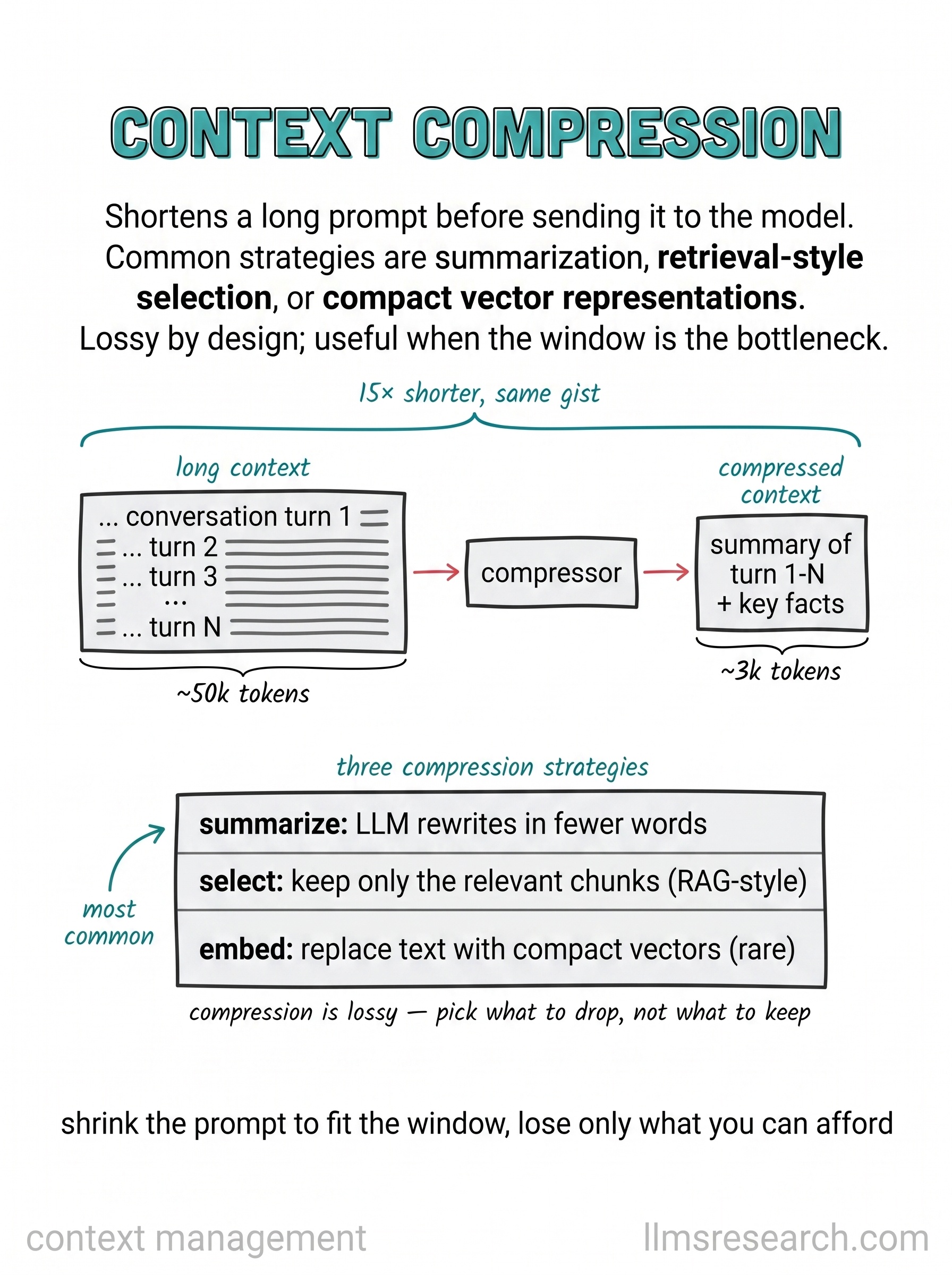
The card shows a wide bar labeled long context, roughly fifty thousand tokens, fed through a compressor box, emerging as a narrow bar of a few thousand tokens labeled compressed context. A bracket notes the shrink ratio while claiming the gist remains. Below, three strategies appear: LLM summarization, retrieval-style selection of relevant chunks, and learned soft-token compression distinct from ordinary embedding retrieval.
Compression trades detail for space. Summaries drop names, qualifiers, and negation if the summarizer is careless. Selection keeps only chunks that match the current query but may discard background needed for the next turn. Learned compressors encode many tokens into fewer latent slots; they are less common in production but appear in research systems such as ICAE-style approaches.
Use compression when the window is the bottleneck and you accept controlled loss. Good pipelines log what was removed, keep raw sources for re-fetch, and recompress when the user shifts topic. Pair summarization of old chat with verbatim retention of the latest user message and any cited evidence. Evaluate on tasks where missing a single fact matters, not only on fluency.
The card’s footer line states the design choice: shrink the prompt to fit, lose only what you can afford. That means compression policy belongs next to token budgeting and truncation rules. It is not a substitute for retrieval when facts are sparse; it is how you carry forward what retrieval already found when history grows too long to ship whole.