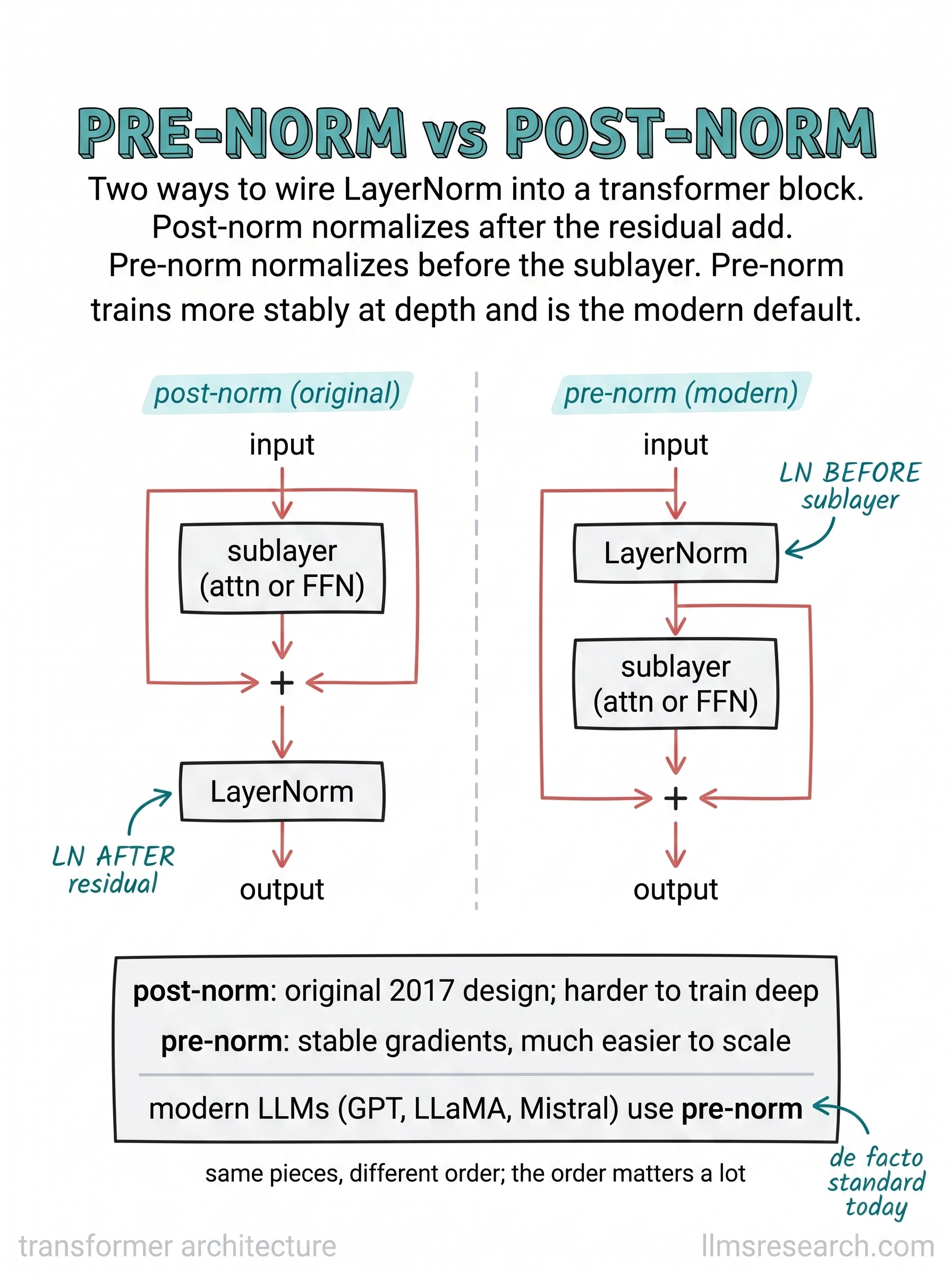
The previous cards covered what normalization does and a cheaper way to do it. This one is about where it goes. The pieces of a block are the same either way; the order in which normalization, the sublayer, and the residual add are wired together is the whole question, and the card’s closing line is right that the order matters a lot.
The two diagrams show the split. In post-norm, the original 2017 design, the input goes through the sublayer, the residual adds the input back, and normalization comes last, after the add. In pre-norm, normalization comes first: the input is normalized, then passed to the sublayer, and the residual adds the untouched input back at the end. The label captures it in four words on each side, LN after residual versus LN before sublayer.
Why the placement matters comes down to the residual path. In pre-norm, the shortcut from input to output carries the signal without any normalization sitting on it, so gradients flow back through the stack cleanly. In post-norm, normalization sits on that path, and across many layers this makes very deep models harder to train without extra care such as learning-rate warmup or careful initialization. The card states the tradeoff plainly: post-norm is harder to train deep, pre-norm gives stable gradients and is much easier to scale.
That is a genuine tradeoff rather than a free win. Post-norm can reach slightly better final quality at moderate depth when it does train, which is part of why the original transformer used it. As models grew deeper, the training stability of pre-norm mattered more than that margin, and the field moved.
The annotation records where things landed: modern LLMs such as GPT, LLaMA, and Mistral use pre-norm, and the note calls it the de facto standard today. Pair that placement with RMSNorm as the normalization itself and you have the configuration most current open models ship with.