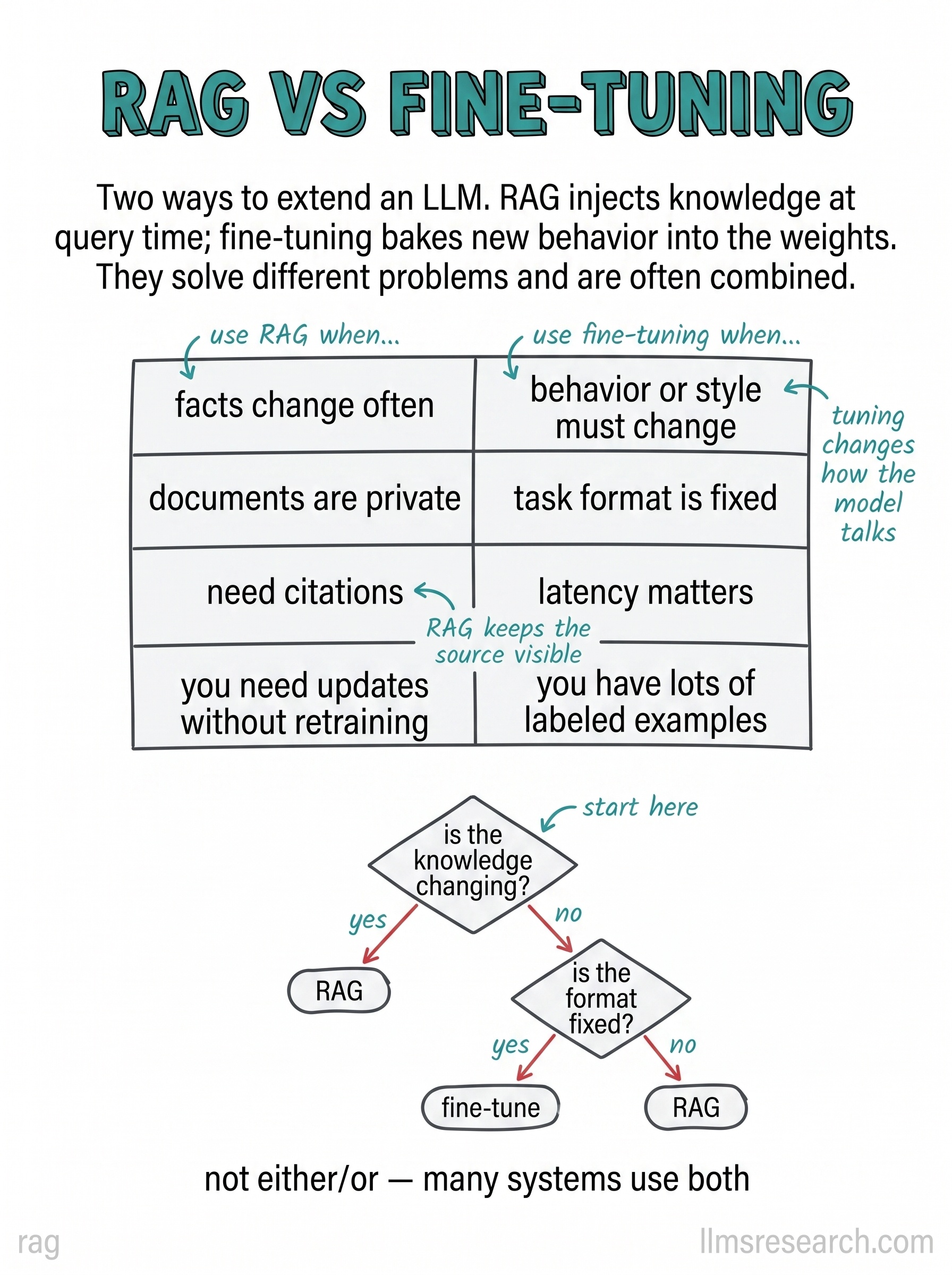
Teams that need a model to know more or behave differently face two main paths. RAG adds knowledge at query time by retrieving documents and stuffing them into the prompt. Fine-tuning changes the model’s weights so new behavior or knowledge is baked in. The card compares when each approach fits.
The two-column table lists the deciding factors. Use RAG when facts change often, when documents are private and should not be memorized into shared weights, when you need citations that keep the source visible, or when you want updates without retraining. Use fine-tuning when behavior or style must change, when the task format is fixed, when you need low-latency inference without a retrieval step on every query, or when you have substantial labeled examples to train on.
The flowchart below walks through the decision in order. If the knowledge changes frequently, RAG is the natural first branch. If the knowledge is stable but the output format or tone must shift, fine-tuning is the better tool. The footer notes that this is not either-or: many production systems retrieve documents and also run a fine-tuned model that knows how to use them.
The distinction is about where information lives. RAG keeps knowledge in an index you can edit, version, and permission separately from the model. Fine-tuning stores patterns in parameters, which is harder to update but removes per-query retrieval cost and latency. RAG makes sources auditable. Fine-tuning changes how the model talks and structures answers.
The practical takeaway is to match the tool to the problem shape. Changing facts and proving where they came from points to RAG. Changing skills, format, or tone points to fine-tuning. When both needs exist, combine them: a tuned model that follows your output schema, plus retrieval that supplies current evidence.