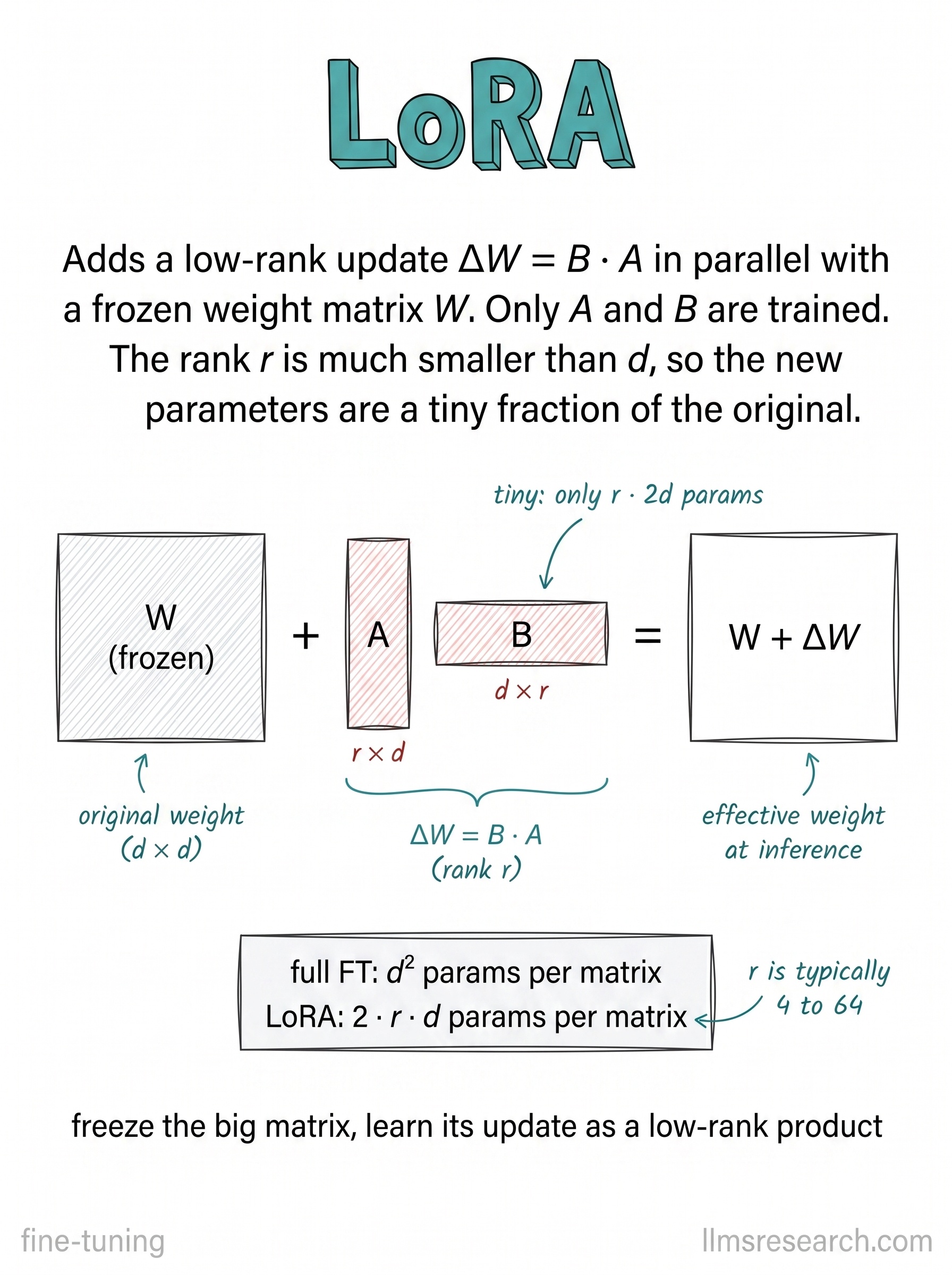
LoRA is the PEFT method that made freezing the base model practical, and the card shows exactly how it works. The original weight matrix W, of size d by d, stays frozen. Alongside it runs a small parallel branch that produces an update delta-W, and only that branch is trained. At inference the model behaves as if its weights were W plus delta-W, so the update is added back on top of the frozen matrix.
The trick is in how delta-W is built. Rather than being a full d by d matrix, which would be just as expensive to train and store as W itself, it is factored into two thin matrices: A of size r by d, and B of size d by r, with delta-W equal to B times A. The number r is the rank, and it is chosen to be much smaller than d. The card marks r as typically 4 to 64. Because the two factors are narrow, the parameter count drops sharply. Full fine-tuning of this matrix would train d-squared parameters; LoRA trains 2 times r times d, which for a small r is a tiny slice of the original.
The bet underneath this is that the change a task needs to make to a weight matrix is low-rank, meaning it can be captured well by a product of narrow matrices even though W itself is full-rank. This holds up remarkably well in practice for adapting a pretrained model to a new task, which is why LoRA became the default. It is worth being clear that it is an assumption about the update, not a mathematical certainty, and tasks that need a large, high-rank change to behavior can be underserved by a small r.
Two properties make LoRA convenient beyond the parameter savings. Because the adapter is separate from the frozen base, a single base model can host many LoRA adapters, one per task, each stored as a small file. And because the update can be folded into W by simple addition, a merged model adds no inference cost over the original. The next card walks through the handful of knobs that control how a LoRA adapter is configured.