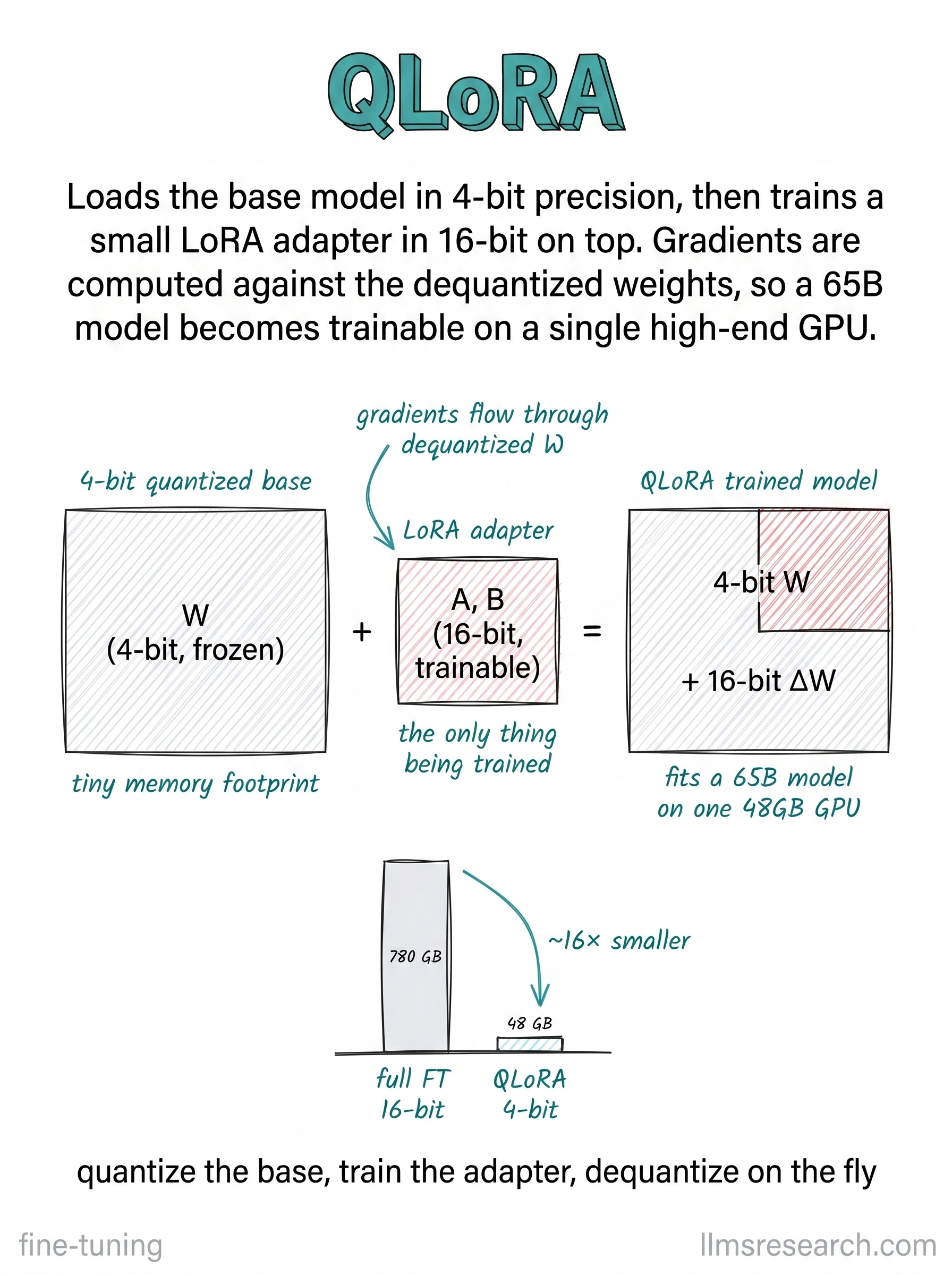
QLoRA attacks the one cost LoRA leaves untouched. LoRA freezes the base and trains only a small adapter, but the frozen base still has to sit in memory at full size, and for a large model that alone can overflow a single GPU. QLoRA’s answer is to store the frozen weights in 4-bit precision. The card shows the recipe as a sum: a 4-bit quantized base W on the left, a trainable LoRA adapter A and B kept in 16-bit in the middle, and the combined trained model on the right, holding 4-bit W plus a 16-bit delta-W.
The subtle part is how training still works when the base is quantized. You cannot compute meaningful gradients directly against 4-bit numbers, so during the backward pass the relevant weights are dequantized back to higher precision on the fly, the gradient flows through those dequantized values, and only the adapter is updated. The base weights are never changed; they exist in 4-bit for storage and are expanded temporarily only where computation needs them. The card marks this with the note that gradients flow through the dequantized W, and that the adapter is the only thing being trained.
The payoff is memory. The card compares a full 16-bit fine-tune of a 65B model at around 780 GB against QLoRA at around 48 GB, roughly 16 times smaller, which is the difference between a cluster and a single high-end 48 GB GPU. That shift is what put fine-tuning of large models within reach of individual researchers rather than only well-resourced labs.
The tradeoff to keep in view is that 4-bit storage is lossy, so the frozen base is a slightly degraded version of the original. In practice the quality cost is small, in part because the trainable adapter can absorb some of the error, and QLoRA became a standard way to fine-tune large models cheaply. It builds directly on the precision ideas from mixed-precision training and the low-rank update from LoRA, combining them into one memory-efficient recipe. The next card steps back to an earlier PEFT design that places its trainable modules differently.