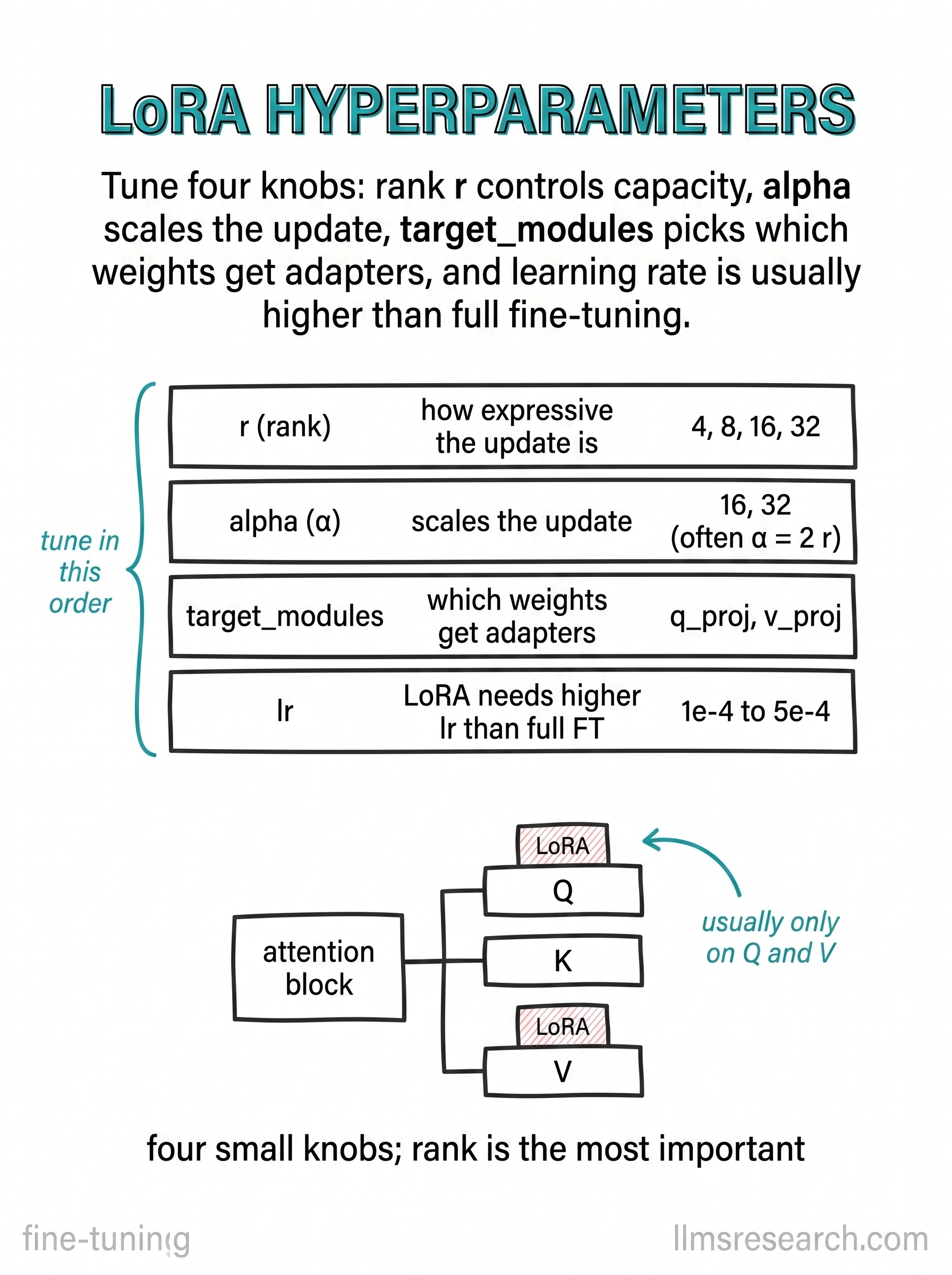
LoRA has few moving parts, and the card lays out the four that matter, in the order it suggests tuning them. First is r, the rank, which sets how expressive the update can be; the card lists typical values of 4, 8, 16, and 32. Rank is the most important knob because it is the one that decides capacity: too small and the adapter cannot represent the change the task needs, too large and you give up the efficiency that made LoRA attractive in the first place.
Second is alpha, a scaling factor applied to the update before it is added back to the frozen weights. The effective contribution of the adapter scales with alpha divided by r, so alpha and rank interact rather than acting independently. The card notes the common convention of setting alpha to twice the rank, which keeps the scaling roughly stable as you change r. Third is target_modules, which chooses which weight matrices actually receive adapters. The diagram at the bottom shows an attention block with its query, key, and value projections, and adapters attached only to Q and V. That is the usual choice, and the card marks it as such: adapting query and value projections tends to capture most of the benefit while leaving key projections untouched.
Fourth is the learning rate. The card points out that LoRA needs a higher learning rate than full fine-tuning, in the range of 1e-4 to 5e-4, which is noticeably larger than the rates typical of full-model training. The reason is that only a small set of freshly initialized parameters is being trained, and they start with no useful signal, so they can and should move faster than a full set of pretrained weights that only needs nudging.
None of these are exotic settings, and that is part of LoRA’s appeal: four small knobs, with rank as the one to reach for first. The card’s closing line makes the same point. Getting rank and its interaction with alpha right handles most of the tuning, and the module selection and learning rate tend to follow established defaults. The next card takes LoRA one step further by shrinking the frozen base itself.