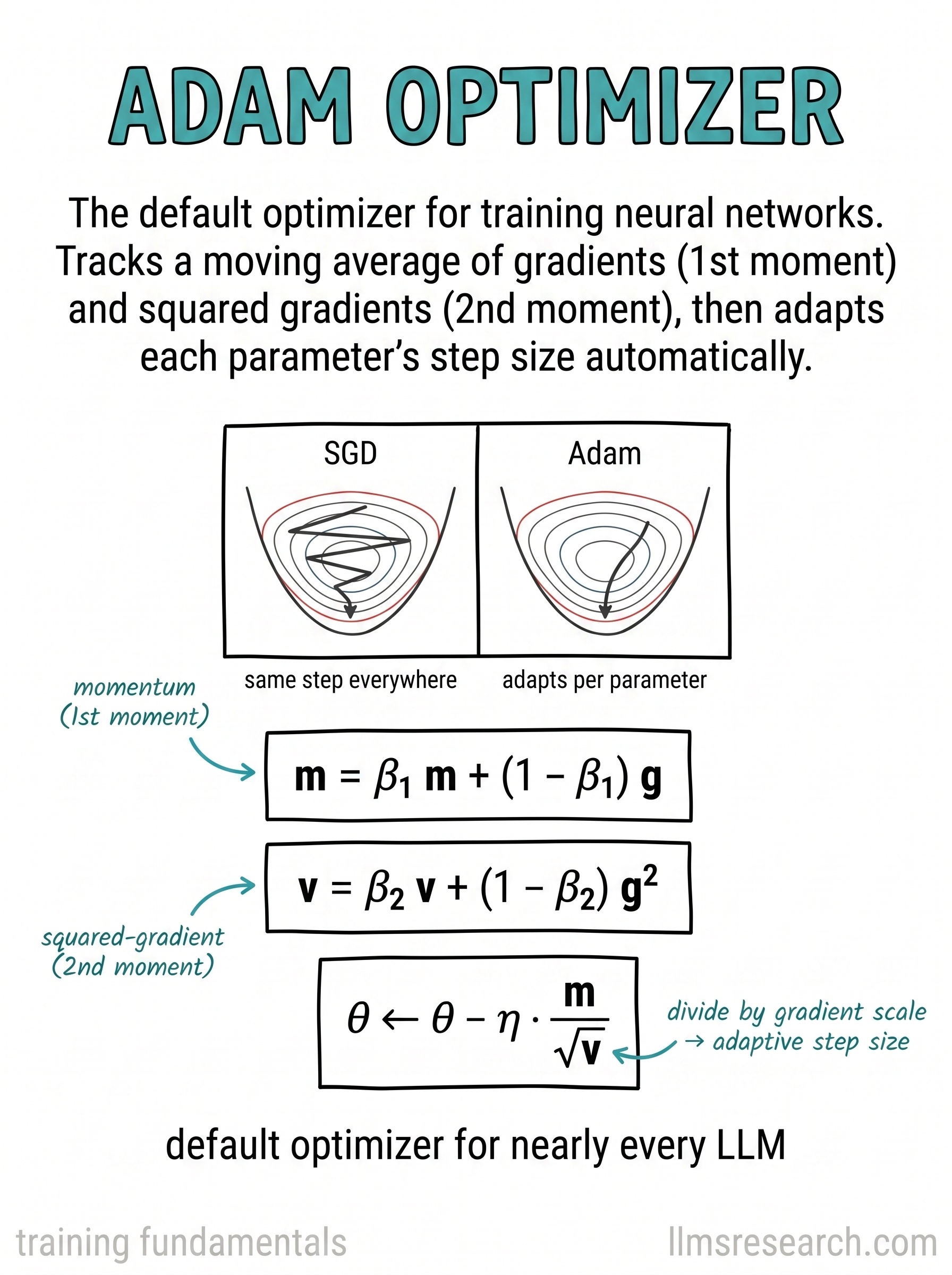
The loss tells the model how wrong it is. The optimizer decides what to do about it. The simplest choice, plain gradient descent, moves every parameter by the same learning rate times its gradient. The card’s left panel shows the cost of that uniformity: in a valley that is steep in one direction and shallow in another, a single step size makes the path zig-zag across the steep walls while crawling along the shallow floor. Adam is the fix that nearly every LLM uses instead.
Adam keeps two running averages per parameter. The first, written m, is a smoothed average of recent gradients. This is momentum: it damps the zig-zagging by averaging out directions that keep flipping sign and reinforcing directions that stay consistent. The second, written v, is a smoothed average of squared gradients, a measure of how large that parameter’s gradients have been recently. The two update rules on the card have the same form, a decay factor beta times the old average plus a small slice of the new value, with beta1 controlling the gradient average and beta2 the squared-gradient average.
The final line is where the adaptation happens. The parameter moves by the learning rate times m divided by the square root of v. Dividing by the square root of v is the key idea: parameters whose gradients have been large get their steps shrunk, and parameters whose gradients have been small get their steps kept large. The right panel shows the result, a fairly direct path to the bottom because each coordinate is scaled to its own gradient history rather than sharing one global rate.
A few practical notes the card leaves implicit. The version used in practice is almost always AdamW, which handles weight decay separately from the gradient update and tends to generalize better on large models. Adam also carries a real memory cost, because m and v are full copies of the parameters, so an optimizer state can be twice the size of the model itself. That overhead is one of the reasons large-scale training pushes so hard on the memory-saving techniques in the cards that follow.