A single attention computation can only follow one pattern of who-looks-at-whom at a time. Multi-head attention runs several of them side by side so the model can track different relations at once.
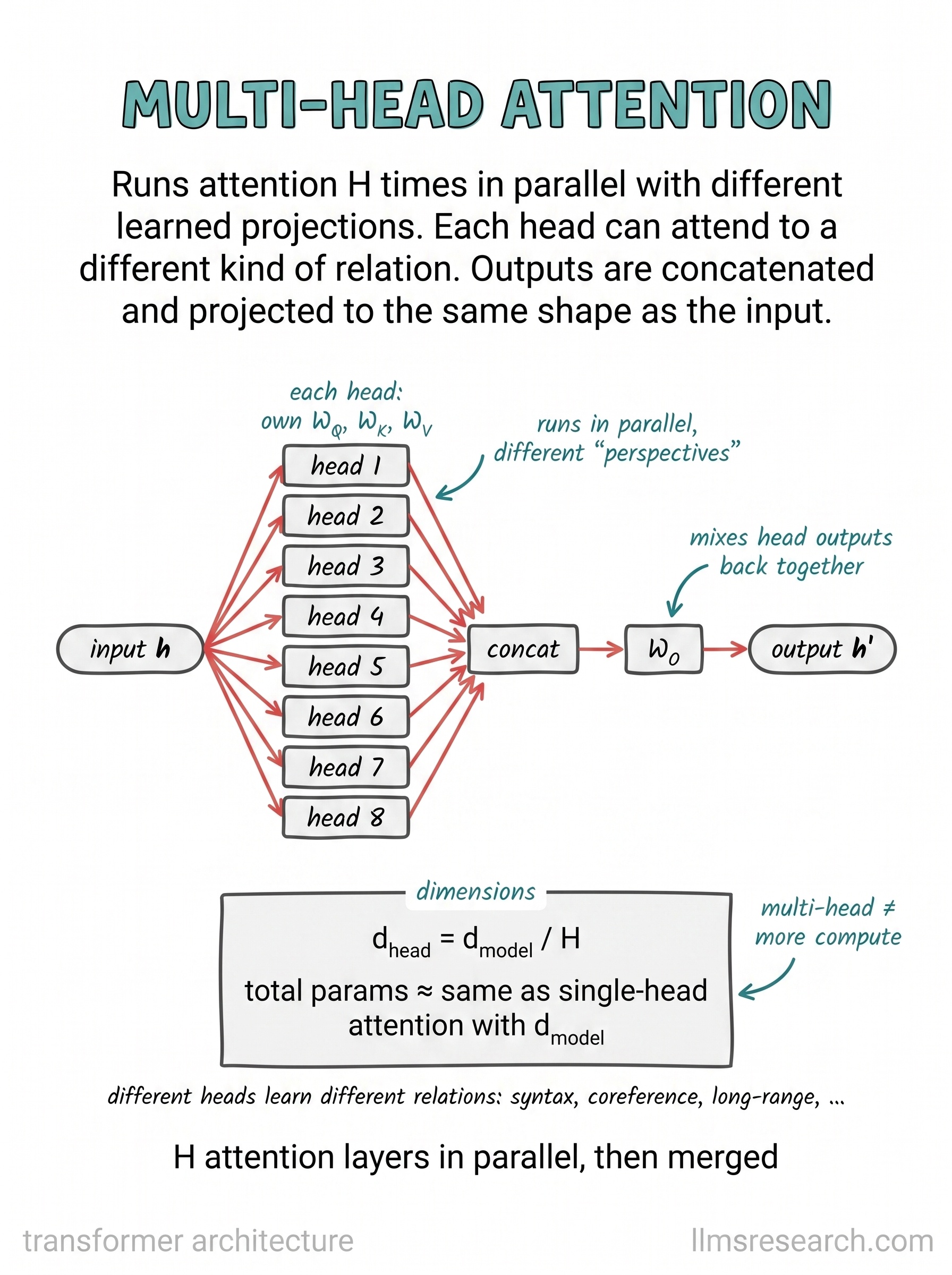
The card shows one input h fanning out to eight heads. Each head has its own learned W_Q, W_K, and W_V, so each computes the scaled dot-product attention from the previous cards on its own projection of the input. Because the projections differ, the heads end up specializing: one might follow local neighbors, another subject-verb agreement, another long-range links. The card calls these different perspectives on the same sequence. Their outputs are concatenated, then passed through a final matrix W_O that mixes them back into a single vector h prime with the same shape as the input.
The dimension box answers the obvious cost question. Each head works at a smaller width, d_head equals d_model divided by H, the number of heads. Eight heads at one eighth the width each add up to the full model width, so the total parameter count is about the same as a single head running at full d_model. The annotation states it plainly: multi-head is not more compute. You are splitting the same budget across several smaller attention computations rather than spending more.
That reframing is the useful part. Multiple heads buy representational variety at roughly fixed cost. Instead of one attention pattern trying to serve every kind of relation, the model gets H specialists and a final layer to combine them.
The next card zooms into a single one of those heads to see what it computes and what kinds of patterns individual heads have been found to learn.