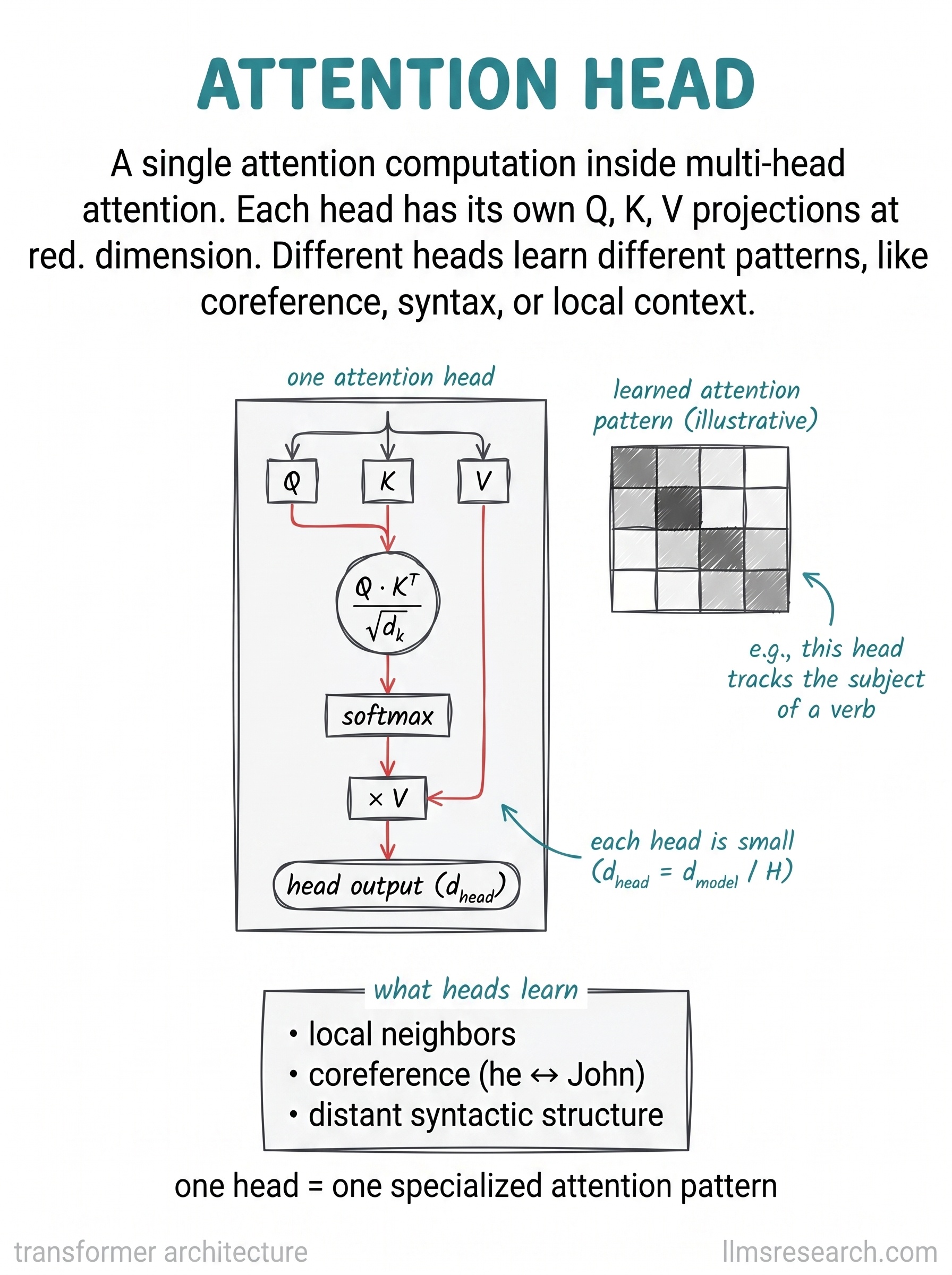
The multi-head card looked at the whole fan of heads. This card zooms into one of them and asks what a single head actually is and does.
Inside the box on the card is the pipeline from the scaled dot-product card, running at the head’s own reduced width. The head takes its Q, K, and V, computes Q times K transpose over the square root of d_k, applies softmax, multiplies by V, and emits a head output of size d_head. The note reminds us each head is small, d_head equals d_model divided by H, which is why running many of them costs about the same as one full-width attention.
The more interesting content is the attention pattern. The grid on the right is an illustrative map of which positions this head attends to, and the caption suggests this particular head tracks the subject of a verb. That is the point of the card: a head is not a generic averager, it tends to converge on a specific, interpretable job. The list gives common examples that have been observed, attending to local neighbors, resolving coreference such as linking “he” back to “John”, and picking up distant syntactic structure.
A word of care on this. These patterns are found by inspecting trained models after the fact, not assigned in advance. Nobody tells head three to do coreference; it settles into something like that because the objective rewards it and the other heads cover other relations. The interpretations are useful and often clean, but they are read off the model rather than built into it.
So the summary line fits: one head equals one specialized attention pattern. The chapter now leaves the core mechanism and turns to the variations that shape which positions a head is allowed to see, starting with masking.