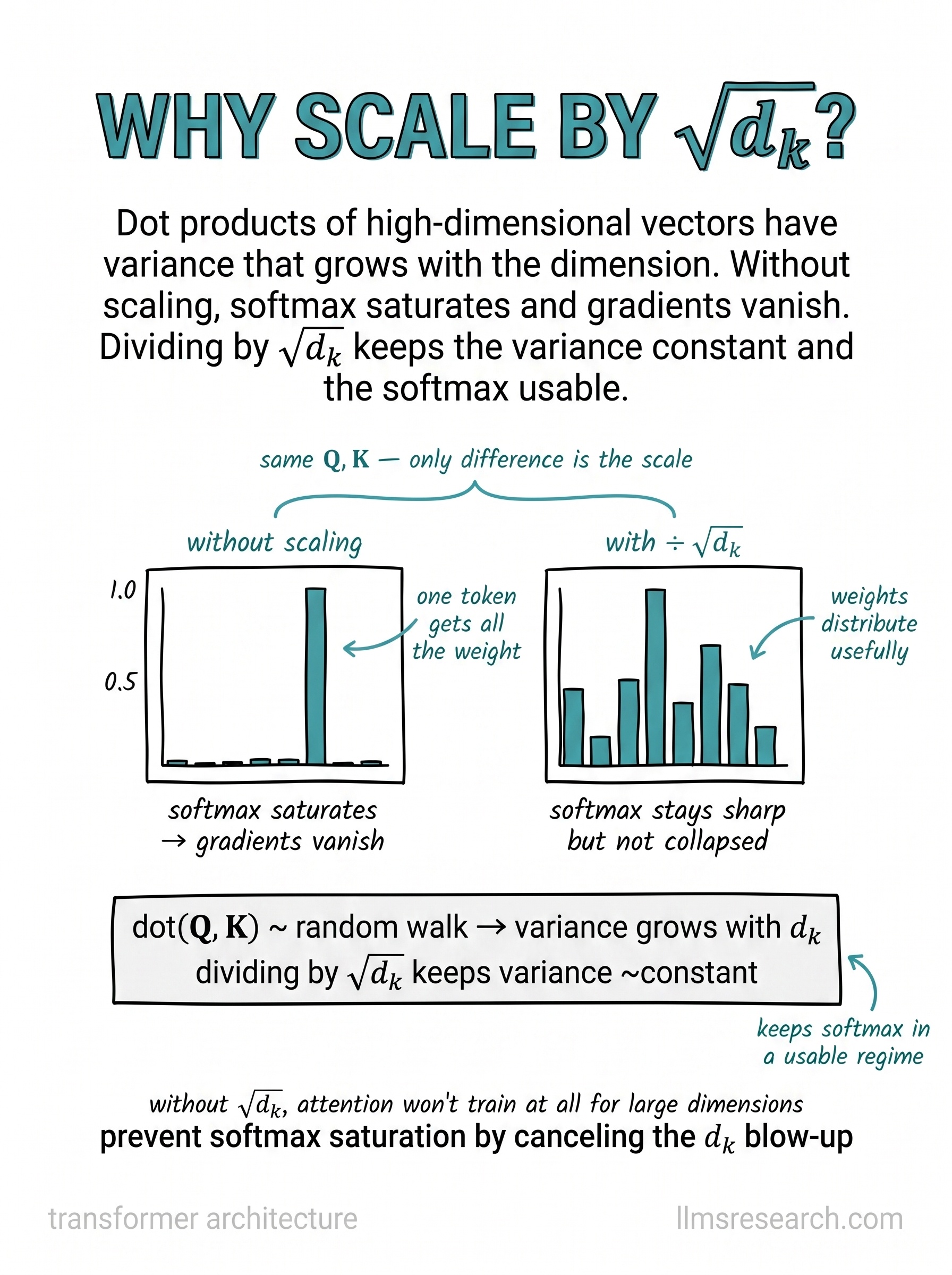
The scaling step in the attention formula looks like a detail, but without it attention does not train at all on large models. This card explains the reason.
The issue starts with the dot product. A dot product sums d_k products of paired numbers, and when the vectors are high-dimensional that sum behaves like a random walk: its variance grows with d_k. So the raw scores from Q times K transpose get larger in spread as the key dimension grows. Feed scores with a large spread into softmax and it saturates, meaning almost all the weight collapses onto a single token. The card shows this on the left: one bar near 1.0 and the rest flat near zero.
A saturated softmax is a training problem, not just an aesthetic one. When the output is nearly one-hot, its gradient is close to zero, so almost no learning signal flows back. The card labels this directly, softmax saturates and gradients vanish. Dividing by the square root of d_k cancels that growth, keeping the score variance roughly constant regardless of dimension. The right panel shows the result: the same queries and keys, but now the weights spread across several tokens, sharp enough to be selective yet not collapsed.
The reason the correction is specifically the square root, not the dimension itself, follows from the variance argument. Standard deviation scales with the square root of the variance, so dividing by the square root of d_k is what restores a constant scale. It is the right-sized correction, no more.
The takeaway on the card is blunt: without this factor, attention will not train for large dimensions. It is a small division with an outsized effect, which is why it earns its own card rather than a footnote in the formula.