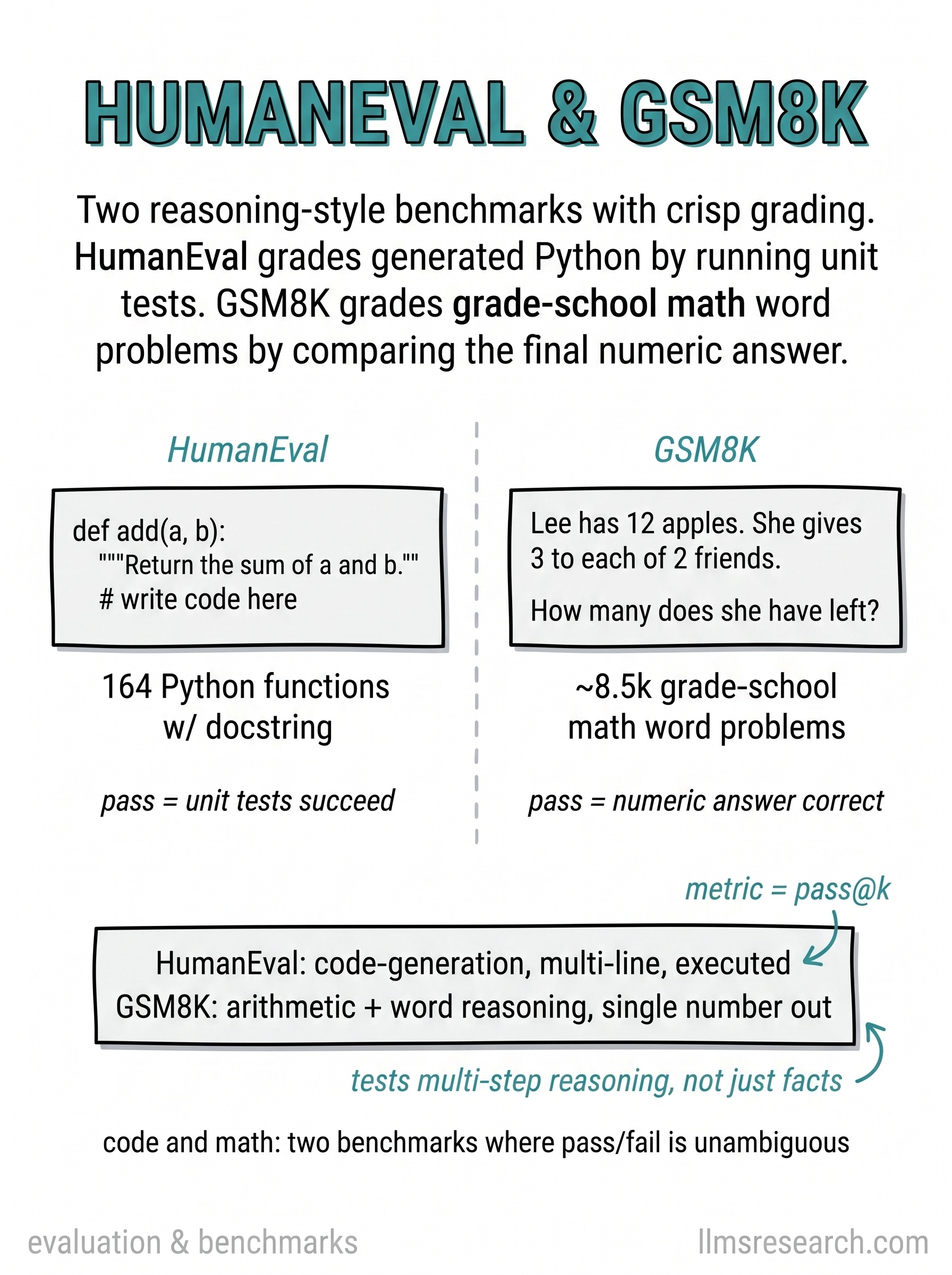
Where MMLU tests knowledge with a letter pick, HumanEval and GSM8K test whether the model can produce a correct result under executable grading. The card splits the diagram in two. On the left, HumanEval shows a Python function stub with a docstring and a blank body. The model fills in code, and pass means the unit tests succeed. On the right, GSM8K shows a short word problem about apples and friends. Pass means the final number matches the reference.
The comparison box states what each benchmark stresses. HumanEval is code generation: multi-line output that must compile and pass hidden tests. GSM8K is arithmetic plus word reasoning: the model must parse the story, compute steps, and emit one number. Both use pass@k style metrics, where k independent samples are drawn and success counts if any sample passes. That matters because a single lucky generation can succeed while the model is unreliable.
The grading mechanism removes ambiguity that plagues open-ended evaluation. HumanEval does not ask a human whether the code looks right; it runs tests. GSM8K does not grade the reasoning chain, only the extracted answer, though wrong reasoning with a right number still passes. That makes scores easy to compare but hides partial credit and reasoning quality.
Together these benchmarks became standard complements to MMLU because they probe execution and multi-step reasoning rather than static facts. The card’s caption captures the appeal: code and math are two domains where pass/fail is unambiguous. Use them when you need a hard check that the model can act, not only recall, but read them alongside contamination checks and harder reasoning suites for a fuller picture.