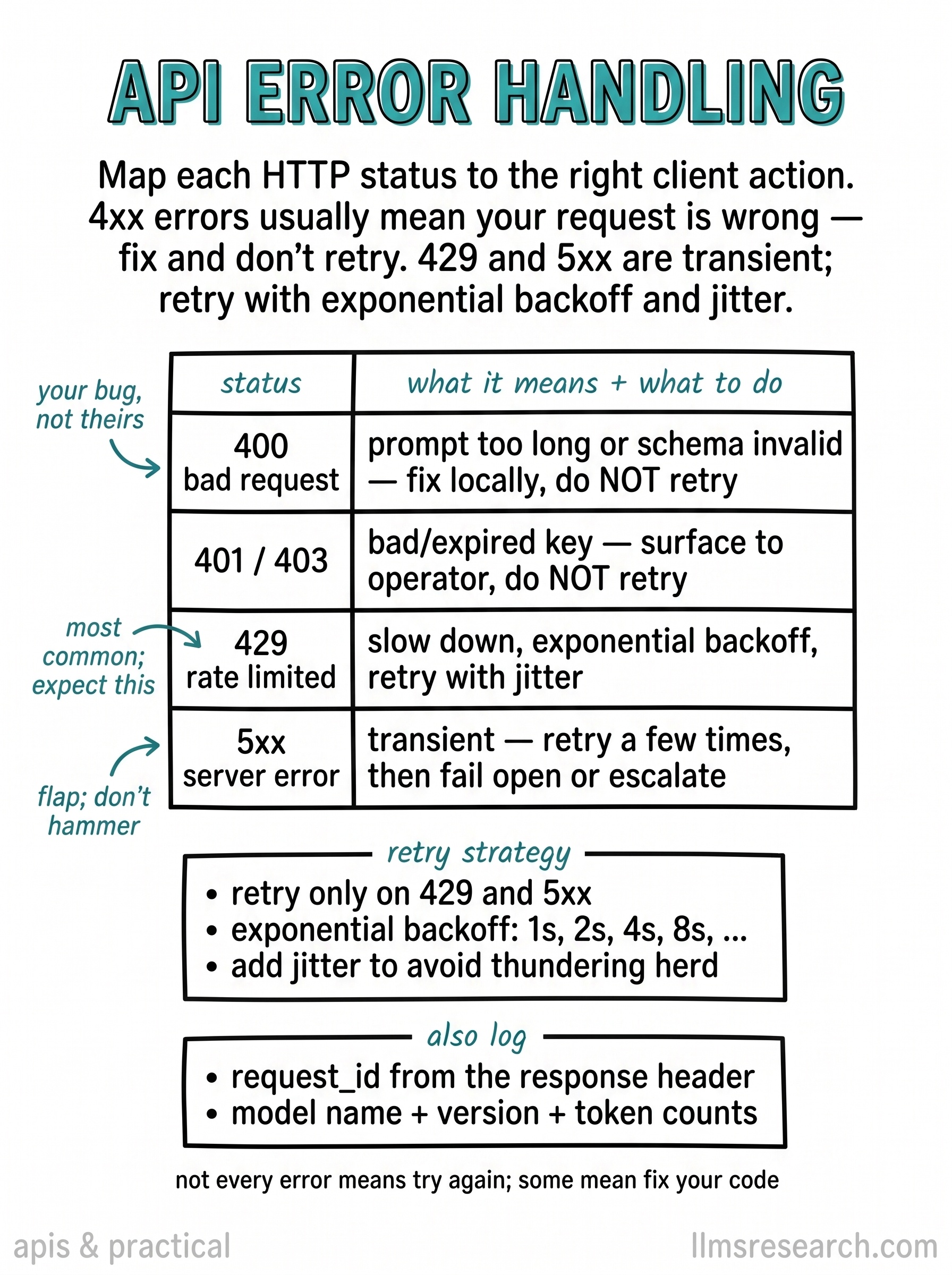
The card centers on a two-column table. The left column lists HTTP status codes you will see on LLM APIs. The right column pairs each code with what it means and what the client should do next. Below the table sit a retry-strategy box and a short logging checklist.
Not every error deserves another request. A 400 bad request usually means the payload is invalid: prompt too long, malformed JSON, or a schema the model cannot satisfy. That is a local bug. Fix the input and do not retry the same body. A 401 or 403 points to credentials: missing key, expired token, or insufficient permission. Surface that to an operator and stop automatic retries.
429 rate limited is the status most production clients see in normal operation. It means you exceeded a quota, not that the model failed. Slow down, honor Retry-After when present, and use exponential backoff with jitter so many clients do not recover in lockstep. Transient 5xx responses from the provider may merit a small number of retries, but repeated hammering on a flapping endpoint makes outages worse for everyone.
The retry box on the card keeps the policy narrow: retry only on 429 and 5xx, back off on a schedule such as one, two, four, and eight seconds, and add jitter to spread load. The logging box reminds you to capture request_id from response headers plus model name, version, and token counts. Those fields matter when you open a support ticket or debug a spike in failures.
The practical line at the bottom is the rule to internalize: not every error means try again, some mean fix your code. Classify by status before you loop. Agent-level failure handling covers tool mistakes and planning loops; this card is the HTTP layer underneath, where the first decision is whether the request was wrong, forbidden, throttled, or temporarily unavailable.