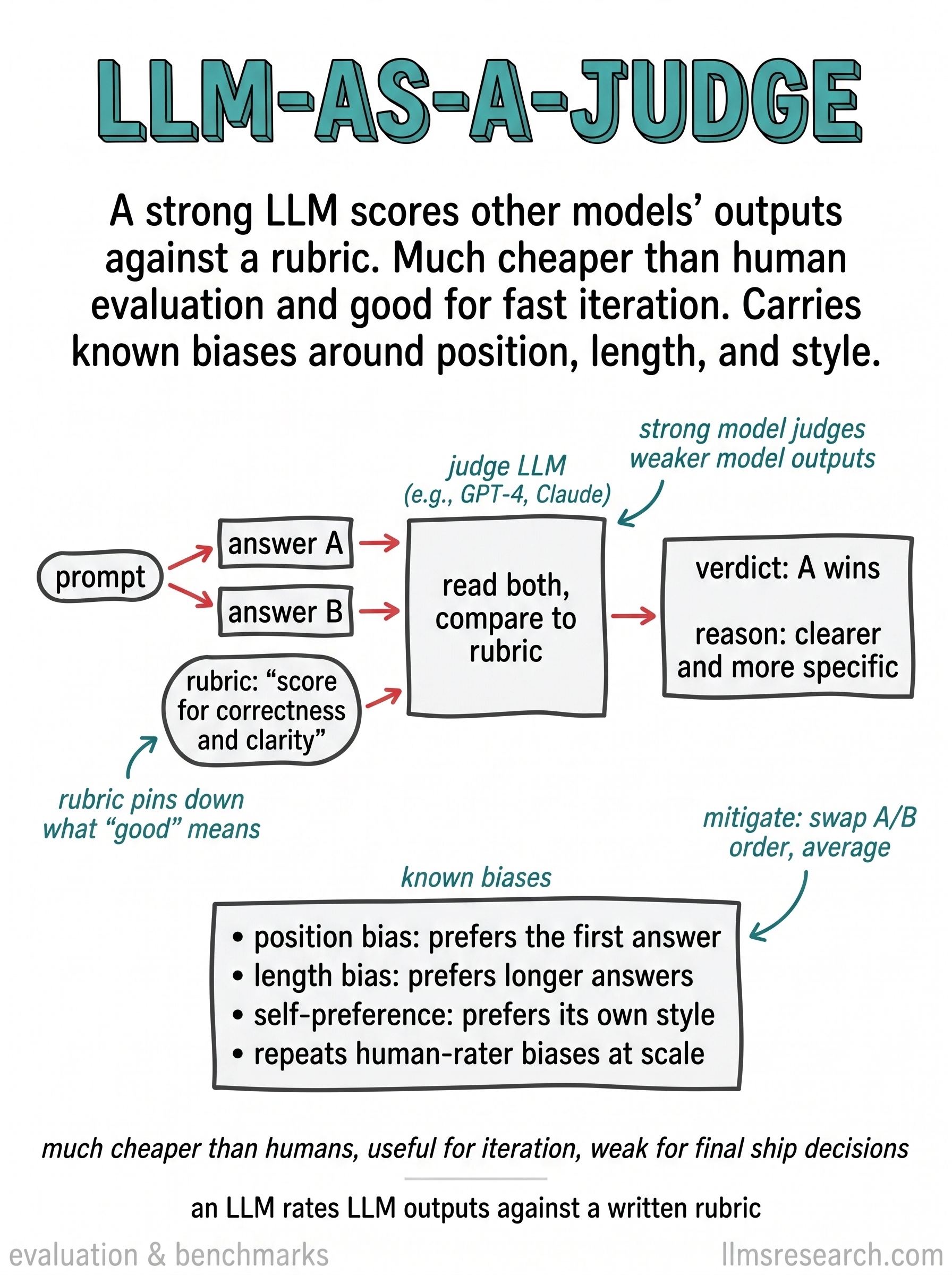
Human evaluation is reliable but costly, so teams substitute a strong model as rater. The card shows the pipeline. Two candidate answers branch from the same prompt. A rubric pill defines what good means, for example correctness and clarity. A judge LLM reads both answers against the rubric and returns a structured verdict with a winner and a short reason.
The rubric is what makes the setup more than vibes. Without it, the judge drifts toward its own preferences. With it, you get repeatable criteria you can tune across runs. A capable judge model is important: it needs enough reasoning depth to compare answers fairly. Weaker judges correlate poorly with humans and with each other, which limits how much trust you can place in the scores.
The known biases box is the price of automation. Position bias favors whichever answer appears first. Length bias favors longer answers even when shorter ones are clearer. Self-preference favors outputs that match the judge’s own style. LLM judges also inherit human rater biases at scale because they were trained on human text and often calibrated on human labels. Mitigations include swapping A and B order and averaging, using multiple judge prompts, and spot-checking against human ratings.
The practical division of labor is stated in the footer note. LLM-as-a-judge is much cheaper than humans and works well for iteration during model development. It is a weak substitute for final release decisions where stakes and edge cases matter. Use it to rank checkpoints quickly, log regressions, and filter candidates for human review, but do not treat a single judge score as proof of user-facing quality.