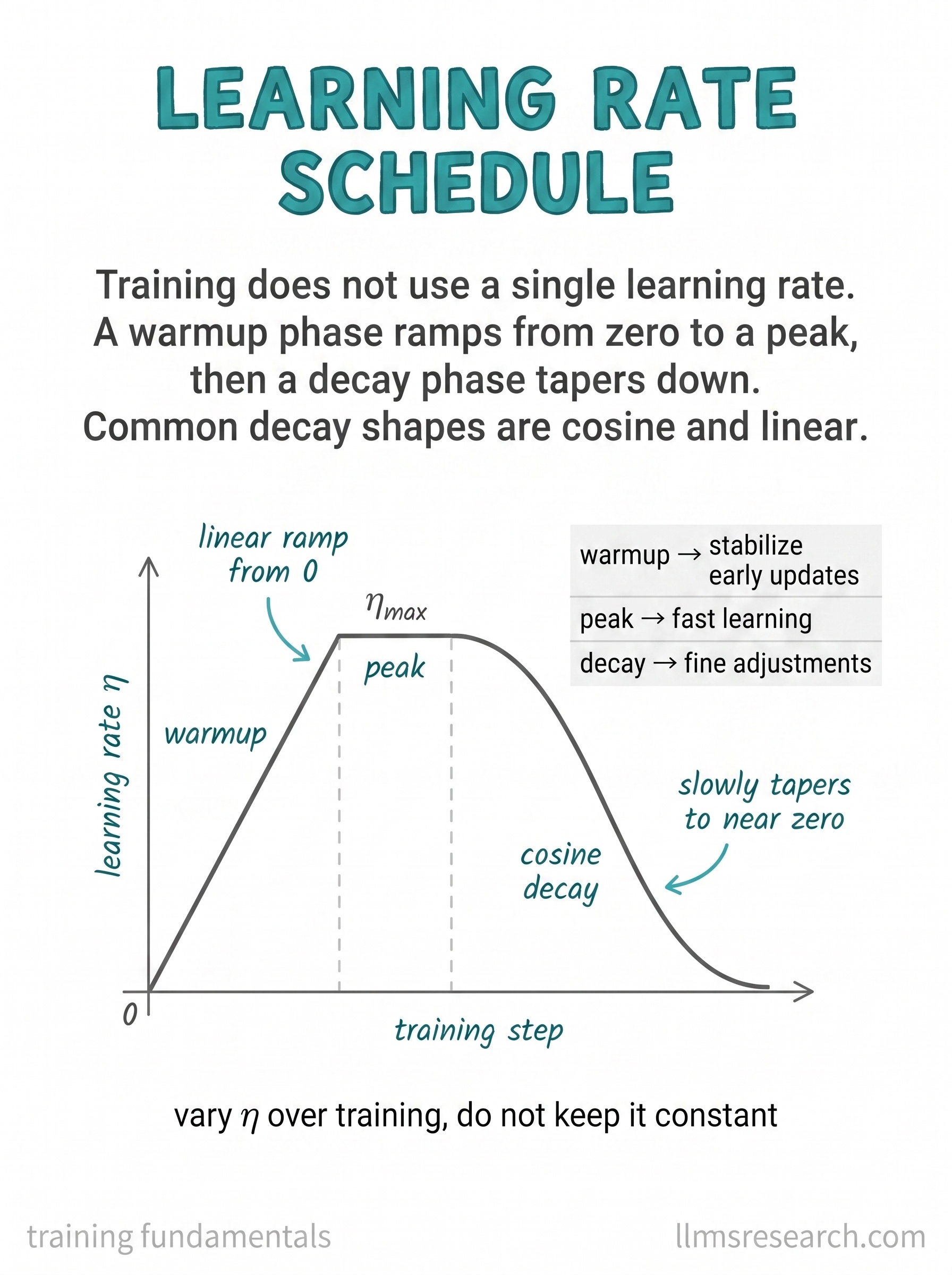
Adam adapts the step size per parameter, but there is still a global learning rate multiplying everything, and that number is not left fixed. The card plots how it moves over training: a ramp up, a short peak, then a long taper down. The horizontal axis is the training step, not time, and the shape is chosen deliberately rather than tuned away.
The warmup phase is the ramp from zero. Early in training the weights are random and the gradients are noisy, so a large step immediately can send the model somewhere it cannot recover from. Starting near zero and increasing linearly over the first fraction of steps lets the optimizer’s running averages, the m and v from the previous card, fill with sensible values before any large update lands. It is a stabilizer for the part of training that is most fragile.
Once warmup ends the rate sits at its peak, the fastest useful learning the setup can tolerate, and then the decay phase begins. The card draws a cosine curve, the common choice, tapering the rate slowly toward near zero by the end of training. The reasoning is that large steps are good for covering ground while the model is still far from a good solution, and small steps are better for settling into one without bouncing around it. Cosine decay spends most of its length at moderate rates and only collapses to very small steps near the finish.
A practical constraint hides in that curve. Cosine decay is scheduled against a planned total number of steps, so it assumes you know in advance how long training will run. If you stop early you never reach the low-rate refinement, and if you want to keep training past the planned end there is no clean way to extend the same curve. That rigidity is part of why some large runs prefer alternatives that decay toward a constant floor or hold a plateau, which are easier to resume. The warmup-then-decay pattern itself is nearly universal; the exact decay shape is where teams still differ.