Quantization algorithms produce smaller weights, but serving still needs a file format that packs those weights with enough metadata to load them correctly. GGUF is the de facto container for local LLM inference.
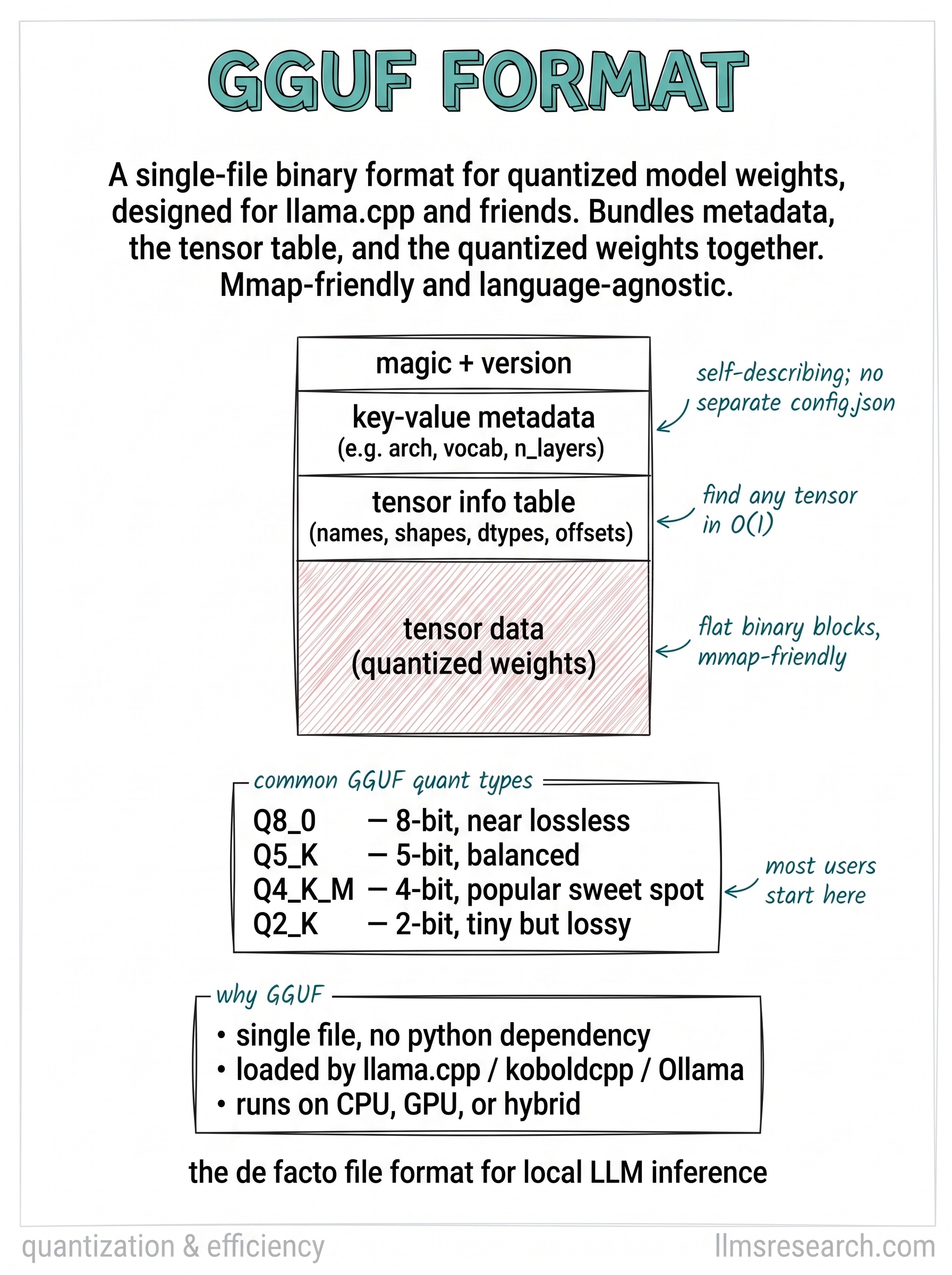
The card sketches a .gguf file as a vertical stack of sections. At the top sit a magic number and version header. Below that is key-value metadata covering architecture name, vocabulary, layer count, and similar fields, so the file is self-describing without a separate config.json. Next is a tensor info table listing each tensor’s name, shape, dtype, and byte offset, allowing any tensor to be located in constant time. The largest section at the bottom holds the quantized weight data itself, drawn as flat binary blocks that memory-mapping can load efficiently.
The middle panel lists common GGUF quantization types. Q8_0 is 8-bit and near lossless. Q5_K sits in the middle at 5-bit. Q4_K_M is a 4-bit option that many users start from. Q2_K pushes to 2-bit at a noticeable quality cost. The type name encodes both bit width and the specific packing scheme.
The lower panel notes why GGUF became standard for local inference: one file with no Python dependency, loaded by llama.cpp, KoboldCpp, Ollama, and similar tools, running on CPU, GPU, or a hybrid of both. If you download a quantized Llama-family model for offline use, it is likely in this format.