INT4 quantization saves memory, but naive rounding can hurt quality on large language models. GPTQ and AWQ are two widely used recipes for 4-bit weight-only post-training quantization that try to minimize that damage.
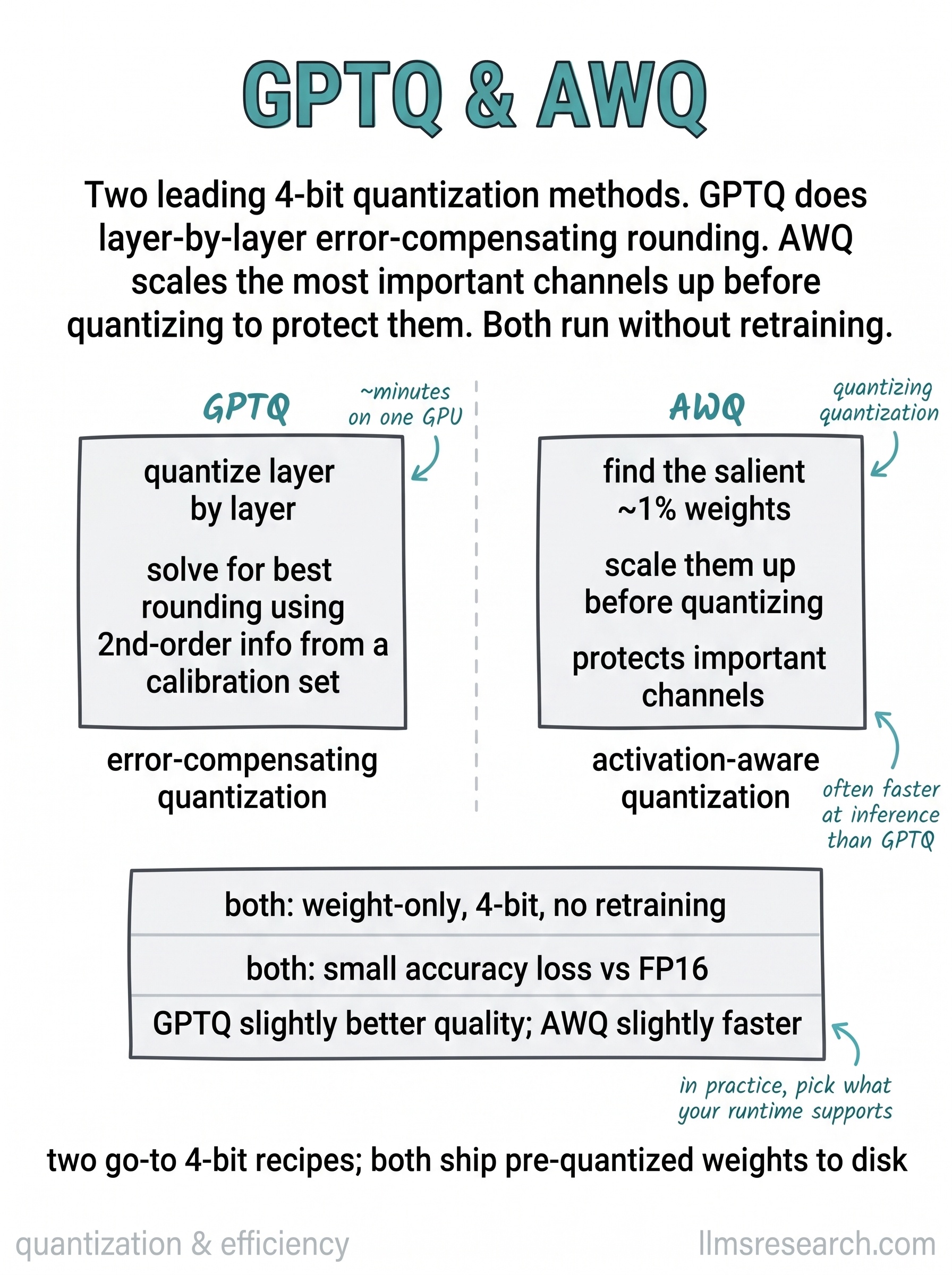
The card splits the diagram into two panels. GPTQ works layer by layer, quantizing one weight matrix at a time while using second-order information from a calibration set to choose rounding that compensates for error introduced in earlier layers. AWQ takes a different path: it finds the small fraction of weights whose activations matter most, scales those channels up before quantization, and thereby protects the channels that carry the most signal through the 4-bit bottleneck.
A shared summary row below both panels notes what they have in common. Both are weight-only, 4-bit, and require no retraining. Both accept a small accuracy loss relative to FP16. GPTQ tends to edge ahead on quality; AWQ often decodes faster at inference time because its scaling scheme maps well to common kernels.
In practice the choice is partly about runtime support. Different inference engines favor one format or the other, and many models ship as pre-quantized weight files ready to load from disk. The card’s bottom line is that these are the two common 4-bit recipes when you need a compressed model without running a full retraining job.