Quantization and pruning shrink an existing model in place. Knowledge distillation takes a different path: train a separate, smaller student model to reproduce the behavior of a larger teacher.
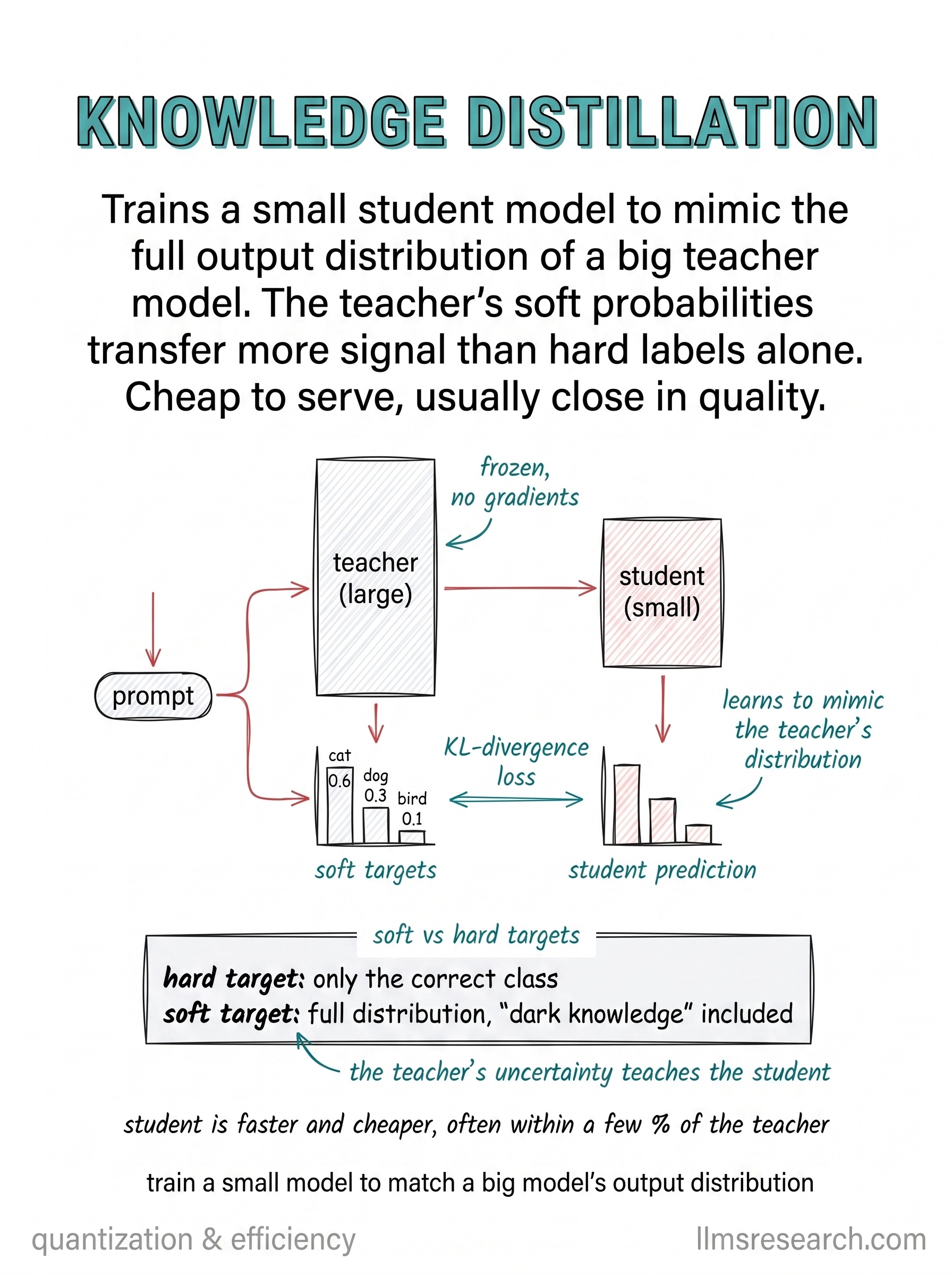
The card shows both models receiving the same prompt. The teacher is a large, frozen model that produces a probability distribution over classes or tokens, such as cat 0.6, dog 0.3, bird 0.1. The student is a smaller, trainable model that produces its own distribution over the same labels. A KL-divergence loss measures how far the student’s distribution sits from the teacher’s, and training pushes them together. The teacher receives no gradient updates; only the student learns.
The middle panel contrasts soft and hard targets. A hard target gives only the correct class. A soft target gives the full distribution, including the relative weights the teacher placed on wrong answers. That relative structure is sometimes called dark knowledge: the teacher’s uncertainty about near-miss labels carries information a single correct label omits.
The result is a student that is faster and cheaper to serve, often within a few percentage points of the teacher on benchmark tasks. The card’s bottom line is direct: train a small model to match a big model’s output distribution, not just its top prediction.