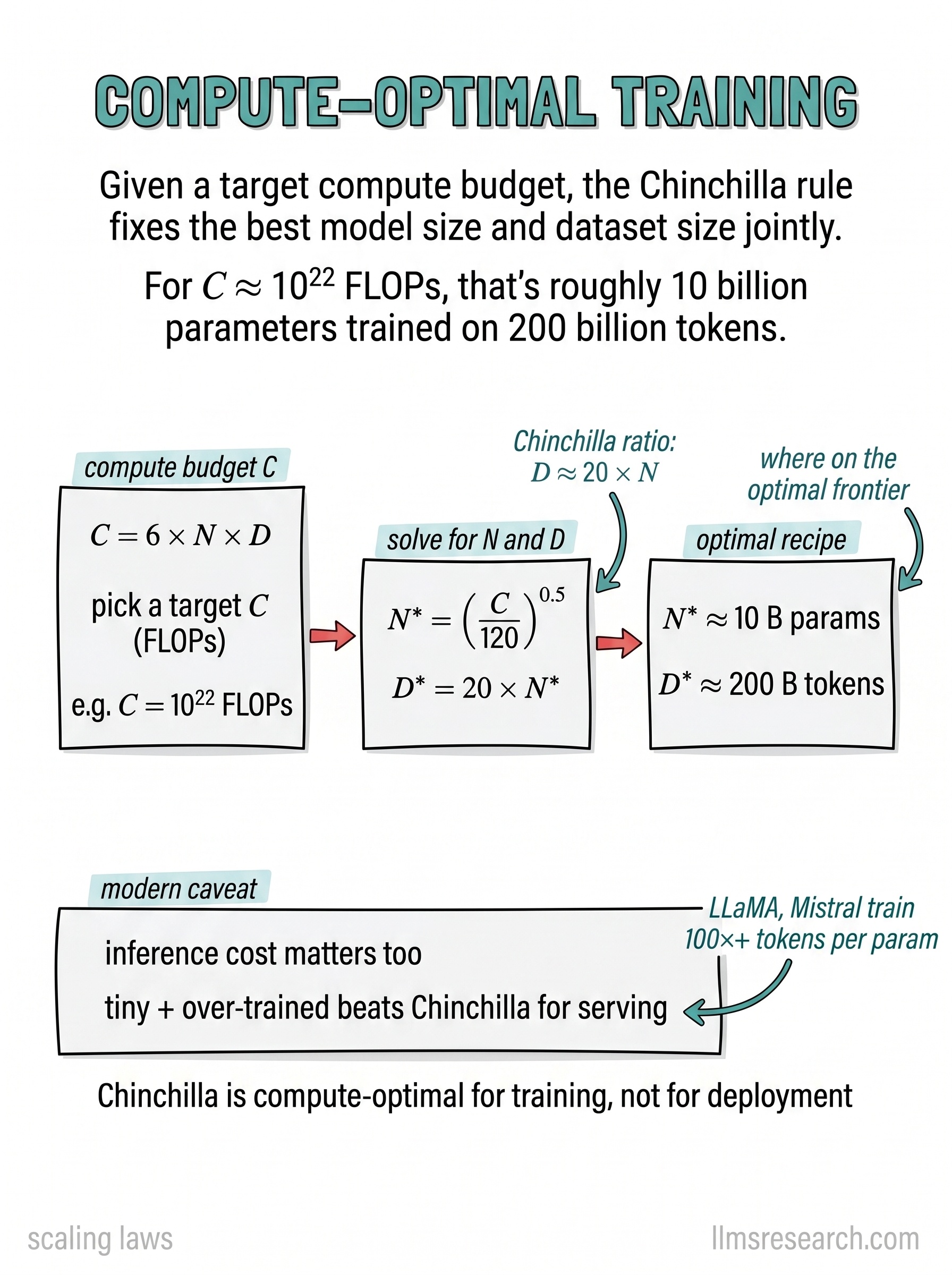
The previous card stated the Chinchilla ratio. This one runs it as a procedure. The question it answers is the one a team actually faces: I have decided how much compute I can spend, what size model should I build and how many tokens should I train it on. The card lays the answer out as three boxes, budget to solved sizes to a concrete recipe.
The first box fixes the budget. Compute is C equals 6 times N times D, and you pick a target C in FLOPs, say 10 to the 22. The second box solves for the two unknowns by combining that constraint with the Chinchilla ratio D equals about 20 times N. Substituting one into the other leaves a single equation, and the card writes its solution as the optimal parameter count N-star equal to the square root of C over 120, with the optimal token count D-star then being 20 times N-star. The constant 120 is just 6 times 20, the FLOPs factor times the ratio, folded together. The third box reads off the result: for 10 to the 22 FLOPs, that is roughly 10 billion parameters trained on 200 billion tokens.
The value of the recipe is that it removes guesswork from the largest decision in a training run. Rather than picking a model size by intuition and hoping the data matches, you start from what you can afford and let the rule place you on the frontier. Both sizes fall out of one budget number.
The modern caveat box is the part that keeps this honest, and it echoes the warning from the last card. Chinchilla minimizes training compute, but a deployed model is run many times, and inference cost scales with model size, not with how long it was trained. A smaller model trained well past the Chinchilla point, overtrained in the strict sense, can match a larger model’s quality while costing far less to serve. That is why production models like the LLaMA and Mistral families train on well over a hundred tokens per parameter rather than twenty. The caption draws the line: Chinchilla is compute-optimal for training, not for deployment. Which side of the frontier you want depends on whether the dominant cost is the one training run or the millions of queries after it.