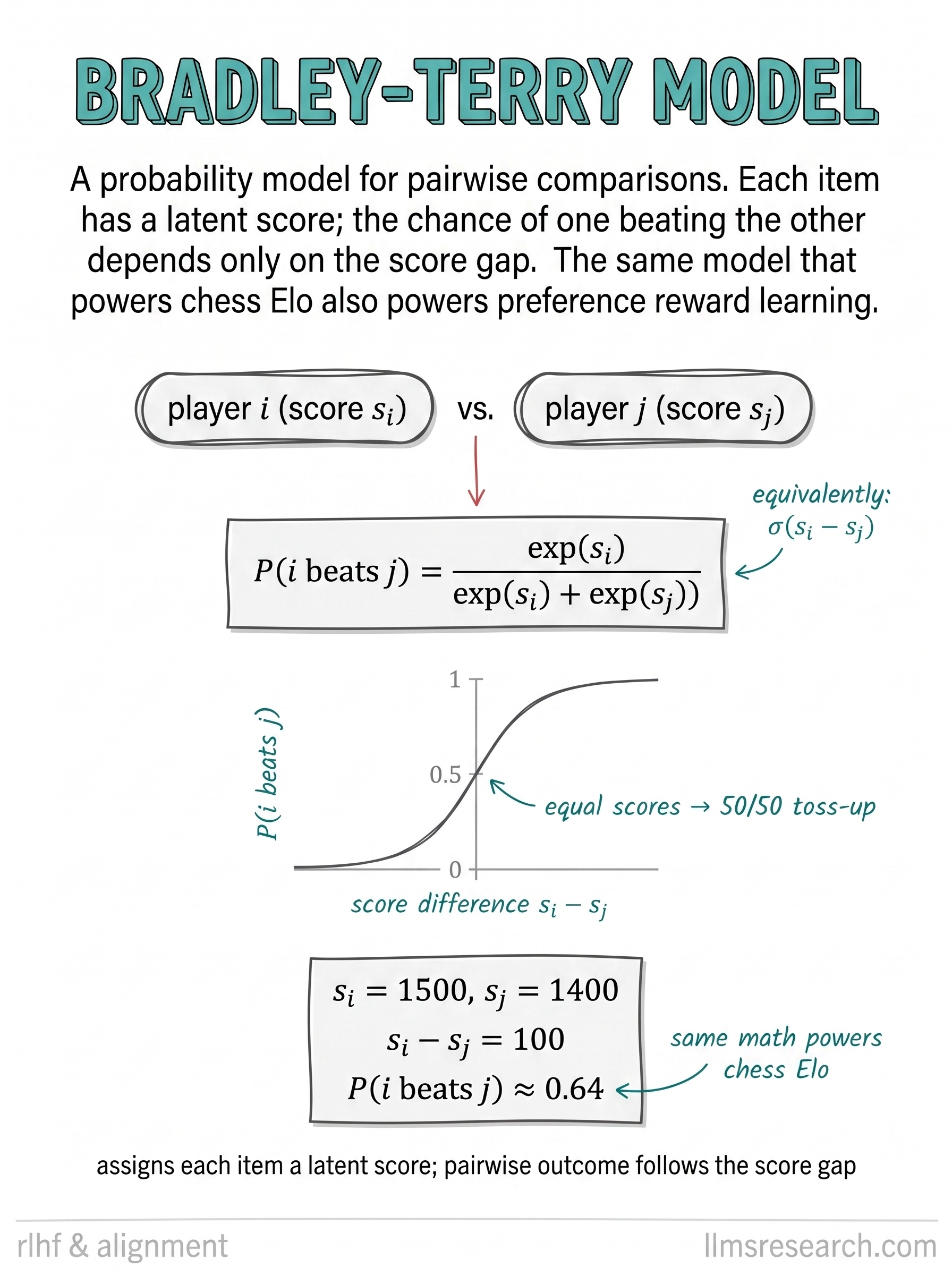
The Bradley-Terry model is the bridge between binary comparisons and a continuous score, and it answers a question the preference data leaves open: if all a human ever tells us is that A beat B, where do the numbers a reward model outputs come from? The answer is to assume each item has a hidden score and that the outcome of any matchup is probabilistic, driven entirely by the difference between the two scores. The card gives the formula: the probability that item i beats item j is the exponential of i’s score over the sum of the exponentials of both scores.
That expression simplifies to something already familiar from earlier in the course. The card notes the equivalent form, a sigmoid of the score difference. Dividing the exponential of i’s score by the sum of both exponentials is algebraically the same as applying the logistic sigmoid to the quantity s_i minus s_j, so the whole model reduces to running the score gap through the sigmoid curve drawn below the formula. When the two scores are equal the difference is zero, the sigmoid returns one half, and the matchup is a coin flip. As the gap grows the curve saturates toward one, and a large enough lead makes the outcome nearly certain.
The chess example grounds the abstraction. Two players rated 1500 and 1400 differ by 100 points, and running that gap through the model gives the stronger player roughly a 64 percent chance to win. This is not a coincidence of notation. Elo ratings are built on the same pairwise-comparison logic, which is why the card says the math that powers chess rankings also powers preference reward learning. In both cases we never observe a score directly; we observe who beat whom and infer scores that make the observed wins likely.
For RLHF the connection closes the loop. The reward model’s loss on the previous card was the negative log sigmoid of the reward gap between chosen and rejected, which is exactly the Bradley-Terry likelihood of the observed preference. Training the reward model is therefore fitting latent scores to a pile of pairwise outcomes, the same estimation problem as assigning Elo ratings from game results. The scalar reward a response receives is its fitted latent score, meaningful only in relation to other responses rather than on any absolute scale.