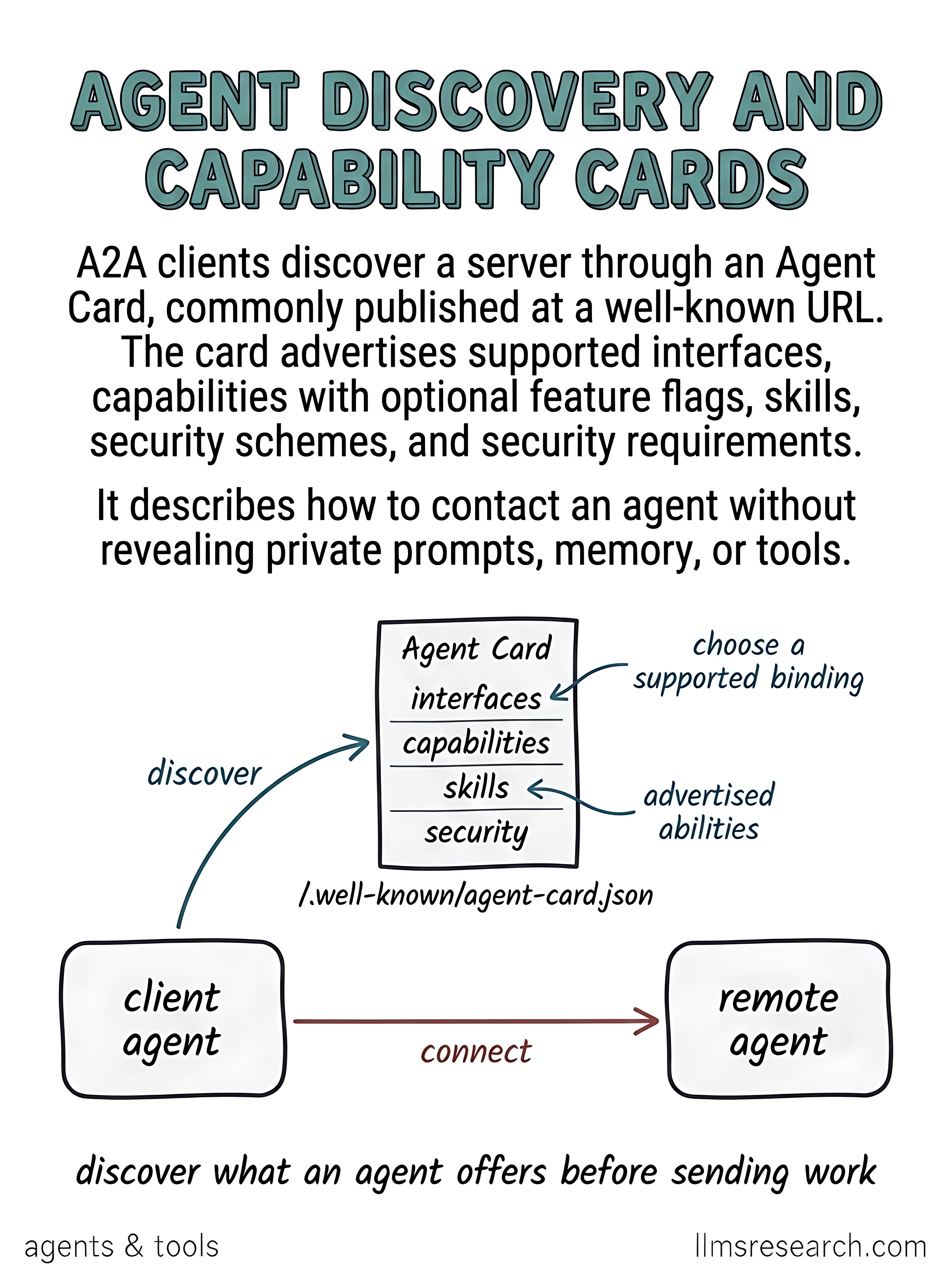
The card draws a left-to-right discovery flow. A client agent on the left follows a teal discover arrow to a central Agent Card document. Below the card is the path /.well-known/agent-card.json in monospace text. Inside the card are rows for interfaces, capabilities, skills, and security. A red connect arrow runs from the client to a remote agent on the right. Callouts note choosing a supported binding at interfaces and advertised abilities at skills. The bottom line reads discover what an agent offers before sending work.
In the current A2A model, the Agent Card is the public face of a remote agent. Field names in the spec include supportedInterfaces, capabilities with optional feature flags, skills, securitySchemes, and securityRequirements. The card tells a client which bindings are available, which optional features such as streaming or push the server advertises, which named skills it exposes, and which authentication schemes apply. It describes how to contact the agent, not the contents of its system prompt, private tools, or internal memory.
This path is specific to remote agent discovery over A2A. MCP server discovery inside a host is a different mechanism and a different card. Discovery also does not replace authorization at request time. Reading a card proves what the server claims to support, not that every claim is safe or truthful. Clients still validate payloads and enforce policy after connect.
Use Agent Cards when agents may live in other organizations or processes and the client must negotiate interfaces before sending tasks. Fetch the well-known document, pick a supported interface, satisfy advertised security requirements, then open work using the protocol types defined elsewhere. Treat the card as a contract surface, not as executable logic.