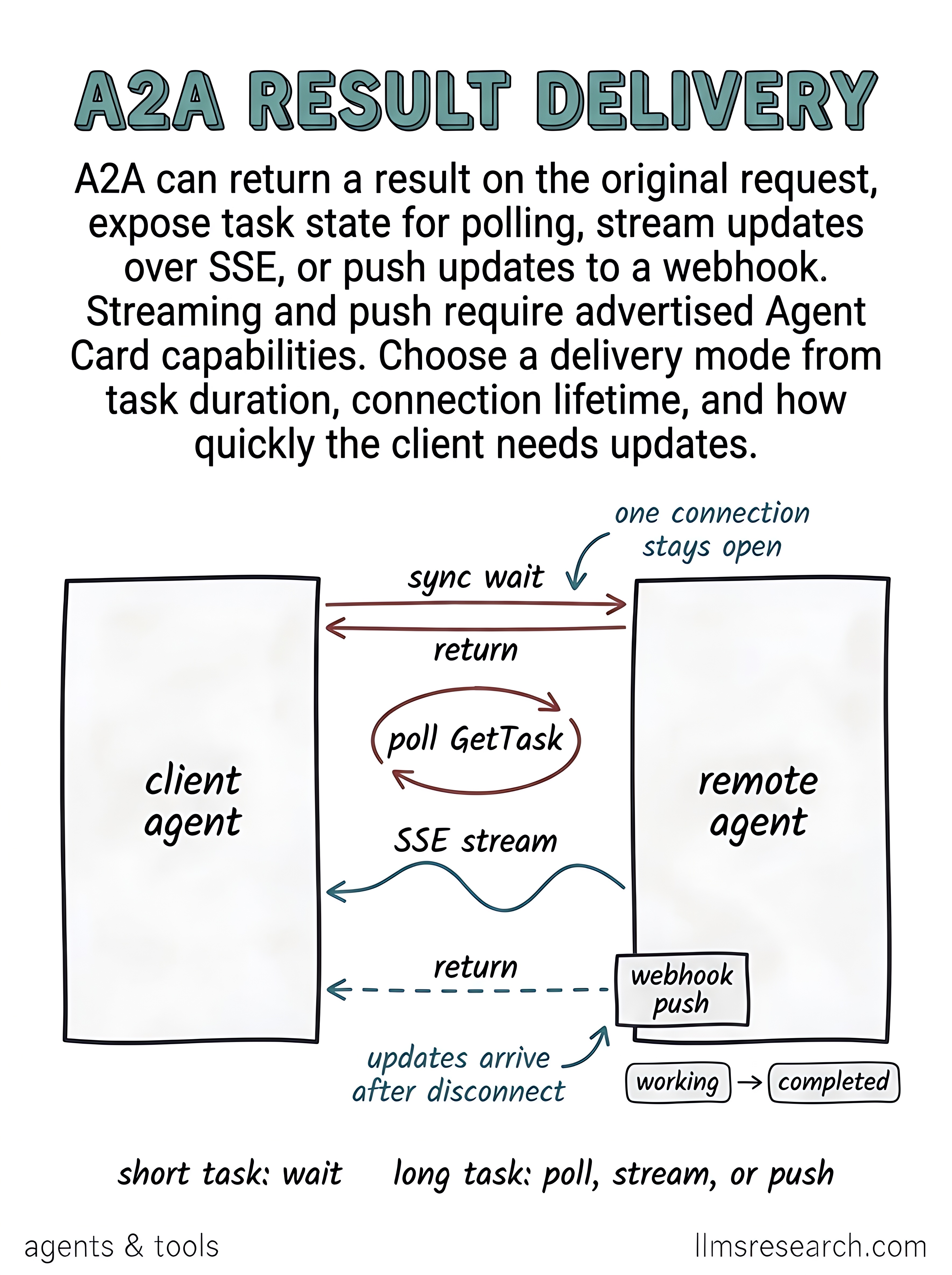
The card places a client agent on the left and a remote agent on the right with four separate paths between them. From top to bottom: a request-and-return arrow labeled sync wait, a circular arrow labeled poll GetTask, a wavy teal line labeled SSE stream, and a dashed teal arrow into a webhook push endpoint. Under the remote agent are status pills working then completed. Callouts mark sync wait as one connection stays open and webhook push as updates arrive after disconnect. A choice line at the bottom reads short task wait, long task poll stream or push.
A2A supports more than one way to learn that work finished or progressed. Synchronous wait keeps the original connection open until the server reaches a terminal or interrupted state. An interrupted response may ask for input or authentication instead of returning a final result. Polling lets the client disconnect and call GetTask later to read state and artifacts, which suits long runs and mobile clients. Server-sent events stream incremental updates on a long-lived HTTP response, which helps UIs that want partial progress without repeated polls. Webhook push delivers updates to a client-provided endpoint after disconnect, which fits backend orchestrators that cannot hold a browser connection open.
Streaming and push require the server to advertise matching capabilities on its Agent Card. Not every deployment implements every mode. Webhook delivery is not the same mechanism as SSE even though both can carry task updates. This card focuses on result delivery for A2A work, not the high-level comparison of direct, async, and event interaction styles covered elsewhere.
Pick sync wait when tasks finish quickly and the client can block. Pick polling when connections are fragile or work lasts minutes to hours. Pick SSE when the client is online and needs frequent progress events. Pick webhooks when a server orchestrator should react after the caller has moved on. Match mode to duration, connection lifetime, and latency needs rather than enabling every option by default.