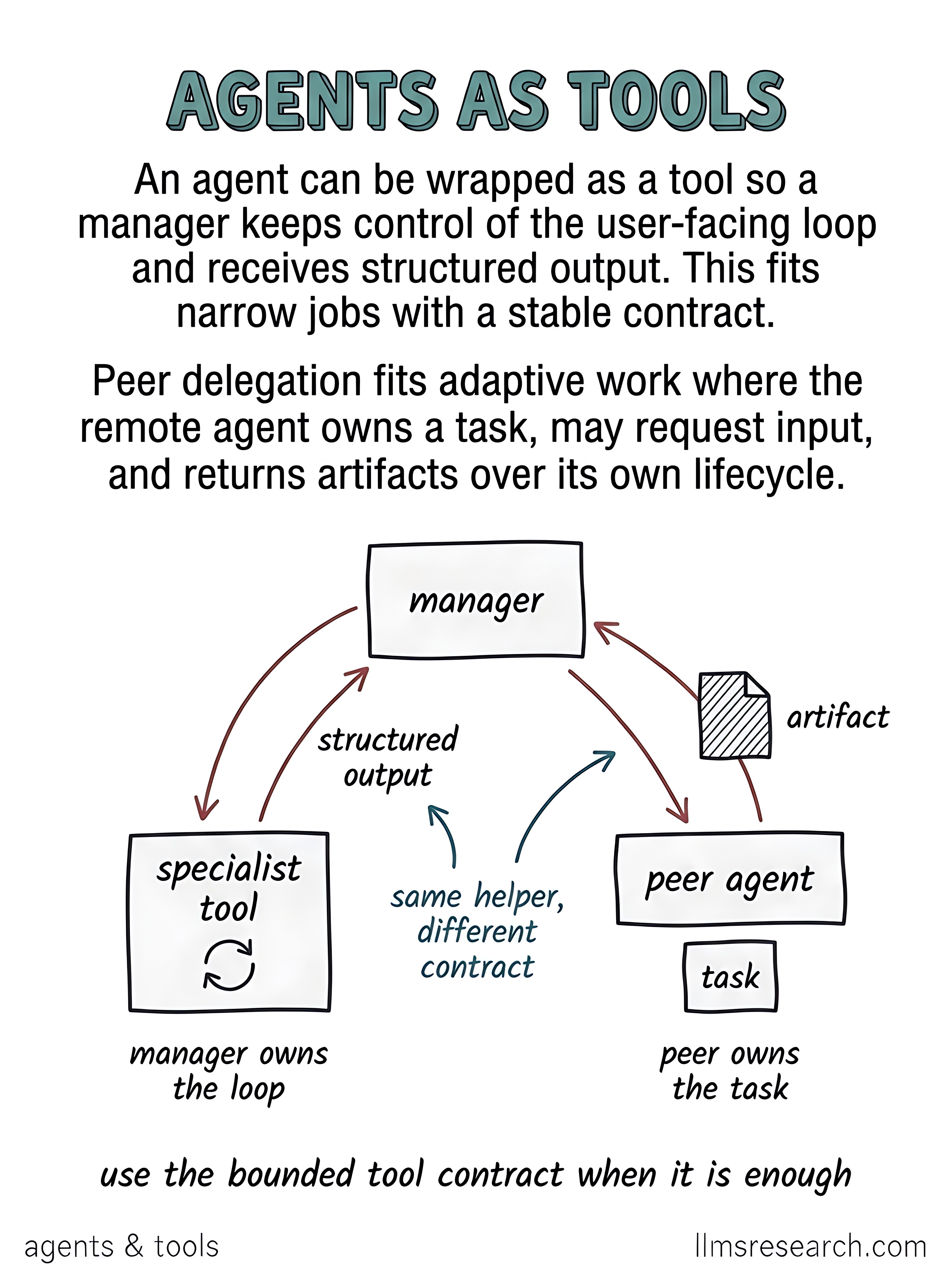
The card shows a manager at the top with two paths below. On the left, a red arrow leads to a function-shaped specialist tool box with a tiny loop symbol inside. A return arrow carries structured output, and a note below reads manager owns the loop. On the right, a red arrow leads to a peer agent with a task card under it. The return arrow carries a hatched artifact document, and a note below reads peer owns the task. Between the paths is a teal note: same helper, different contract. The bottom line reads use the bounded tool contract when it is enough.
Wrapping an agent as a tool means the manager still runs the outer loop that faces the user. It calls the specialist with a fixed input schema, waits for a structured result, and decides what to do next. The inner agent may run its own short loop, but the caller treats it like any other function: one request, one response shape, no external task handle. Peer delegation sends work to another agent that owns an A2A-style task. That peer may ask for input, pause for auth, stream progress, and return artifacts when done. The manager tracks outcomes but does not necessarily control every turn inside the remote work.
This is an orchestration choice, not a new tool-calling syntax. Ordinary function schemas and validation still apply to the bounded path. The tradeoff is control versus flexibility. A tool wrapper is easier to reason about, test, and cap for cost because the contract is narrow. Peer delegation fits adaptive jobs where the specialist must negotiate clarifications or produce large deliverables over time, at the price of more moving parts.
Use the tool wrapper when inputs and outputs fit a stable schema and the manager should retain conversational control. Use peer delegation when the remote agent must own a long-running task lifecycle. Many systems combine both patterns in one workflow.