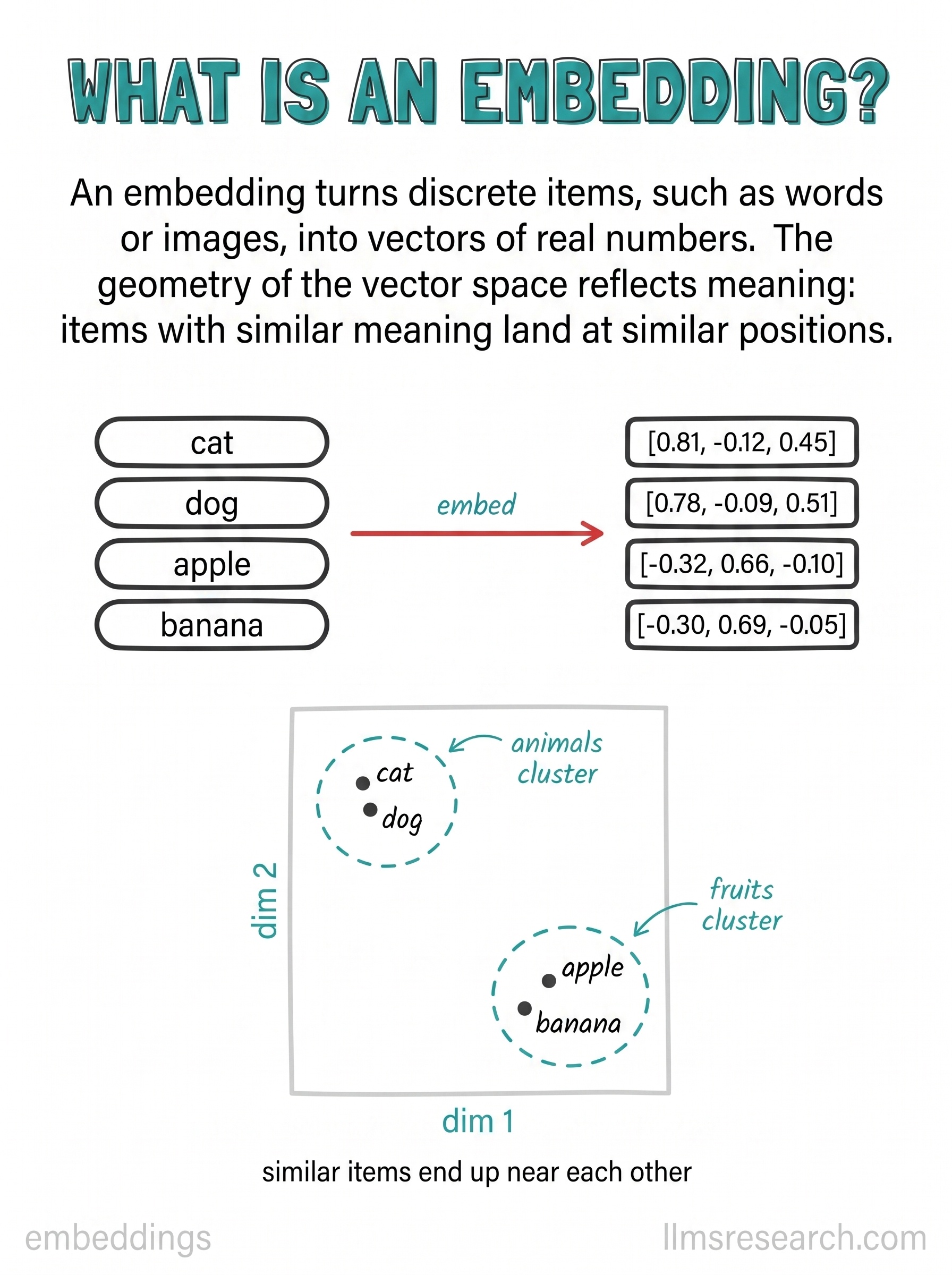
The last chapter ended with a lookup table that hands each token a vector. This card is about what those vectors are for. An embedding is the general idea: represent a discrete thing, a word, an image, a product, as a list of real numbers, so that a model can compute with meaning instead of with arbitrary labels.
The card embeds four words. “cat”, “dog”, “apple”, and “banana” each map to a short vector like [0.81, -0.12, 0.45]. On their own those numbers say nothing. The point is not any single coordinate but where the vectors sit relative to each other. The plot underneath shows the payoff: cat and dog fall close together in one region, apple and banana in another. Similar meanings end up as nearby points.
That property is the whole reason embeddings are useful. A raw token ID has no notion of closeness. Token 500 is not more like token 501 than token 9000. Once items become vectors, distance and direction start to mean something, and a model can generalize. If it learns something about cat, the nearby position of dog lets some of that carry over.
Where do the numbers come from? Nobody writes them by hand. They are learned, the same way the embedding matrix rows were, by adjusting the vectors so the model predicts text well. Meaning is not defined in advance and then stored; it emerges from usage. Words that appear in similar contexts get nudged toward similar positions, so the geometry ends up reflecting how the words are actually used.
Two dimensions on the card are only for drawing. Real embeddings have hundreds or thousands, which is what makes them able to capture many kinds of similarity at once. The next two cards look harder at that space: the directions inside it, and how to measure whether two vectors are close.