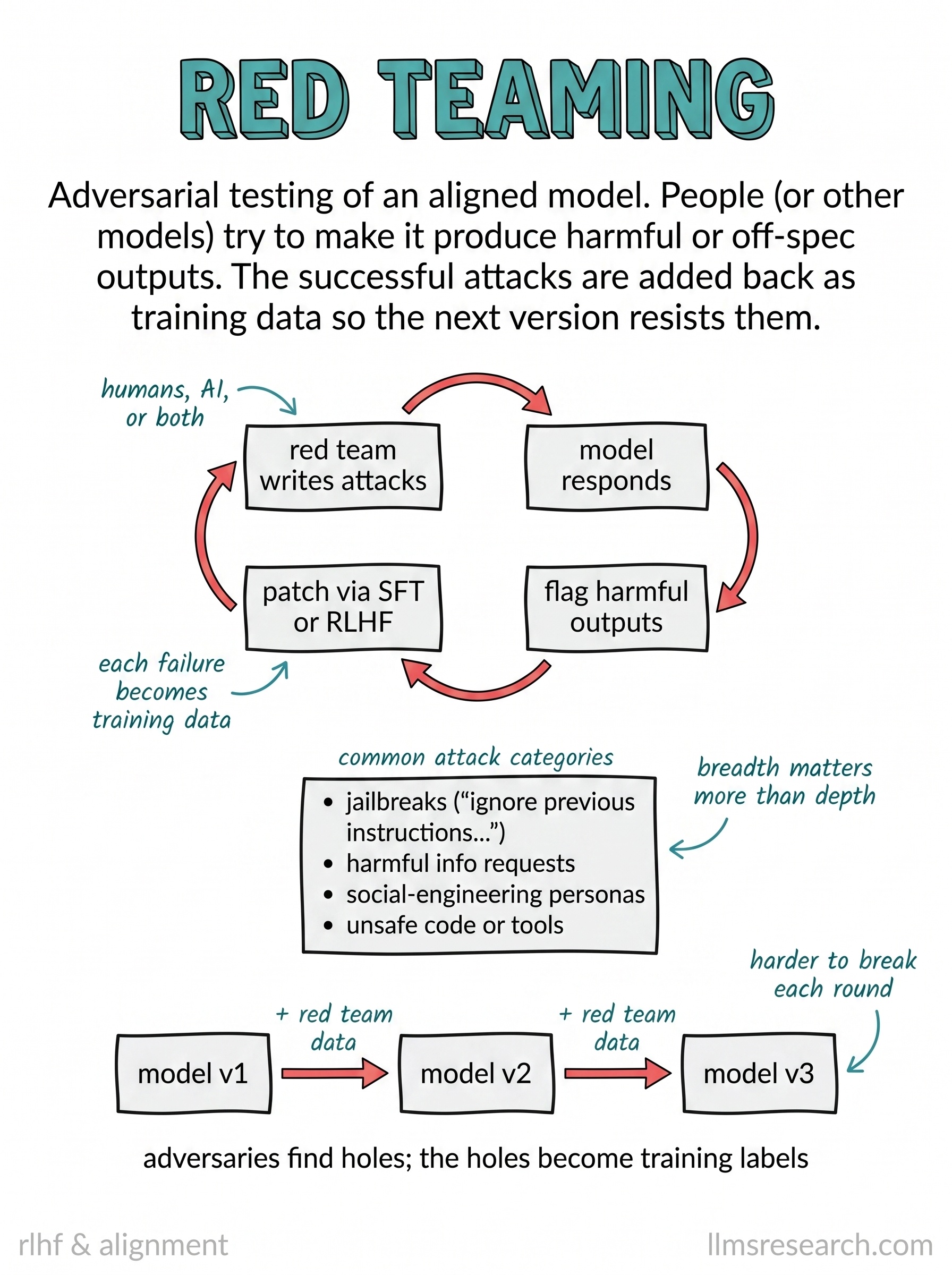
Red teaming is how an aligned model gets stress-tested before and after release. The card draws it as a cycle. A red team, which can be people, other models, or both, writes attacks. The model responds. Harmful outputs get flagged. Those failures are patched via SFT or RLHF, and the loop repeats with the hardened model. The premise is that alignment training never produces a model that refuses everything it should; there are always gaps, and the only way to find them is to have someone actively look.
The loop’s value is that it converts adversarial effort into training signal. Each successful attack is not just a bug report, it is a labeled example of behavior the model should not have produced, and the card’s note that each failure becomes training data is the mechanism. Feeding those examples back through the same SFT and RLHF machinery that aligned the model in the first place teaches it to refuse the newly discovered case. The bottom row shows this playing out across versions: model v1 plus red team data yields v2, v2 plus more red team data yields v3, and the annotation notes it gets harder to break each round.
The list of common attack categories frames how red teamers actually probe. Jailbreaks that try to override instructions, direct requests for harmful information, social-engineering personas that coax the model into a role, and attempts to get it to produce unsafe code or tool calls. The card’s remark that breadth matters more than depth is the strategic point. Finding one clever exploit is less useful than mapping the many different shapes an attack can take, because the model is patched against categories of failure, and a category left untested is a category left undefended.
The honest limit is that this is an arms race, not a finish line. Patching the known attacks makes the next version harder to break, but it does not prove the model is safe, only that it resists the attacks tried so far. New jailbreak families keep appearing, which is why red teaming is a standing process rather than a one-time audit, and why it pairs with the layered defenses on the next card rather than replacing them.