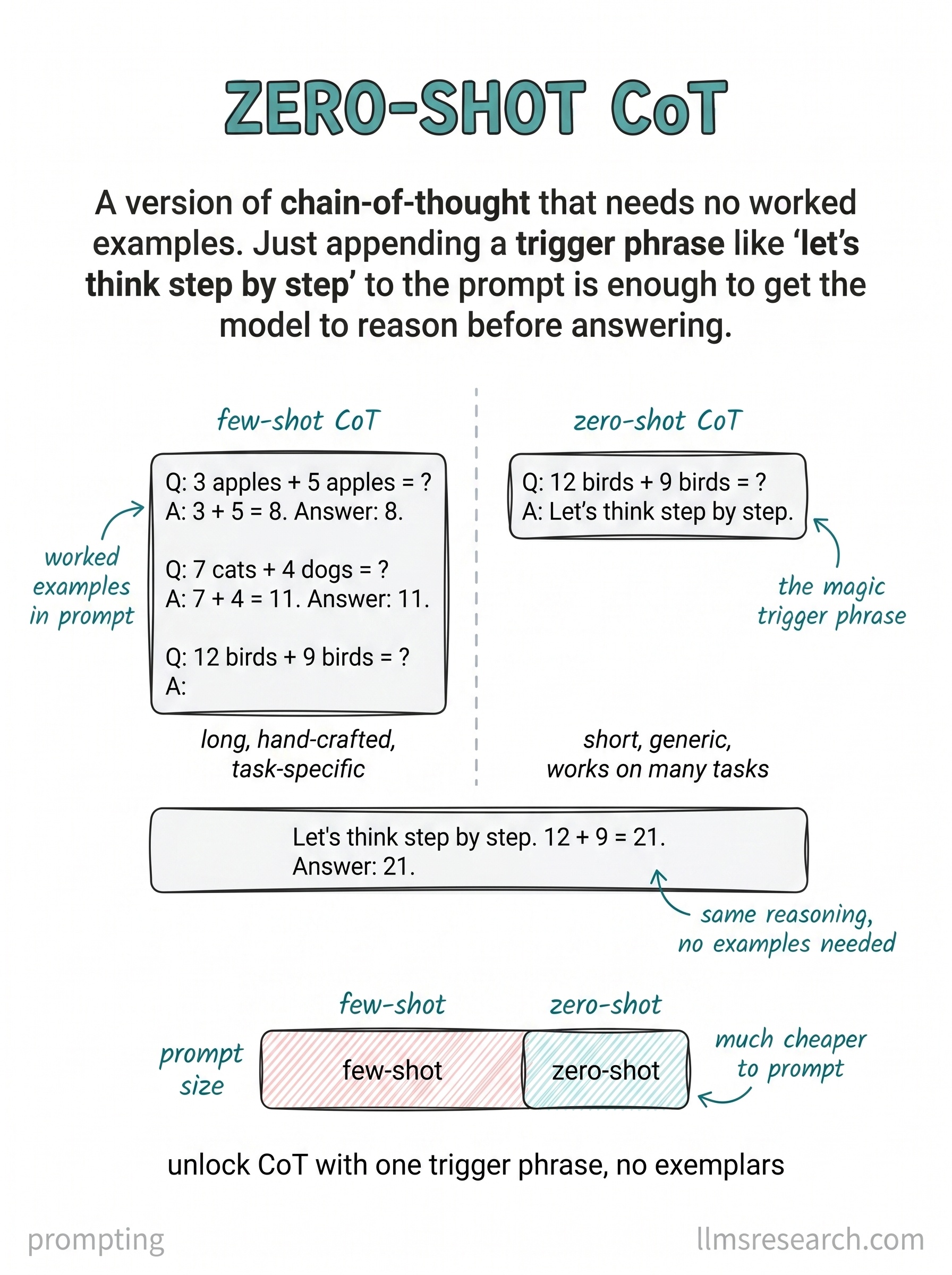
The card contrasts two ways to invoke chain-of-thought on the same problem. The few-shot side shows a long prompt with multiple worked examples, each with full reasoning traces. The zero-shot side shows only the question plus a brief trigger such as “let’s think step by step,” with no exemplars. Both paths reach a correct final answer; the zero-shot prompt is much shorter.
The trigger works because large models have seen many texts where explicit deliberation precedes conclusions. The phrase shifts the prior toward emitting intermediate steps before the answer token distribution sharpens. No gradient step is involved; it is pure conditioning. Effectiveness depends on model scale and instruction tuning. Small or lightly aligned models may ignore the trigger or produce shallow filler steps.
Zero-shot CoT is the default first experiment when you want reasoning without curating examples. It saves context for retrieval, tools, and conversation history. When accuracy plateaus, add one or two targeted few-shot traces that mirror your domain notation and failure modes. Always separate the final answer with a clear delimiter so you can strip reasoning for display or evaluation.
Latency and cost still rise because the model generates more tokens than direct answering. Monitor whether extra steps actually change outcomes on your benchmark; some tasks show no gain. Combine with self-consistency only when the added sample cost is justified. The card highlights efficiency: similar reasoning quality, far fewer demonstration tokens, which makes zero-shot CoT attractive in long-context pipelines where every exemplar competes with user data.