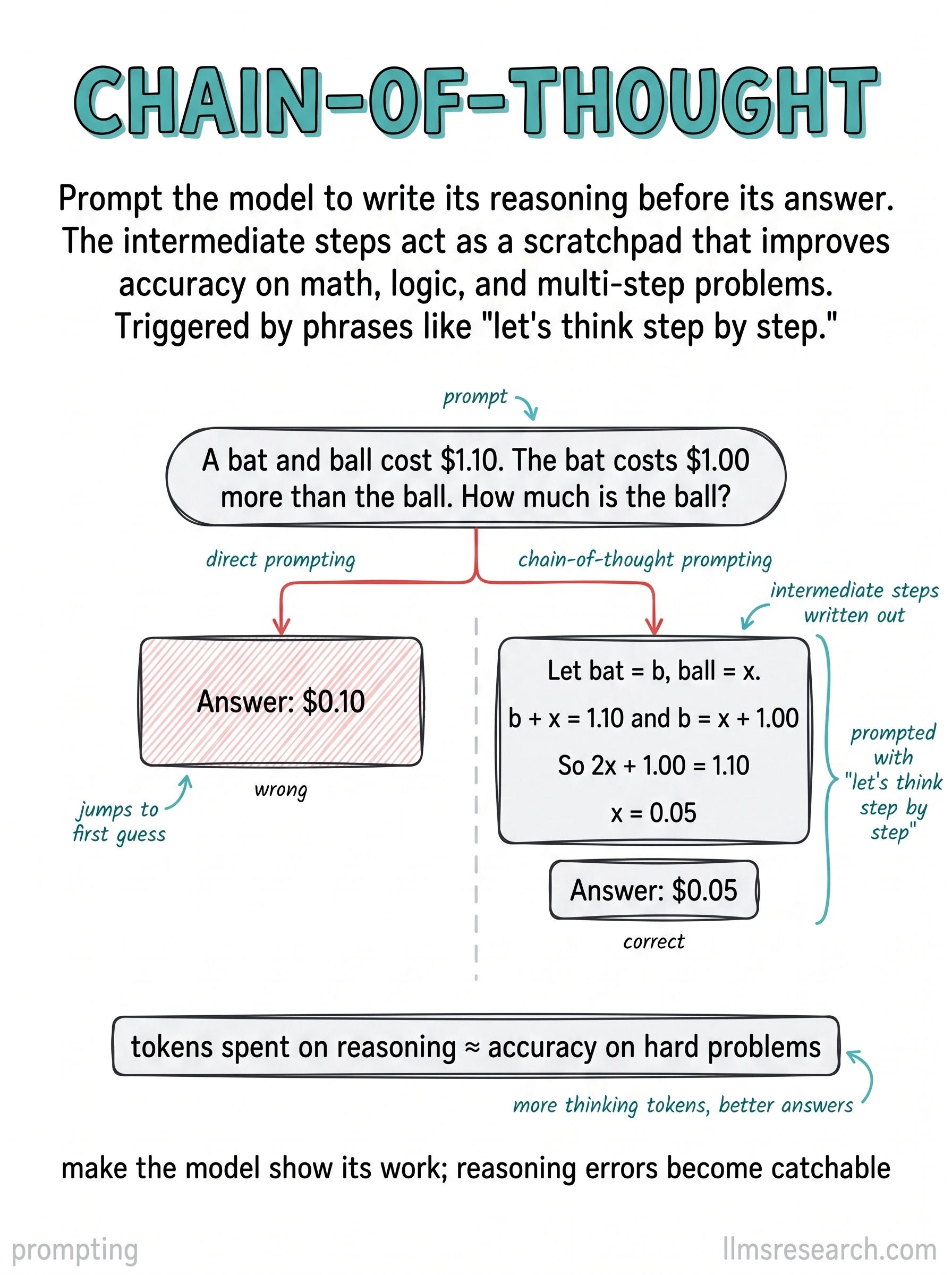
The card places two panels under the same word problem. In the direct panel, the model states a wrong final number with no work shown. In the chain-of-thought panel, it writes intermediate calculations, then reaches the correct result. The only change is whether the prompt requests step-by-step reasoning before the answer line.
Mechanically, later tokens attend to earlier ones. When the model commits intermediate results to text, those tokens become anchors for subsequent steps, similar to scratch work on paper. CoT does not guarantee correctness; each step can still drift. It does increase the chance that errors are localized and that the model allocates capacity to decomposition rather than pattern completion alone.
Few-shot CoT includes worked examples with visible reasoning traces before the new question. Zero-shot CoT uses a short trigger phrase such as “think step by step” without exemplars; that variant has its own card. In either form, ask for the final answer in a fixed format after the reasoning block so downstream parsers can separate work from result. For production, consider hiding the chain from end users while logging it for debugging.
Use CoT when tasks involve carrying values across steps, comparing constraints, or combining multiple facts. Skip it for pure retrieval or single-hop questions where extra tokens add latency without accuracy gains. Pair CoT with temperature zero when you want deterministic arithmetic, and with self-consistency when stochastic sampling helps explore alternate paths. The card’s contrast is the core lesson: same question, visible steps, different error profile.