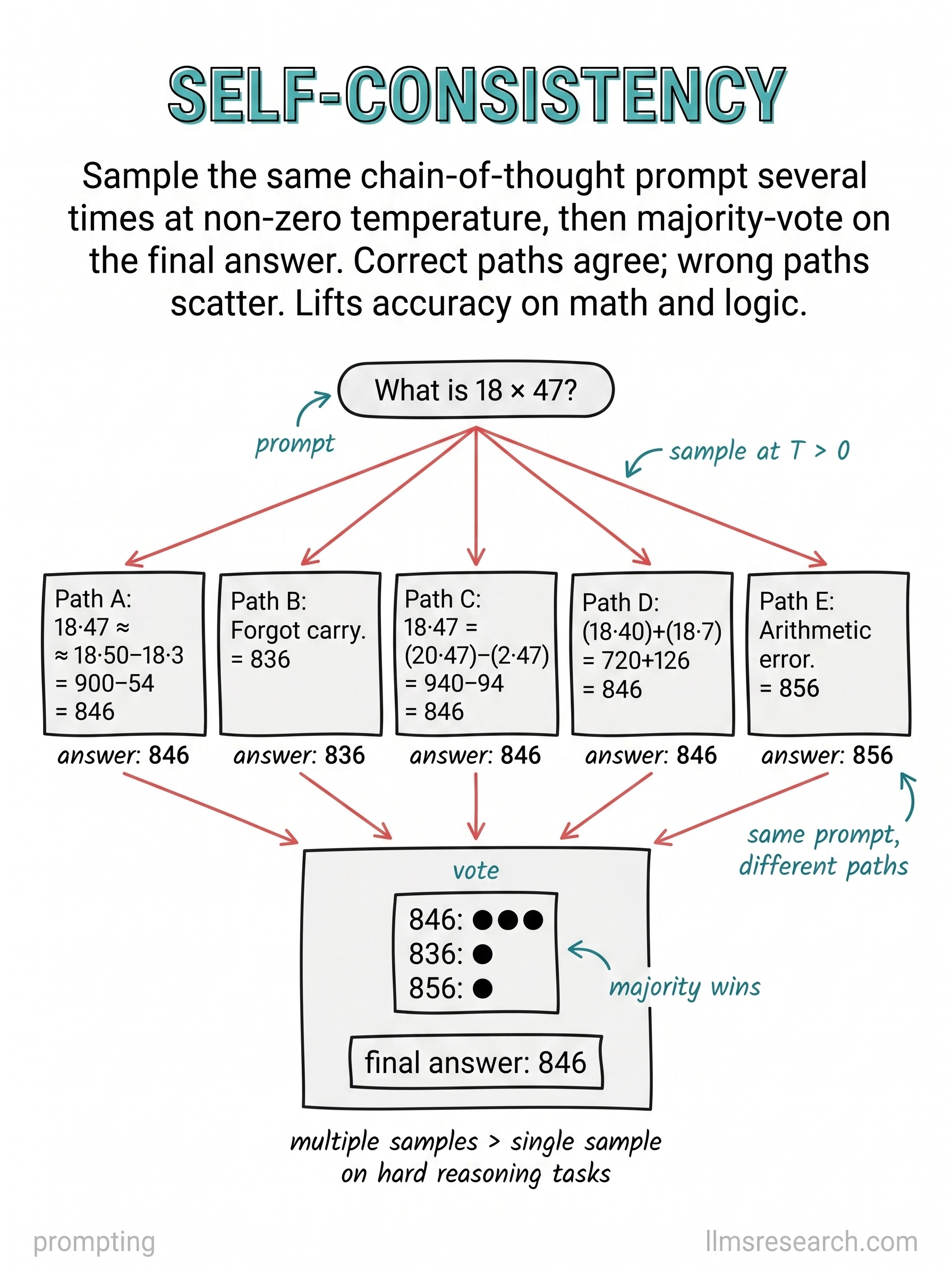
The card shows a fan-out diagram. One prompt enters at the top. Several parallel samples run at temperature above zero, each producing its own chain-of-thought and final answer. Arrows converge on a vote box that selects the majority label. The hero is ensemble reasoning at inference time, not training another model.
Independent samples explore alternate decompositions. On math and logic puzzles, one chain may carry a typo while another reaches the same correct endpoint. Majority vote suppresses outliers when errors are uncorrelated. The method assumes answers are discrete and comparable; free-form essays need a different aggregation strategy.
Cost scales linearly with sample count N. Doubling N doubles tokens and latency. Typical experiments use five to forty samples depending on budget and benchmark gains. Pair with chain-of-thought prompts so each sample includes a trace you can audit. Extract final answers with a strict parser before voting to avoid counting surface-form duplicates as disagreement.
Self-consistency is one form of test-time compute: spend more work per query to raise reliability. It complements model scaling rather than replacing it. Use it when occasional expensive correctness matters more than single-pass speed, such as grading pipelines or high-stakes calculators. When temperature zero already yields stable correct answers, voting adds little. The card’s lesson is statistical: one prompt, many reasoning paths, aggregate to reduce variance.