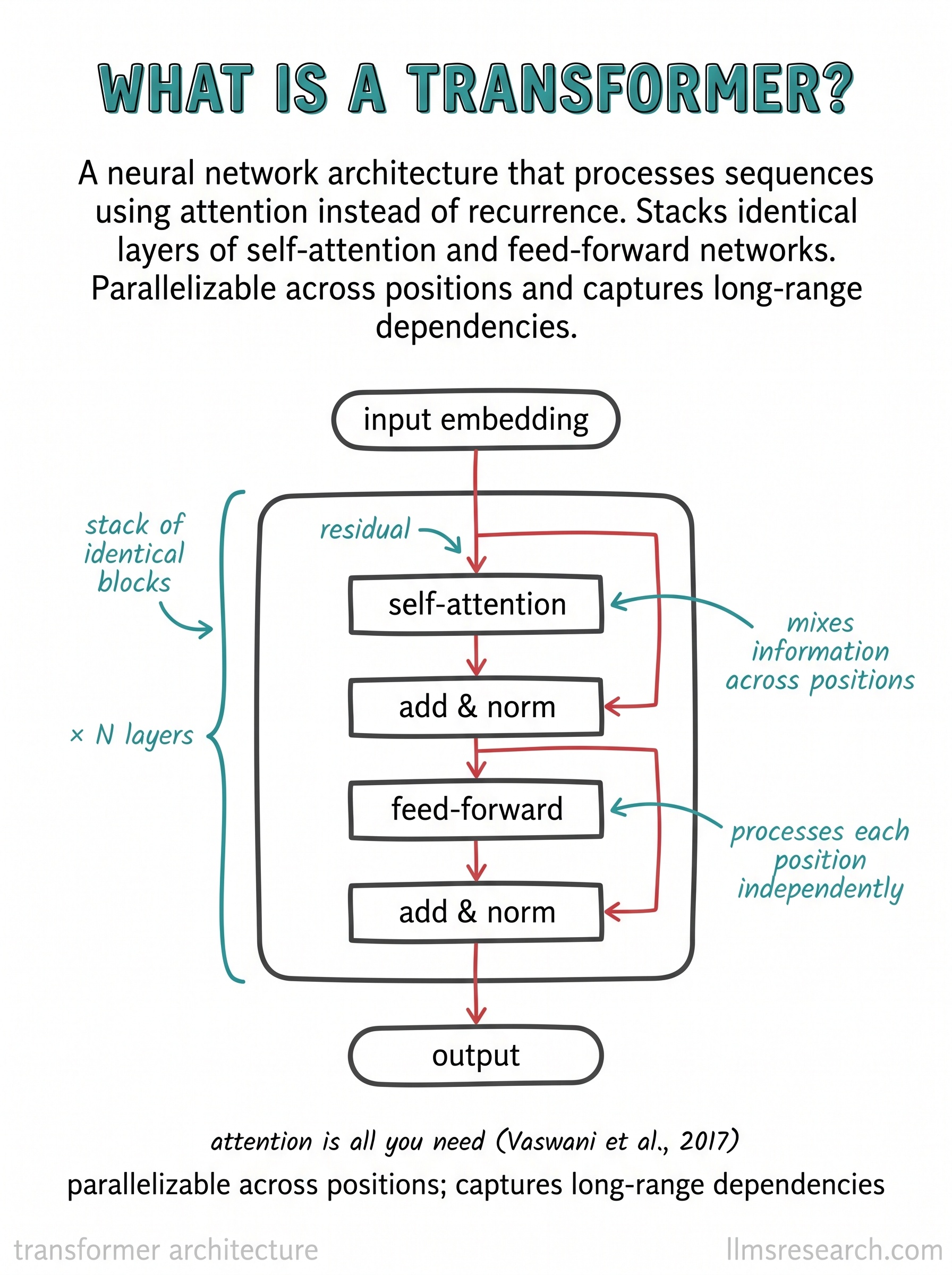
Before 2017, sequence models read text the way you might read it out loud: one token after another, carrying a running memory forward. That memory was the bottleneck. It forced the computation to be sequential, and long-range connections had to survive a long chain of updates to matter. The transformer removed the chain. Instead of passing information along step by step, it lets every position look at every other position directly, in one operation.
That operation is self-attention, and it is the only place in the block where tokens exchange information. The diagram is worth reading closely, because the whole architecture is just two moves repeated:
- Self-attention mixes information across positions. Each token builds its new representation by pulling from the other tokens it finds relevant, which is how a pronoun can reach back to the noun it refers to regardless of distance.
- The feed-forward network processes each position on its own. It never looks sideways. This is where most of the model’s parameters live and where a lot of the stored knowledge seems to sit.
Wrapped around both are the two supporting pieces labelled add & norm. The
“add” is a residual connection: the block’s output is added back to its input, so
each layer only has to learn an adjustment rather than rebuild the signal from
nothing. This is what makes it safe to stack the block dozens of times without
the signal degrading. The “norm” keeps the numbers in a stable range so training
does not diverge.
Why stacking identical blocks works
The block is deliberately uniform, and depth comes from repetition rather than from a sequence of specialized stages. Stack it N times and each layer refines what the last one produced. Earlier layers tend to capture local, surface patterns; later layers compose those into something closer to meaning. Nothing in the design assigns these roles. They emerge from training.
The practical payoff is the phrase along the bottom of the card. Because attention handles all positions at once, the work is parallelizable, which is exactly what modern hardware is good at. That single property is most of the reason transformers scaled when earlier architectures stalled. How they are trained to use this capacity is the next question.